



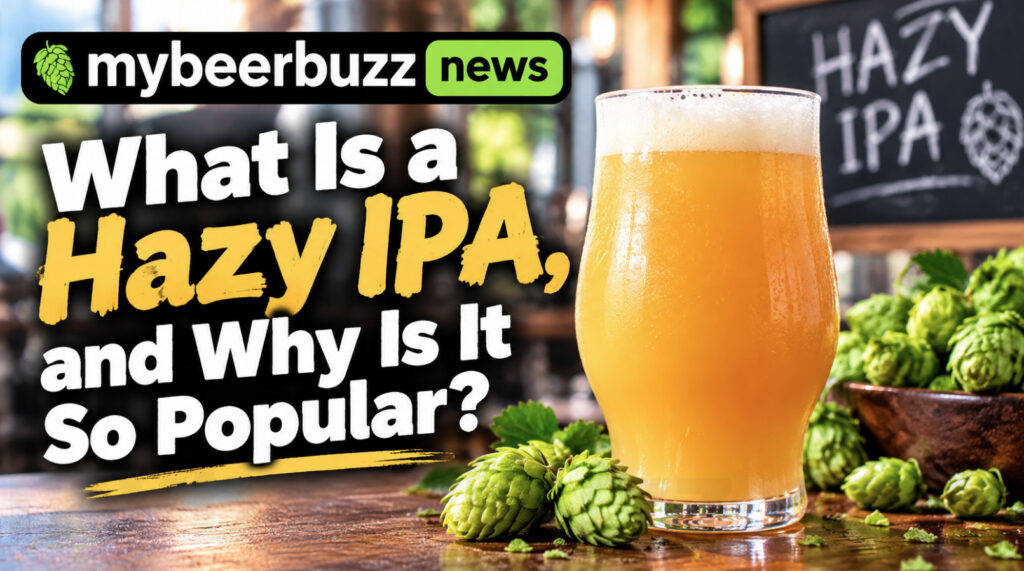
What Is a Hazy IPA, and Why Is It So Popular?
 Story by:
Bil Corcoran
Table of contents
- Introduction
- Quick facts about hazy IPA
- When hazy IPA first appeared
- Hazy IPA vs. New England IPA and other styles
- How brewers create the haze
- Hazy IPA sales and consumer demand
- Great American Beer Festival entries
- Why hazy IPA became so popular
- Conclusion and discussion
- Frequently asked questions
Hazy IPA: Quick facts
| Feature | Details |
|---|---|
| Beer style | India Pale Ale |
| Also known as | Juicy IPA, New England IPA, NEIPA |
| Early landmark beer | Heady Topper from The Alchemist |
| Origin | Vermont and the broader New England brewing scene |
| Flavor profile | Citrus, mango, pineapple, peach, berries and other hop-driven fruit notes |
| Appearance | Cloudy, hazy, sometimes nearly opaque |
| Typical brewing approach | Late hopping, dry hopping, selected yeast strains and a softer malt profile |
| Major competition recognition | Juicy/Hazy IPA was the most-entered category at the 2024 Great American Beer Festival |
| Main appeal | Strong hop aroma, fruit-forward flavor and a softer mouthfeel |
Introduction
A hazy IPA looks different before you even take a sip. Pour one into a glass and you might see a cloudy orange or golden beer with enough suspended material to make it look almost like fruit juice. Then the aroma hits, often bringing mango, pineapple, grapefruit, peach or ripe berries, and suddenly the appearance makes a little more sense.
Hazy IPA has become one of the defining styles of modern American craft beer. What began as a regional approach to brewing hop-forward beer grew into a national category, with breweries of every size producing their own versions and major brands bringing hazy IPAs into grocery stores and convenience stores.
But what is a hazy IPA, exactly? Why did drinkers embrace it so quickly, how does it compare with a traditional American IPA, and what do brewers actually do to create that cloudy appearance?
The answers involve brewing science, changing consumer tastes and a beer industry that has learned how to turn a once-unusual appearance into a recognizable selling point.
When did Hazy IPA first appear?
The modern hazy IPA story leads back to Vermont and The Alchemist, where brewer John Kimmich developed Heady Topper in the early 2000s. The beer, first brewed in 2004, helped establish a different approach to American India Pale Ale, emphasizing powerful hop aroma, substantial flavor and a softer impression of bitterness than many traditional West Coast examples.
Heady Topper was not the first beer in history to appear cloudy, nor did every early New England IPA look like the nearly opaque beers that became popular later. Its importance was that it helped establish a model that other brewers could develop and refine.
Vermont breweries and other New England producers continued experimenting with hop varieties, yeast, grain bills and dry-hopping techniques. As beer enthusiasts discovered these releases, the style spread through online beer communities, brewery visits, limited releases and eventually wider distribution.
The term New England IPA became widely recognized during the 2010s. In 2018, the Brewers Association added a distinct New England-style IPA category to its beer style guidelines, giving the style more formal recognition within the American brewing industry.
The change was bigger than appearance alone. Brewers were building beers around the aroma and flavor of hops while deliberately pursuing a different balance of bitterness, texture and visual clarity.
Hazy IPA vs. New England IPA and other IPA styles
Hazy IPA and New England IPA are frequently used interchangeably, and in everyday beer conversations that usually works. New England IPA describes the regional tradition associated with the style, while hazy IPA describes its most recognizable visual characteristic and a broader range of beers inspired by that tradition.
Not every hazy IPA follows the same recipe, though. Some are pale and lightly cloudy, while others are thick-looking, intensely aromatic and almost opaque.
Traditional American IPA, particularly the West Coast interpretation, generally places more emphasis on a cleaner appearance, sharper bitterness and a more defined hop profile that may include pine, resin, grapefruit and herbal notes. Modern West Coast IPAs can also be less bitter or more fruit-forward than older examples, so the distinction is not absolute.
Here’s how the main styles generally compare:
| IPA style | Appearance | Common flavor profile | Typical impression |
|---|---|---|---|
| Hazy IPA / New England IPA | Cloudy to opaque | Tropical fruit, citrus, stone fruit | Soft, juicy, aromatic |
| West Coast IPA | Clear to lightly hazy | Pine, grapefruit, resin, citrus | Crisp, dry, often more assertively bitter |
| American IPA | Usually clear | Citrus, floral, pine, herbal hops | Balanced malt and hop character |
| Double or Imperial IPA | Varies by recipe | Intense hop character, often stronger alcohol | Bigger, fuller, more powerful |
| Session IPA | Varies by recipe | Citrus, tropical fruit, pine or floral hops | Lower alcohol and easier extended drinking |
These categories overlap. A double IPA can be hazy, and a session IPA can be brewed with New England-style techniques. The word “double” describes strength and intensity rather than clarity, while “session” generally signals a lower-alcohol approach.
That distinction matters because hazy IPA is not simply a regular IPA with something added to make it cloudy. The brewing process, hop timing, yeast selection and finished beer’s balance all contribute to the result.
How do brewers create the haze?
The haze in a well-made hazy IPA is usually the result of several brewing factors working together. It is not necessarily yeast left behind because the brewer forgot to filter the beer, and it does not automatically mean the beer is unfinished or defective.
1. Hop compounds and grain proteins
Hops contain polyphenols, while malted barley and other grains supply proteins. During brewing and fermentation, some of these compounds interact and form tiny particles that remain suspended in the beer, scattering light and creating haze.
The amount and stability of that haze depend on the recipe, brewing conditions and how the beer is handled.
2. Heavy late hopping
Hazy IPA brewers commonly add substantial quantities of hops late in the boil, during whirlpooling or after fermentation. These additions help retain and extract aromatic compounds that contribute citrus, tropical fruit, floral and other hop characteristics.
Dry hopping, which involves adding hops during or after fermentation rather than boiling them, is particularly associated with the style. It boosts aroma and can contribute to the beer’s cloudy appearance through interactions between hop material and beer proteins.
3. Yeast selection
Certain yeast strains contribute fruity fermentation character and interact with hop compounds in ways that help shape the finished beer. Some strains also leave more haze than others, depending on their behavior during fermentation and settling.
Yeast-derived haze is only part of the picture. A brewer cannot reliably reproduce every modern hazy IPA simply by selecting a cloudy yeast strain.
4. Malt and grain choices
Oats and wheat are common ingredients in hazy IPA recipes because they contribute proteins and can help create a fuller, softer mouthfeel. Oats may add a silky texture, while wheat can contribute body and foam stability.
Neither ingredient is mandatory, however. Brewers can create hazy IPAs with different grain bills, and adding oats or wheat alone will not guarantee the desired appearance.
5. Filtration and handling
Many hazy IPAs are packaged without the aggressive filtration that would remove much of their suspended material. Brewers must balance appearance, flavor stability, shelf life and consistency when deciding how to process the finished beer.
There is a limit to what haze can tell you. A beer that is cloudy because it was intentionally brewed that way is not the same as a beer that has become unexpectedly cloudy due to contamination or another problem. Haze is a characteristic, not a universal quality test.
Hazy IPA sales: how does it compare with regular IPA?
The short answer is that hazy IPA has become a major commercial force, but the overall IPA category remains larger than the hazy subcategory alone.
According to Circana data reported by Brewbound in January 2025, IPA accounted for 49.41% of craft beer dollar sales in tracked off-premise retail channels in 2024. IPA dollar sales exceeded $2.277 billion, increasing 1.8% from the previous year, even as volume slipped slightly.
Those figures cover the broader IPA category, not hazy IPA alone.
Hazy IPA nevertheless commands a significant share of the market. Craft Beer & Brewing reported that hazy IPA represented 12.5% of craft beer dollars in chain retail at the beginning of 2024, up from 10.7% a year earlier, based on data analyzed by 3 Tier Beverages. That made hazy IPA one of the leading individual craft beer categories, behind standard IPA and imperial IPA, along with seasonals.
The distinction between dollars and volume matters. A category can generate more revenue because of pricing, packaging and product mix without selling more beer by volume. Retail figures also exclude much of the beer poured in taprooms and bars, where hazy IPA remains a familiar choice.
Individual brands demonstrate the style’s reach. Sierra Nevada Hazy Little Thing IPA generated more than $123 million in tracked retail dollar sales in 2024, according to Circana data reported by Brewbound. Its sales increased 7.6% year over year, with volume up 6.3%.
That is not proof that every hazy IPA is growing or that hazy IPA outsells all traditional IPA variants. It does show that the style has moved well beyond small brewery taprooms and specialty beer shops.
Great American Beer Festival entries show Hazy IPA’s reach
The Great American Beer Festival provides another useful measure of the style’s standing in American brewing.
At the 2024 GABF competition, the Juicy/Hazy IPA category received 349 entries, making it the most-entered category in the competition. West Coast IPA followed with 292 entries, while American-Style IPA received 217.
The competition evaluated 8,836 commercial beer entries across its beer categories, with breweries from all 50 states, Washington, D.C., and Puerto Rico represented.
These numbers show that hazy IPA is not a fringe style. Hundreds of breweries are willing to submit their beers for professional evaluation, competing against other producers who have developed their own interpretations of the same general category.
The numbers also demonstrate why comparing hazy IPA with regular IPA requires care. GABF uses separate competition categories for different styles, and entries represent breweries choosing to participate. They are not retail sales figures or a direct measure of what consumers purchased.
Still, the Juicy/Hazy IPA category’s leading position is a strong indication of how important the style has become within the American craft brewing community.
Why is Hazy IPA so popular?
The first reason is flavor. Many hazy IPAs emphasize the fruity aromatic compounds associated with modern hop varieties, making them appealing to drinkers who enjoy citrus, pineapple, mango, peach and berry-like notes.
The second reason is mouthfeel. Oats, wheat, yeast selection and brewing techniques can produce a rounded texture that feels softer than the sharper, drier profile associated with some traditional IPAs. That can make hop intensity feel more approachable, although hazy IPAs can still be bitter and alcoholic.
Appearance also plays a role. A cloudy orange beer stands out in a cooler filled with clear lagers and pale ales, and breweries have used that distinctive look to establish recognizable brands.
Then there is variety. One hazy IPA might focus on Citra hops and bright citrus, while another leans into tropical fruit, white grape or stone fruit. Brewers can vary hop combinations, fermentation techniques, alcohol strength and grain bills without abandoning the general style.
But popularity creates its own problems. Hazy IPA is especially vulnerable to declining aroma and flavor as its hop character fades during storage. Oxygen exposure and warm distribution conditions can damage the fresh, fruit-forward qualities that drinkers expect, so a beer that tastes excellent shortly after packaging may be less impressive months later.
That is why freshness matters. Check package dates where available, buy from retailers with good turnover and store beer appropriately. A hazy IPA’s appearance might remain cloudy even after its best aromas have faded, which is another reason not to judge freshness by appearance alone.
Conclusion: Hazy IPA has earned its place
Hazy IPA became popular because brewers found a compelling way to emphasize hop aroma, fruit-forward flavor and a softer drinking experience. The New England brewing tradition helped establish the style, while improved hop varieties, yeast experimentation and widespread distribution carried it into the mainstream.
Sales data show that hazy IPA is a substantial part of craft beer retail, and the Great American Beer Festival’s 349 entries in the 2024 Juicy/Hazy IPA category demonstrate its standing among professional brewers.
It is not a replacement for every traditional IPA, and it does not have to be. Clear West Coast IPAs, bitter American IPAs and hazy New England-style beers can all offer something different.
The real question is whether breweries can continue producing fresh, distinctive hazy IPAs rather than relying on the cloudy appearance and familiar fruit descriptions to do all the work.
What do you think? Has hazy IPA improved American craft beer, or has the industry become too dependent on one style? Share your thoughts and your favorite hazy IPA in the comments.
Frequently asked questions about Hazy IPA
What makes an IPA hazy?
Haze usually comes from interactions between hop polyphenols, grain proteins and other suspended material, with yeast and brewing techniques also influencing the final appearance.
Is Hazy IPA the same as New England IPA?
The terms are often interchangeable. New England IPA refers to the regional brewing tradition, while hazy IPA is a broader description that can include beers inspired by that style.
Does Hazy IPA have more hops than regular IPA?
Not necessarily. Many hazy IPAs use substantial late-hop and dry-hop additions, but hop quantities and bitterness vary by recipe. A hazy beer is not automatically hoppier or stronger than a clear IPA.
Does Hazy IPA have less bitterness?
It can taste less sharply bitter because of its hop profile, malt character and softer mouthfeel. However, some hazy IPAs have substantial bitterness, and the style does not have one fixed bitterness level.
Does Haze mean a beer is unfiltered?
Many hazy IPAs receive little or no filtration, but haze alone does not prove a beer is unfiltered. Different combinations of ingredients and brewing techniques can create or preserve haze.
Does Hazy IPA sell better than regular IPA?
The broad IPA category remains larger overall. Hazy IPA is a major subcategory, accounting for a reported 12.5% of craft beer dollars in chain retail at the beginning of 2024, but that figure is not directly comparable with the entire IPA category.
Why does Hazy IPA lose flavor over time?
Hop aroma compounds can fade or change through oxidation and other storage-related reactions. Warm temperatures and oxygen exposure can accelerate quality loss, making freshness particularly important for hop-forward beers.
Related news from mybeerbuzz.com:
Sierra Nevada Citrus Little Thing IPA Coming to 12-oz Cans — a recent look at a new hazy IPA from Sierra Nevada. Deschutes Even Funner Hazy IPA & Helles-Style Lager — a comparison of a new hazy IPA and a traditional lager. Avery Brewing Head Over Haze Imperial Hazy IPA Coming Soon — a stronger imperial interpretation of hazy IPA. Fresh Beer: The Case for Standardized Freshness Date Coding — related coverage on beer freshness and date labeling. New Holland Space Machine Hazy IPA Series Launch — a look at a brewery’s hazy IPA lineup.
zzubreebym



Comments 0
No Readers' Pick yet.