






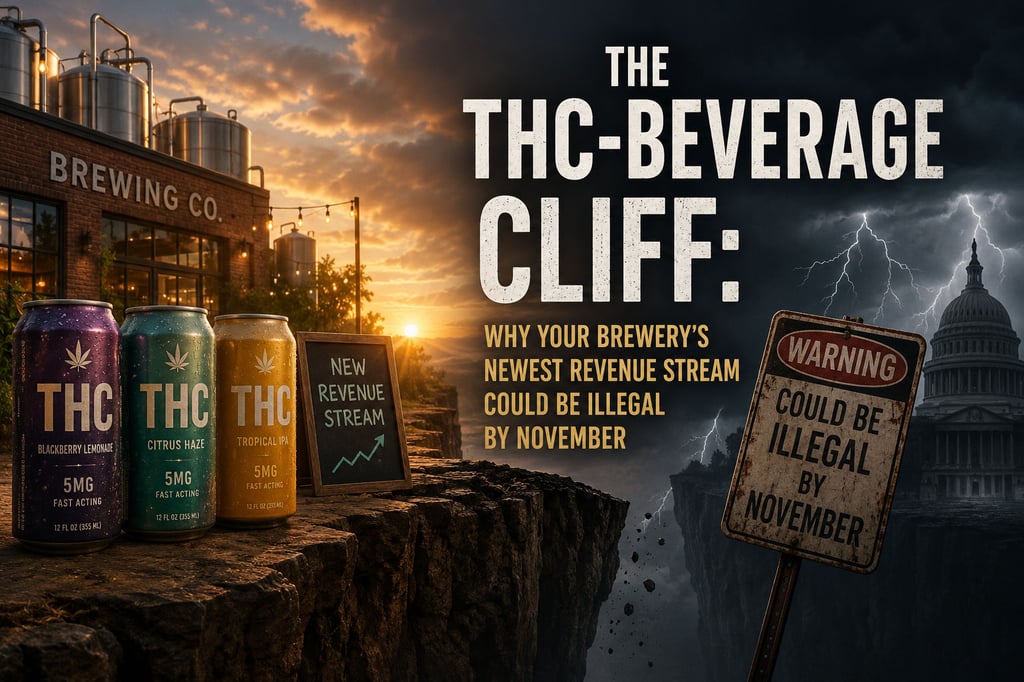
The THC-Beverage Cliff: Why Your Brewery’s Newest Revenue Stream Could Be Illegal by November
 Story by:
Bil Corcoran
Story by:
Bil Corcoran
Section I: The Mirage of the “New Revenue Stream”
For the past two years, the craft brewing industry has been chasing a ghost. Facing a historic, stubborn decline in beer volumes and an increasingly fickle consumer base, many independent breweries pivoted with desperate optimism toward THC-infused “social tonics.” These cannabis-derived beverages, marketed as the modern, health-conscious alternative to the heavy, caloric pint, offered a lifeline. For a time, they seemed like the perfect synergy: a new revenue stream that utilized existing brewing equipment, distribution networks, and taproom footprints.
But as of July 2026, the mirage is rapidly dissipating. The industry’s pivot wasn’t a sustainable diversification; it was a high-stakes gamble on a regulatory loophole that is about to snap shut.
On November 12, 2026, the provisions of P.L. 119-37, codified in the federal funding package signed last year, officially take effect. The law mandates a strict 0.4mg total THC cap per retail container, rendering an estimated 95% of the hemp-infused beverages currently on shelves federally illegal. For the brewery that bet its quarterly growth projections on 5mg or 10mg seltzers, this isn’t just a hurdle; it is an existential “Hemp D-Day.”
The scramble for THC revenue exposed a deeper, more uncomfortable truth: in the rush to capture the “sober-curious” or “cannabis-curious” dollar, many breweries stopped competing on their core competency, the craft of brewing, and started competing on “what sells.” This identity crisis has left once-proud independent producers vulnerable, having hitched their financial survival to a legislative anomaly rather than genuine brand loyalty. As the clock ticks toward November, the question is no longer how to innovate, but who will be left standing when the regulatory floor gives way.
Table of Contents
- The Mirage of the “New Revenue Stream”
- The Legislative Cliff: Why 95% of Products Are Doomed
- The “Taproom Identity Crisis” Revisited
- The “Beer-Flavored” Resurrection: Why Traditionalists Will Win
- Strategic Action for Owners: The Post-November Playbook
- Conclusion: The Morning After
- Frequently Asked Questions
Quick Facts: The 2026 Regulatory Pivot
| Feature | Current Status (Pre-Nov 2026) | New Federal Rule (Post-Nov 2026) |
| Legal Basis | 2018 Farm Bill (0.3% Delta-9 by dry weight) | P.L. 119-37 (H.R. 5371) |
| THC Metric | Delta-9 only | Total THC (includes THCA) |
| THC Limit | 0.3% by dry weight | 0.4 mg per container |
| Impact on 5–10mg Drinks | Legal (with wide variance) | Federally Prohibited |
| Synthetic Cannabinoids | Gray area (Delta-8/HHC) | Explicitly Excluded |
Section II: The Legislative Cliff: Why 95% of Products Are Doomed
The term “regulatory cliff” is often used in political discourse to describe minor adjustments, but for the craft beverage industry, it is a literal description of the precipice created by P.L. 119-37. When this law takes full effect on November 12, 2026, it doesn’t just tighten oversight, it effectively dismantles the legal foundation upon which the entire hemp-derived beverage market was built.
The Death of the Dry-Weight Loophole
Since the 2018 Farm Bill, the industry operated on a singular, elegant loophole: the definition of hemp as cannabis containing less than 0.3% Delta-9 THC by dry weight. For a 12-ounce beverage, that percentage allowed for a surprising amount of THC. By utilizing the water weight of the liquid to dilute the concentration, manufacturers could legally pack 5mg, 10mg, or even 25mg of THC into a single can while remaining technically compliant with a “dry weight” calculation. It was a mathematical sanctuary that fueled an explosion of “social tonics” across taprooms nationwide.
Section 781 of the 2026 Act strips this sanctuary away. It replaces the percentage-based metric with a “Total THC” standard, inclusive of Delta-8, Delta-9, and even THCA, and, more crucially, it imposes a hard ceiling of 0.4 milligrams of total THC per finished retail container.
The Math of Obsolescence
To understand why this is a wipeout, consider the math of the current market. A standard 5mg hemp-infused seltzer is not merely “over the limit”; it is an order of magnitude beyond federal compliance. Under the new rule, the entire 12-ounce can is limited to 0.4mg of THC. Because this limit is applied to the finished retail container rather than a “per serving” basis, the current practice of labeling a beverage as having multiple servings to bypass the cap is rendered moot.
Reformulation to these levels,effectively trace amounts, strips the product of its primary value proposition: the psychoactive “lift” that consumers are paying for. A beverage with 0.4mg of THC is, for all intents and purposes, a non-intoxicating soft drink. For breweries that invested capital in co-packing lines, custom branding, and shelf space for these products, the math is sobering: they are left with a massive inventory of federally prohibited product.
The “Similar Effects” Trap
The Act goes further by expressly prohibiting cannabinoids that are synthesized or manufactured outside the plant, such as Delta-8 or HHC derived through CBD isomerization. For breweries that pivoted to these “legal alternatives” to get around potential state restrictions on Delta-9, the cliff is even steeper. The federal government has signaled that these synthetic isomers no longer qualify for the hemp exemption.
Between the 0.4mg cap on naturally occurring cannabinoids and the total prohibition of synthetic alternatives, the market for “craft” THC beverages faces a total contraction. Industry analysts estimate that approximately 95% of the existing hemp-derived cannabinoid market will be rendered non-compliant. We aren’t looking at a transition period; we are looking at a market-wide liquidation event masquerading as a regulatory update.
Section III: The “Taproom Identity Crisis” Revisited
The desperation to pivot toward THC-infused tonics was never truly about the cannabinoids; it was a symptom of an industry-wide nervous breakdown. For the better part of a decade, the craft brewery model was predicated on an unspoken agreement: the consumer would trade up to a higher-priced, “craft” experience in exchange for constant novelty. But as the 2026 data confirms, that “elastic loyalty” has snapped. As beer volumes faltered, breweries stopped acting like manufacturers of a high-quality product and began operating like frantic lifestyle brands, casting about for any trend that could drive foot traffic to their taprooms.
The Venue vs. Value Trap
This has created a profound identity crisis. In their rush to stay relevant, many breweries surrendered their focus on the liquid to prioritize their utility as a “third space.” The taproom, once a secondary showcase for a brewery’s production prowess, became the primary business, with the beer itself often relegated to a side-show, or worse, a commodity.
When a brewery pivots to THC drinks, they are essentially signaling that they have lost faith in their ability to win on beer alone. They aren’t just diversifying; they are admitting that their core offering, their actual beer, is no longer enough to justify a customer’s choice over a competitor’s taproom or, more crucially, their own couch. This shift from “brewer of beer” to “peddler of recreational experiences” has fundamentally alienated the core enthusiast while failing to establish a sustainable brand identity for the new, “mindful” drinker.
The Commoditization of the “Vibe”
The THC pivot represents the ultimate form of “Vibe Economics.” By filling taproom draft lines with lab-formulated, psychoactive tonics, breweries have drifted further from the craft ethos that built the industry. This is not the “thoughtful formulation” that early pioneers championed; it is a transactional pursuit of the “intoxicant-of-the-month.”
The data shows that while younger drinkers (21–34) are still engaged, they are increasingly polarized—they want transparency, quality, and health-conscious options. By leaning into THC seltzers, breweries have tried to “hack” this demand, but they’ve missed the point: the modern consumer is looking for authenticity, not a higher-margin way to get buzzed.
The High Cost of the Pivot
The most dangerous consequence of this identity crisis is the dilution of the brand. When a customer walks into a brewery, they are looking for a sense of place and a standard of quality. When the menu is cluttered with inconsistent, trend-chasing THC beverages, that “sense of place” evaporates. The brewery stops being a destination and starts being a commodity-service provider.
As we approach the November 2026 regulatory cliff, the breweries that suffer the most won’t just be the ones that lose their THC revenue. They will be the ones that, in their rush to diversify, hollowed out their own brand identity. They bet their future on a trend that provided no long-term loyalty, leaving them with nothing but a confused customer base and a product portfolio that no longer reflects the “craft” they once promised to uphold. The taproom identity crisis was never just about what is in the glass; it was about the fundamental question of what a brewery is actually for.
Section IV: The “Beer-Flavored” Resurrection: Why Traditionalists Will Win
For the breweries that resisted the siren song of the THC pivot, the upcoming November “regulatory cliff” is not a disaster—it is a vindication. While their counterparts were busy retrofitting equipment for cannabinoid emulsification and navigating the legal nightmare of hemp compliance, the “traditionalists” were doubling down on the only asset that holds long-term value: the liquid itself. In 2026, the marketplace is beginning to reward this commitment to quality with something that THC tonics never could: sustainable, repeat-purchase loyalty.
The Return to “Beer-Flavored” Beer
The market is currently undergoing a “Great Re-Balancing.” After years of “innovation for innovation’s sake”—where novelty was prioritized over drinkability, consumers are experiencing severe palate fatigue. The data is unequivocal: the 2026 drinker is tired of the cloying sweetness of fruited sours and the aggressive, palate-wrecking intensity of triple IPAs.
In their place, we are seeing a massive, industry-wide resurgence of classic, “beer-flavored” beer. The craft lager renaissance has matured beyond the novelty of a “craft pilsner” into a sophisticated program of German Helles, Czech dark lagers, and crisp, rice-based session beers. These styles are the “litmus test” for any professional brewery. They cannot be hidden behind heavy hop oils or artificial flavors; they require technical precision, clean fermentation, and patience, the very pillars of the brewing craft that were sidelined during the height of the “hype-beer” era.
Quality as an Economic Anchor
While THC-tonic brands are currently facing an existential threat, traditionalist breweries are finding resilience in the “Premium Value” equation. In a tighter economy, consumers are becoming more discerning. They are rejecting mediocre, high-priced craft beer in favor of “worth-it” pints. The breweries that survive are the ones that provide a perfectly executed, classic beer that delivers consistent refreshment.
Unlike the THC segment, which relies on the “novelty hit” to drive sales, traditional beer built its foundation on the “repeat pour.” By focusing on sessionable, lower-ABV beers that align with the growing cultural mandate for moderation, these breweries are finding that their product remains relevant for every occasion, from the World Cup watch parties to casual weekday evenings. They are not merely “chasing the sober-curious”; they are providing a better, more authentic alternative to the “wellness-washed” functional beverages that are about to be swept off the shelves.
The Survival Advantage
The traditionalists hold a distinct operational advantage. By not diversifying into the complex, risky, and high-capital-expenditure world of cannabis, they remained agile. Their supply chains are stable, their insurance premiums are predictable, and their focus is unified. As the regulatory floor gives way in November, these breweries will be the only ones standing in a market suddenly devoid of “lifestyle” distractions. They have positioned themselves not as a venue for the latest fad, but as a reliable source of quality, community, and tradition. In the “morning after” the regulatory reckoning, these brewers will find that by doing less, they actually achieved more.
Section V: Strategic Action for Owners: The Post-November Playbook
For the brewery owner, the period between today and November 12, 2026, is not a time for passive waiting, it is a period of aggressive operational triage. The impending regulatory shift is a stress test that will separate businesses built on transient trends from those built on fundamental business principles. If your revenue projections rely on hemp-derived THC, your “Plan B” must become your “Plan A” today.
The Immediate Audit: Identifying Margin Erosion
The first step is a clinical assessment of your current portfolio. You must treat your SKU list with the same cold detachment as a venture capitalist. If a THC beverage or a “hype-driven” product is currently consuming floor space or sales energy but is destined for non-compliance, you must calculate its “liquidation value” before the deadline.
- Financial Transparency: Utilize real-time cost visibility to understand your true Cost of Goods Sold (COGS). If your THC-tonic program is subsidizing other parts of the business, you must immediately model the financial impact of its removal.
- SKU Rationalization: Use this deadline as an opportunity to purge the “long tail” of low-performing beers and non-compliant beverages. The breweries surviving in 2026 are producing less variety and earning more per pint.
The Pivot: Reclaiming the Taproom as a Destination
If your taproom has relied on the novelty of THC tonics to drive traffic, you must replace that “hook” with genuine community value. The most successful breweries are shifting away from “product-first” growth toward “experience-first” stability:
- Operational Discipline: Replace the unpredictability of “fad-chasing” with rigorous production standards. This means investing in software that links your financials, inventory, and forecasting. When you know your margins to the penny, you can pivot production schedules on the fly to meet actual consumer demand rather than projected hype.
- Strengthening Local Roots: Instead of chasing broader distribution for niche products, invest in the people already in your zip code. Build recurring experiences, not just one-off events, that make your taproom a habitual “third space.” Whether it’s focused hospitality training for staff or creating unique, local-only draft offerings, the goal is to drive repeat traffic through relationships, not just novel intoxicants.
Future-Proofing: The “Beer-First” Strategy
For those looking beyond the regulatory deadline, the path forward is a return to technical mastery.
- Diversification through Quality: If you must explore non-alcoholic alternatives to THC, focus on natural, botanical, or adaptogenic ingredients that fall outside the “intoxicating” classification, and do so with an eye for flavor profile rather than psychoactive effect.
- Capitalizing on Consolidation: The shakeout in November will inevitably force many undercapitalized breweries to close. Well-run breweries with disciplined margins and clean data will be in a prime position to acquire assets, expand their footprint, or secure more favorable partnerships with distributors who are desperate for stable, compliant brands.
This isn’t about mere survival; it’s about professionalizing the taproom environment to match the economic realities of 2026. By tightening operations and refocusing on your core identity, you aren’t just weathering a regulation—you are building a business that is fundamentally more robust, resilient, and ready to lead the industry on the other side of the cliff.
Section VI: The Morning After
As the sun rises on November 13, 2026, the craft beer industry will find itself in a landscape fundamentally altered by the regulatory reality of the previous day. For the brands that built their identity on the quick-fix promise of high-dose THC tonics, the “morning after” will be marked by quiet taprooms, significant inventory write-offs, and a scramble to reconcile with a consumer base they largely ignored in their pursuit of the cannabinoid trend.
However, for the broader industry, this “reckoning” serves a vital purpose. The regulatory floor has been cleared of the speculative, high-margin, and legally unstable products that have distracted from the actual craft of brewing for the last twenty-four months. What remains is a marketplace forced into maturity. The breweries that survive this transition are not those that were “first to market” with a risky additive, but those that maintained a relentless focus on product consistency, operational efficiency, and, above all, the quality of their beer.
The identity crisis that defined the mid-2020s, the confusion over whether a brewery is a community venue, a real estate project, or a lab for psychoactive concoctions, will likely resolve itself through a return to basics. The “taproom” will once again be defined by the quality of the pint, and the “brewery” by the precision of its process. November 13, 2026, marks the end of the “hype-era” and the beginning of a leaner, more disciplined, and ultimately more sustainable chapter for independent beer.
Frequently Asked Questions (FAQ)
1. What is the significance of November 13, 2026?
It is the date when the provisions of H.R. 5371, signed into law in 2025, take full effect, imposing a 0.4mg total THC cap per retail container for hemp-derived products.
2. Why will 95% of current THC beverages be non-compliant?
Most current products contain 5mg to 25mg of THC per container. The new law imposes a strict 0.4mg ceiling across the entire package, making these products federally prohibited.
3. Does the new rule apply per serving or per container?
It applies per container. Splitting a large dose into multiple smaller servings within the same package will not bypass the federal 0.4mg limit.
4. Will all hemp products be banned?
No. CBD-dominant products, hemp seed oils, and products with negligible total THC (under 0.4mg per container) remain federally compliant.
5. How should brewery owners prepare?
Owners should perform a comprehensive SKU audit, liquidate non-compliant inventory before the deadline, and pivot operations back toward traditional beer production and “third space” hospitality.
zzubreebym



Comments 0
No Readers' Pick yet.