






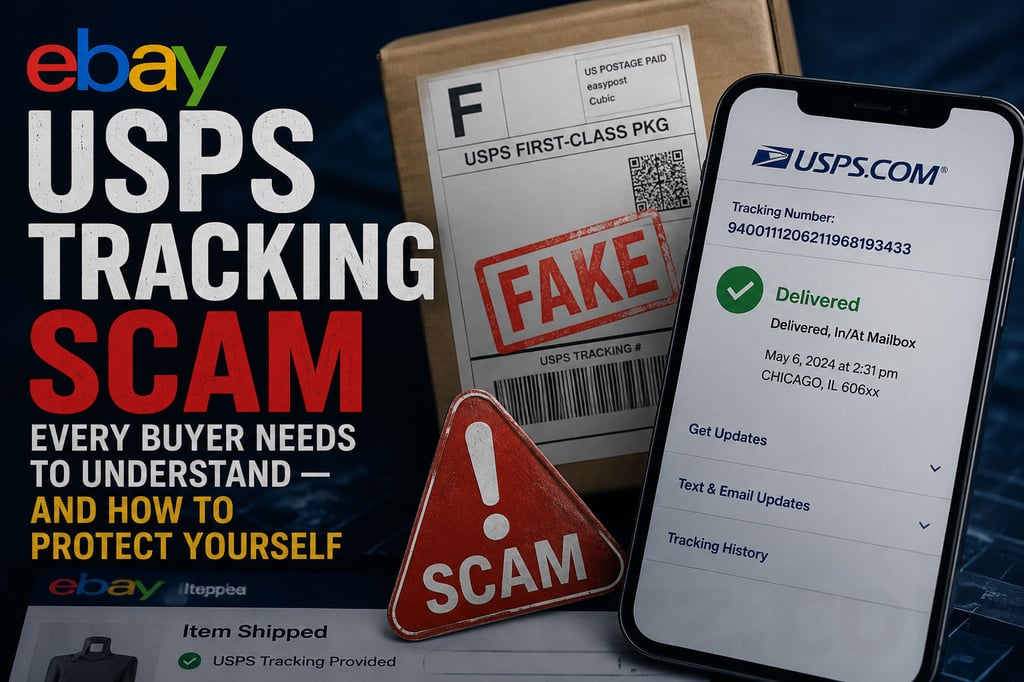
The eBay USPS Tracking Scam Every Buyer Needs to Understand — And How to Protect Yourself
 Story by:
Bil Corcoran
Story by:
Bil Corcoran
I’ve been buying, selling, and building stores on eBay since the platform’s earliest days. I’ve watched the marketplace evolve from a quirky online auction site into a massive global retail engine. I’ve seen every kind of scam, loophole, and buyer‑seller dispute imaginable. But the scam emerging right now, one that exploits USPS tracking limitations, is one of the most damaging I’ve ever encountered. It’s costing buyers real money, eroding trust, and creating a dangerous environment where scammers can win disputes simply by manipulating the system.
This isn’t a small annoyance or a fringe issue. This is a structural vulnerability in how USPS tracking displays delivery information, and scammers have figured out how to weaponize it. Because USPS tracking only shows city, state, and ZIP code, not the full delivery address or recipient name, eBay’s automated systems often side with the scammer. And unless a buyer knows exactly how to fight back, they lose their money, their item, and their ability to get eBay to listen.
This is the second time I’ve personally encountered this scam, and it’s clear that it’s spreading. So let’s break down exactly how it works, why it’s so effective, and what you can do to protect yourself.
How the USPS Tracking Scam Works
The scam hinges on one simple fact: USPS tracking does not show the delivery address or the recipient’s name. Anyone with a tracking number can see only the city, state, and ZIP code. USPS does this for privacy reasons, understandable, but unfortunately exploitable.
Here’s the step‑by‑step breakdown of how scammers pull it off:
1. You buy an item on eBay.
Everything looks normal. The seller appears legitimate, the listing looks fine, and you pay for the item.
2. The scammer generates a fake shipping label.
Instead of using eBay’s built‑in shipping tools, the scammer manually creates a label outside the platform. This allows them to enter any address they want.
3. They choose a random address in your ZIP code.
This is the key. They don’t ship the item to you. They ship an empty envelope or junk mail to a random person who happens to live in your town and ZIP code.
4. USPS delivers the junk mail to the random address.
The unsuspecting recipient throws it away, having no idea they’re part of a scam.
5. USPS tracking updates to “Delivered.”
And here’s the problem: USPS tracking shows your city, your state, your ZIP code, but not your address.
6. eBay sees “Delivered” and closes the case.
eBay’s automated system checks the tracking number, sees that it was delivered to your ZIP code, and rules in favor of the seller.
You lose your money. You never receive your item. The scammer walks away clean.
This is why the scam is so dangerous: it uses legitimate USPS tracking to create the illusion of a valid delivery.
Why eBay’s System Fails to Catch This
eBay’s dispute system is heavily automated. When a buyer claims an item wasn’t received, eBay checks the tracking number. If USPS shows “Delivered,” eBay almost always sides with the seller, even if the buyer insists the package never arrived.
Because USPS tracking does not show the full address, eBay’s system cannot verify whether the package was delivered to the correct location. And unless a buyer pushes back hard, the case is closed.
This is why scammers love this method: It uses the system’s own rules against the buyer.
How to Fight Back — The Only Method That Works
This part requires persistence, patience, and a little luck. But it can work.
1. Go to the USPS tracking page.
Enter the tracking number the scammer provided.
2. Scroll down to the “Need More Help? / FAQ” section.
Click on FAQ and then Delivered.
3. Look for the sentence that says:
“Visit the email us page on usps.com to submit a service request to your local Post Office™ for eligible items.
4. Submit a service request.
Include everything:
- The tracking number
- Your actual address
- A statement that the package was not delivered to you
This triggers an internal USPS investigation.
5. Wait for your local postmaster to contact you.
They will usually call or email. They will not give you the exact address where the package was delivered, but they will confirm whether it was delivered to your address or someone else’s.
This is the evidence you need.
6. Send the USPS confirmation to eBay.
This is the hardest part. You must get eBay to actually read the letter and acknowledge that the tracking number does not match your address.
Sometimes it takes multiple messages. Sometimes it takes calling. Sometimes it takes escalating the case.
But once eBay sees written confirmation from USPS, they can overturn the decision.
Why This Scam Is Growing
Scammers love this method because:
- It’s easy.
- It’s cheap.
- It’s hard for buyers to fight.
- eBay’s automated system almost always sides with the scammer.
- USPS tracking limitations make it nearly impossible to prove fraud without a postmaster’s help.
This scam is spreading because it works, and because eBay has not yet implemented a system to verify full delivery addresses.
What eBay Needs to Fix
eBay could stop this scam instantly by:
- Requiring full address verification from USPS
- Flagging tracking numbers created outside eBay
- Blocking sellers who repeatedly ship to mismatched addresses
- Allowing buyers to submit USPS documentation directly to dispute teams
- Requiring sellers to photo the completed label with name, address and tracking before shipping.
Until then, buyers are vulnerable.
Final Thoughts — And Why I’m Sharing This
I’ve been on eBay for nearly 30 years. I’ve seen every scam imaginable. But this one is different because it exploits a structural weakness in USPS tracking and eBay’s automated dispute system.
I’m sharing this because buyers deserve to know how to protect themselves, and because the only way to stop this scam is for more people to understand how it works. I’m also sharing this because it erodes buyer confidence in eBay, so every seller ultimately suffers for the actions of scammers.
I’ll continue updating this as I work through my second encounter with the scam. The more information we share, the harder it becomes for scammers to exploit the system.



Comments 0
No Readers' Pick yet.