





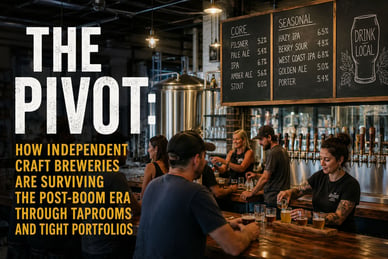
The Pivot: How Independent Craft Breweries Are Surviving the Post-Boom Era Through Taprooms and Tight Portfolios
 Story by:
Bil Corcoran
Story by:
Bil Corcoran
Table of Contents
Introduction: The End of the Hyper-Growth Era
- The State of the Industry: Decoding Current Craft Beer Market Realities
- From Hyper-Distribution to Hyper-Local: The Resurgence of Taproom Economics
- Portfolio Rationalization: Trimming Dead-Weight SKUs to Save Margins
- Wholesale Realities: Navigating Distributor Consolidation and Retail Space
- Diversifying Revenue: Food Programs, NA Integration, and Alternative Experiences
- The Long-Term Play: Building an Authentic Brand Asset That Earns Natural Backlinks
- Frequently Asked Questions (FAQ)
Introduction: The End of the Hyper-Growth Era
For over two decades, the independent craft beer movement operated under a singular, intoxicating directive: scale at all costs. Armed with visions of sprawling regional distribution networks, shiny new stainless-steel tanks, and countless retail shelf placements, thousands of independent craft breweries rushed to capture market share. It was an era defined by hyper-expansion, endless recipe experimentation, and the belief that consumer demand for craft beer was boundless.
Today, that landscape has fundamentally shifted. The post-boom era has arrived, bringing with it a sobering macroeconomic reality. Rising input costs, tightening consumer wallets, intense competition from alternative beverage categories like ready-to-drink (RTD) cocktails, and formidable supply chain pressures have forced a reckoning. Brewery founders and operators can no longer rely on brute-force wholesale volume to mask operational inefficiencies.
Instead, survival requires a strategic, disciplined pivot. The most resilient independent craft breweries are abandoning the race for national ubiquity in favor of localized control, hyper-profitable taproom ecosystems, and aggressive portfolio rationalization. This comprehensive deep-dive explores the structural changes defining modern craft beer success. Whether you are an industry analyst tracking macro trends or a brewery owner navigating margin compression, understanding these evolving business models is essential for long-term viability in an increasingly competitive marketplace.
Key Points
- The Post-Boom Correction: The craft beer industry has shifted from hyper-expansion and national distribution to operational discipline and margin preservation.
- Taproom Economics: On-premise tasting room sales eliminate middleman distribution costs, providing significantly higher gross margins per barrel.
- SKU Rationalization: Trimming slow-moving, low-margin beers frees up working capital, reduces inventory waste, and focuses production on reliable core flagships.
- Wholesale Realities: Navigating and consolidating distributor networks requires data-driven sales pitches and proof of high-velocity retail movement.
- Revenue Diversification: Integrating non-alcoholic craft options, in-house food programs, and weekday community events extends customer dwell times and boosts per-capita spending.
1. The State of the Industry: Decoding Current Craft Beer Market Realities
The modern craft beer industry is undergoing its most significant structural correction in decades. Gone are the days of double-digit annual volume expansions that masked underlying operational friction. According to recent data synthesized from the Brewers Association and industry analytics firms, total operating U.S. breweries have stabilized near 9,300 facilities, marking an end to the frantic gold-rush era of rapid startup growth. This plateau is not a sign of a dying market; rather, it signals a necessary maturation phase where supply is finally aligning with real-world consumer demand and shifting lifestyle habits.
A deeper examination of mid-year operational metrics reveals a complex narrative of contraction balanced by localized resilience. Off-premise retail scan data tracked by NielsenIQ indicates continued pricing pressure and volume softness across traditional grocery and big-box channels. Consumers facing persistent inflationary pressures are rationing their discretionary spending, impacting impulse purchases of high-priced packaged six-packs. Yet, this retail softness contrasts sharply with the surprising stability observed in direct-to-consumer draft channels and neighborhood taprooms, where experiential drinking habits continue to hold firm despite broader economic headwinds.
Compounding these volume shifts are relentless macro pressures on the operational side of the ledger. Breweries continue to absorb elevated overhead costs across raw materials, including specialized hops, malted grains, and imported specialty ingredients, alongside stubbornly high aluminum can and packaging material expenses. Furthermore, logistics and freight expenditures remain well above historical baselines, eating into already tight distribution margins.
At the same time, the competitive landscape has expanded far beyond traditional beer categories. Independent craft breweries are no longer just competing against macro lagers; they are fighting for wallet share against a surging wave of ready-to-drink (RTD) spirit-based cocktails, functional wellness beverages, hard seltzers, and a rapidly expanding market segment for non-alcoholic craft alternatives. This crowded beverage ecosystem means that traditional sales-volume strategies, relying on wider distribution footprints and constant regional expansion, frequently result in higher shipping costs and diminished returns.
For independent craft breweries, decoding these market realities requires a shift in analytical focus. Survival and profitability in the post-boom era depend less on chasing aggregate barrelage across distant state lines and more on understanding hyper-local consumer behavior, managing supply chain exposure, and ruthlessly protecting gross margins on every barrel produced. As wholesale tiers consolidate and retail shelf space becomes fiercely contested, the breweries thriving today are those embracing operational discipline, auditing their true cost-per-barrel metrics, and leaning into the high-margin, community-centric business models that insulate them from broader macroeconomic turbulence.
2. From Hyper-Distribution to Hyper-Local: The Resurgence of Taproom Economics
As the limits of regional expansion become glaringly apparent, forward-thinking independent craft breweries are orchestrating a deliberate shift away from complex distribution networks and back toward their home turf. The epicenter of this evolution is the taproom. Far from being a mere marketing appendage or an afterthought tasting bar, the on-premise taproom has re-emerged as the financial bedrock and primary profit engine for modern craft brewery survival.
Why Taprooms Outperform Packaged Goods
To understand why the taproom model is winning, one only needs to look at the math of gross margins. When a brewery sells a packaged six-pack through a third-party distributor and a grocery retailer, the economic pie is carved up aggressively. Between distributor markups, retail slotting fees, breakage, and logistics overhead, the brewery’s actual take-home margin per barrel shrinks dramatically.
Conversely, selling that same barrel of beer directly across your own tasting room bar-top eliminates the middleman entirely. On-premise sales routinely yield significantly higher gross margins per barrel, turning every pint poured into a direct infusion of working capital. This high-margin cash flow provides a crucial cushion against rising raw material costs and inflation, making taprooms indispensable shock absorbers during economic downturns.
The Taproom as an Immersive Community Anchor
Surviving the post-boom era requires treating the taproom not just as a place to buy a beer, but as an essential community gathering space. Modern consumers are increasingly driven by experiential retail, they want connection, atmosphere, and authenticity.
Successful taprooms are actively engineering their spaces to maximize customer dwell time and per-capita spending. This involves going beyond industrial concrete floors and picnic tables to create warm, inviting environments with flexible seating, localized art installations, and family-friendly or pet-friendly zones. By hosting weekly trivia nights, run clubs, live acoustic music, and neighborhood fundraisers, breweries transform themselves from beverage manufacturers into irreplaceable cultural hubs. When a brand becomes embedded in the social fabric of its neighborhood, it builds a fiercely loyal consumer base that recession-proofs its business against changing retail trends.
The Strategic Blueprint: Shrinking the Footprint
This realization has prompted a growing wave of operational restructuring. Many independent microbreweries that spent the late 2010s aggressively chasing distribution deals across multiple states are now strategically pulling back. By intentionally shrinking their distribution footprint, canceling contracts with distant, low-performing distributors, and focusing 80 percent or more of their total production volume directly through their own tasting room bar-tops, these businesses drastically lower their freight expenses, eliminate out-of-date inventory issues, and regain absolute control over product freshness and brand presentation.
Ultimately, the pivot from hyper-distribution to hyper-local represents a return to the foundational roots of the craft movement. By prioritizing direct-to-consumer taproom engagement over the high-risk gamble of national scale, independent craft breweries are securing stable, high-margin revenue streams designed to weather any economic climate.
3. Portfolio Rationalization: Trimming Dead-Weight SKUs to Save Margins
For years, the unwritten rule of the craft beer tasting room and distribution catalog was simple: more choice equals more sales. Breweries raced to build massive, ever-shifting draft menus and prolific release schedules, regularly churning out dozens of distinct stock-keeping units (SKUs) ranging from pastry stouts to experimental fruited sours. Today, that endless rotator model has become an invisible anchor dragging down profitability. In a post-boom market defined by margin compression and rising input expenses, portfolio rationalization is no longer optional, it is a vital survival strategy.
Maintaining twenty or more disparate beers on draft simultaneously places an immense strain on brewery operations. Each unique recipe requires distinct raw materials, specialized hop varieties, precise yeast management, and dedicated fermentation tank time. When a brewery spreads its production across a sprawling lineup of low-velocity beers, it locks up valuable working capital in slow-moving inventory. Furthermore, managing an overloaded draft system increases cold-storage complexity, accelerates ingredient waste, and strains packaging lines with frequent changeovers that cause costly downtime.
Beyond the brewery floor, an overcomplicated product portfolio actively dilutes brand identity. Consumers looking at an overwhelming menu often experience decision fatigue rather than excitement. Moreover, distributor partners and retail buyers are increasingly reluctant to take chances on fringe styles, preferring to allocate precious cooler space to reliable, high-velocity movers.
The antidote to this operational bloat is ruthless SKU rationalization. Leading independent craft breweries are auditing their true cost-per-barrel metrics, analyzing every single recipe to calculate labor overhead, packaging expenses, and actual margin contribution. They are trimming low-margin, high-labor styles that fail to pull their weight, replacing them with a streamlined, disciplined core portfolio anchored by exceptional, approachable flagships, such as clean, crisp craft lagers or well-balanced pale ales that appeal to a broad consumer base.
Alongside these reliable core brands, successful breweries are utilizing an agile, limited-release strategy. Instead of maintaining a sprawling, permanent lineup, they introduce short-run seasonal specialties that create genuine urgency and excitement without clogging up production schedules or tying up tank space indefinitely. By focusing production on fewer, higher-turning recipes, brewery founders can negotiate better bulk pricing on raw materials, streamline brewing operations, and ensure that every pint poured meets the highest possible standard of freshness and profitability.
4. Wholesale Realities: Navigating Distributor Consolidation and Retail Space
While the taproom serves as the primary profit engine for modern independent craft breweries, navigating the wholesale tier remains a critical puzzle piece for brands seeking stable regional visibility. However, the wholesale landscape has undergone a dramatic corporate consolidation. Major beer distributors and mega-wholesalers are aggressively trimming their books, dropping smaller independent craft portfolios in favor of high-volume macro brands, hard seltzers, and booming total-beverage categories like ready-to-drink cocktails. For independent brewers, securing and retaining distributor attention requires a complete overhaul of how they approach the wholesale market.
The wholesaler bottleneck means that simply dropping off a sales sheet no longer works. Distributors want to partner with brands that minimize logistical friction and demonstrate proven velocity on retail shelves. To cut through the noise, independent breweries must approach distributor relations with data-driven precision. This means arming sales representatives with local scan data, consumer demographic insights, and clear proof of repeat purchases rather than just relying on the romance of craft storytelling. When a brewery can prove that its core flagships turn faster than competing regional brands, it transforms from a high-maintenance account into an indispensable revenue driver for the distributor.
Securing shelf space in independent grocery stores, bottle shops, and local tap accounts is equally fiercely contested. Retail buyers are operating under strict inventory controls, prioritizing high-margin, reliable movers over experimental one-off batches that risk sitting on shelves past their expiration date. To win and hold these valuable tap handles and cooler doors, independent brewers must focus on collaborative local marketing. Partnering directly with bar owners and independent grocers to host joint tasting events, sponsor community nights, or create custom point-of-sale displays helps drive foot traffic straight to the retail partner’s location, creating a mutually beneficial relationship that protects shelf space against corporate competition.
For some independent breweries, the frustrations of working with consolidating middlemen have sparked a serious re-evaluation of self-distribution. Bringing distribution back in-house eliminates wholesaler fees and gives founders total control over cold-chain logistics, product freshness, and direct retailer relationships. However, self-distribution is not a silver bullet; it requires significant capital investment in refrigerated delivery vehicles, dedicated sales staff, and complex routing software.
Ultimately, navigating wholesale realities in the post-boom era demands realism and discipline. Whether partnering with a streamlined regional distributor or managing a localized delivery fleet, independent craft breweries must treat their wholesale operations as a tightly managed business unit. By focusing distribution efforts exclusively on high-velocity core products and strategic local accounts, breweries can maintain valuable off-premise visibility without letting logistics eat away at their bottom line.
5. Diversifying Revenue: Food Programs, NA Integration, and Alternative Experiences
As market pressures redefine the boundaries of the traditional business model, surviving and thriving in the modern craft beer landscape requires looking far beyond standard beverage sales. The most resilient independent craft breweries are transforming their facilities into diversified, multi-revenue hubs. By intelligently expanding their offerings to meet shifting consumer preferences, these businesses are increasing per-capita spending, extending customer dwell times, and capturing entirely new demographic segments.
One of the most powerful shifts in recent years is the explosive rise of non-alcoholic (NA) craft options and functional wellness beverages. The cultural attitude toward alcohol consumption has experienced a profound evolution, with a growing cohort of consumers actively choosing moderation or seeking alcohol-free alternatives without sacrificing flavor or social inclusion. By utilizing advanced brewing techniques to craft world-class non-alcoholic IPAs, stouts, and crisp lagers, independent breweries are opening their doors to designated drivers, health-conscious athletes, and the burgeoning “sober-curious” movement. Crucially, adding an NA tier to the taproom menu keeps entire social groups at the table longer, driving additional food and merchandise sales that would have otherwise walked out the door.
Equally critical to modern revenue diversification is solving the food problem. Historically, many craft breweries relied on external food trucks to feed their taproom patrons. While food trucks offer a low-overhead starting point, they introduce logistical unpredictability: trucks cancel, weather drives customers inside while keeping vendors away, and service speeds can fluctuate wildly. Today, forward-thinking breweries are bringing food programs in-house, ranging from permanent rustic kitchens and collaborative pizza pop-ups to streamlined fast-casual menus. Offering reliable, high-quality food dramatically extends customer dwell times, increases average check sizes, and turns a quick afternoon beer into a full evening dining experience.
Beyond food and non-alcoholic beverages, independent breweries are leaning heavily into experiential monetization. A taproom floor sitting empty on a Tuesday or Wednesday night represents lost potential. Innovative operators are converting their square footage into active community profit centers by hosting structured events. From trivia nights and craft workshops to run clubs, yoga-and-beer classes, and private corporate bookings, these activations turn physical space into a dynamic community anchor. Furthermore, partnering with local artists, makers, and community organizations fosters deep emotional connections with the surrounding neighborhood.
Ultimately, diversifying revenue is about removing reliance on a single product line. By blending high-margin taproom hospitality, thoughtful non-alcoholic options, integrated food programs, and community-driven events, independent craft breweries create a resilient, multi-stream business model capable of weathering economic shifts and capturing the evolving demands of today’s consumers.
6. The Long-Term Play: Building an Authentic Brand Asset That Earns Natural Backlinks
As independent craft breweries navigate the complex realities of the post-boom era, long-term survival ultimately depends on building an authentic, resilient brand asset. In a crowded digital and physical marketplace, fleeting marketing gimmicks no longer suffice. Consumers, trade analysts, and business journalists are actively looking for genuine operational transparency, consistent quality, and deep community roots.
For brewery founders and industry marketers, this operational discipline translates directly into digital authority. When you build a business model anchored by rigorous cost-of-production audits, smart taproom execution, portfolio rationalization, and innovative revenue diversification, you create a compelling narrative.
Transparency as a Marketing Strategy
Building an authentic brand asset starts with radical transparency. Sharing your operational journey, such as why you trimmed your SKU count, how you navigated wholesaler consolidation, or how you successfully integrated non-alcoholic options, establishes your brewery as a thought leader. When external publications write deep-dive business articles on modern craft beer trends, they naturally link back to primary sources that offer real-world data and actionable frameworks.
Implementation Checklist for Independent Founders
- Audit Your Portfolio: Eliminate low-margin, slow-moving SKUs to free up working capital and tank space
. - Prioritize the Taproom: Focus 80% or more of your volume on direct-to-consumer on-premise sales to maximize gross margins.
- Diversify Revenue: Integrate reliable food programs, non-alcoholic craft options, and weekday community events.
Ultimately, while the hyper-growth expansion era of craft beer has passed, a massive opportunity remains for structurally disciplined brands. By aligning operational efficiency with authentic storytelling, independent craft breweries can secure both long-term financial survival and the digital authority needed to dominate search rankings for years to come.
Frequently Asked Questions (FAQ)
1. Why are independent craft breweries shifting away from wide distribution?
Chasing national and multi-state distribution often results in high shipping expenses, distributor markups, and inventory management challenges. With retail shelf space fiercely contested and margins squeezed by rising input costs, many breweries are pulling back to focus their volume on local, high-margin direct-to-consumer taproom sales.
2. What is portfolio rationalization in the craft beer industry?
Portfolio rationalization is the practice of auditing a brewery’s recipes and eliminating slow-moving, low-margin stock-keeping units (SKUs). By trimming an overcrowded draft menu down to a streamlined core lineup of reliable flagships and agile limited releases, breweries save on raw materials, reduce tank downtime, and protect their profit margins.
3. How do taprooms help breweries survive economic downturns?
Taprooms eliminate third-party distributor and retailer markups, allowing breweries to retain a much higher gross margin per barrel sold. Beyond higher profit margins, taprooms serve as community anchors that build brand loyalty, encourage repeat visits, and provide steady cash flow regardless of broader retail trends.
4. Why are non-alcoholic (NA) craft options important for modern taprooms?
Adding high-quality non-alcoholic craft beers to the menu caters to the growing wellness-focused and sober-curious consumer segments. It keeps designated drivers and moderating customers at the table longer, increasing overall food and beverage spend without alienating traditional craft beer drinkers.
zzubreebym



Comments 0
No Readers' Pick yet.