



The Taproom Identity Crisis: Why Consistency, Not Novelty, is the Key to Craft Survival in 2026
 Story by:
Bil Corcoran
Story by:
Bil Corcoran
Section I: The Mirage of the Infinite Tap List
For over a decade, the “innovate or die” mantra has been the North Star of the American craft beer movement. Brewers were pressured to churn out a constant stream of new releases, viewing every Friday as a deadline for a fresh new beer. The industry fell into a dangerous trap: the belief that relevance could only be maintained through perpetual novelty. However, as we navigate the economic landscape of 2026, it has become clear that this “hype-cycle” business model is fundamentally unsustainable.
The pressure to constantly innovate has eroded brand identity and created massive operational overhead. When a brewery’s success depends entirely on the next “viral” beer release, it ceases to be a sustainable business and becomes a high-stakes treadmill. The operational costs of this model, fragmented inventory, experimental ingredient spoilage, and the relentless strain of R&D on brew staff, have hidden costs that often outweigh the revenue from limited-edition hype. More importantly, this culture of perpetual change has compromised the very thing that builds long-term loyalty: consistency.
We are currently witnessing a necessary, if painful, market correction. The industry is pivoting from an era of “innovation-at-all-costs” to an era of “operational rigor.” In this new climate, the most successful breweries are being redefined not by the length of their pilot-system list, but by the unwavering reliability of their core products and the intentionality of their hospitality.
This section explores why the “infinite tap list” is actually a barrier to growth. It challenges the assumption that consumers want a different experience every week and argues that the true “identity” of a brewery in 2026 is found in the discipline of its core lineup. By shifting focus away from the chaotic race for the next big release and toward a hospitality-focused, community-anchored business model, breweries can escape the identity crisis that has plagued them for years. Success now requires a move toward a more disciplined, value-driven approach, one where the beer is a consistent anchor for a broader, human-centric “third space” experience.
Table of Contents
- The Mirage of the Infinite Tap List
- The Operational Sinkhole: The High Cost of “Always New”
- Consumer Fatigue and the “Reliability Premium”
- Technology as the Foundation of Authenticity
- Redefining the Taproom as a “Third Space”
- The Survival of the Disciplined: Conclusion
- Frequently Asked Questions
Quick Facts: The 2026 Industry Shift
| Metric | The “Hype” Era (Old Model) | The “Reliability” Era (New Model) |
| Primary Goal | Viral social media reach | Long-term customer retention |
| Menu Strategy | Constant rotation/Novelty | Core-focused/Consistency |
| Operational Focus | Experimental R&D | Process efficiency & QC |
| Consumer Value | “FOMO” (Fear of Missing Out) | “Reliability Premium” |
| Staff Priority | Recipe development | High-touch hospitality |
Section II: The Operational Sinkhole — The High Cost of “Always New”
The allure of the “experimental” brewery is undeniable. It is the romantic vision of the craft beer revolution: the brewer as an artist, pushing boundaries, blending ingredients, and daring the consumer to keep up. But in the cold light of 2026, we must separate that artistic sentiment from the harsh arithmetic of the taproom. For many independent breweries, the relentless pursuit of the “next big thing” has become an operational sinkhole, a drain on capital, labor, and, ultimately, quality control.
The Anatomy of a Failed Release
To understand the financial hemorrhage caused by constant novelty, one must look at the anatomy of a typical “hype” release. It begins with the procuring of rare, often overpriced adjuncts or hop varieties. These ingredients are frequently purchased in small, inefficient quantities, stripping the brewery of any economies of scale. Then comes the R&D. Every pilot batch that doesn’t result in a “viral hit” is, effectively, an unrecoverable loss.
When a brewery operates on a constant rotation, the “hidden labor” becomes the silent killer. A brewing team that spends its entire work week cleaning, transferring, and dialing in new recipes for short-run releases is a team that is not optimizing the efficiencies of its core brands. You are paying high-level technical staff to perform tasks that offer diminishing returns. When the pilot batch fails or sells slowly, you aren’t just out the cost of the ingredients; you are out the labor hours that could have been dedicated to perfecting a flagship beer.
The Quality Control Crisis
Perhaps more damaging than the financial waste is the erosion of quality. Consistency is the hallmark of a professional-grade product, yet the “always new” model is the direct antithesis of consistency. Every time a brewer introduces a new recipe, they are introducing an “unintended variable.” A system that is constantly being broken down and reconfigured to accommodate new, experimental adjuncts or wildly different gravity profiles is a system prone to mechanical and biological variance.
When a customer visits a taproom in 2026, they are not just buying a pint; they are buying an expectation of quality. If a patron discovers that the IPA they loved last month is unrecognizable this month because of an experimental hop substitution, the brand equity is diminished. Constant experimentation creates a culture where “that’s just how it tastes this time” becomes the excuse for mediocrity. This is not “craft”; it is a failure of process.
Sustainability Metrics: The Hidden Toll
Finally, we must address the environmental and material waste. Every short-run release requires new packaging, new marketing spend, and, inevitably, the dumping of unsold product when the “hype” falls flat. In a market where overhead costs. energy, water, and specialized labor, are at an all-time high, the disposal of expired, niche, experimental beer is an ecological and financial luxury that no independent brewery can afford.
The most successful breweries of 2026 have recognized this reality. They are pulling back from the brink of the “ever-changing” madness, tightening their portfolios to focus on four or five “anchor” brands that represent the absolute pinnacle of their brewing capability. They have realized that the cost of being “everything to everyone” is the loss of being “anything” at all. By consolidating their production, they can invest in better centrifugation, improved laboratory testing, and the precise process controls that ensure every pint is identical to the last. This isn’t selling out; it is growing up. It is the transition from a collection of chaotic hobbyists to a disciplined, professionalized, and sustainable business entity. Operational rigor is no longer an optional luxury, it is the prerequisite for survival.
Section III: Consumer Fatigue and the “Reliability Premium”
For years, the craft beer industry operated under the assumption that the modern drinker was a thrill-seeker, a “beer geek” who viewed the local taproom as a treasure hunt. We built our business models around the Fear of Missing Out (FOMO), flooding social media with alerts about limited-release, one-off, or “experimental” liquid. We convinced ourselves that if we weren’t changing our tap list every seven days, we were stagnant. However, as we settle into the reality of 2026, we are observing a massive psychological shift. The pendulum has swung away from the “chaser” culture and toward the “Reliability Premium.”
The Emergence of Decision Fatigue
The average consumer walking into a taproom today is often overwhelmed by the paradox of choice. A 20-tap menu featuring four different types of hazy IPA, two experimental sours, and a rotating cast of high-gravity stouts does not create excitement; it creates decision fatigue. When a guest cannot quickly identify what a brewery is known for, or when they are forced to spend ten minutes interrogating the bartender to decipher a chaotic, jargon-heavy menu, the barrier to entry rises.
This fatigue is particularly pronounced among the broader demographic of casual, mid-frequency beer drinkers who keep the taproom lights on. These individuals are not looking for a “specimen” to photograph for Instagram; they are looking for a reliable, high-quality experience that fits their mood. When a brewery fails to provide a consistent “go-to” option, these customers don’t just pick something else—they often disengage from the brand entirely.
The Rise of the Reliability Premium
We are seeing a trend where consumers are increasingly willing to pay a premium for a brewery that delivers “predictable excellence.” In an economy defined by uncertainty, the reliability of a favorite pint has become a comfort. When a customer knows that the flagship Pilsner or the house IPA will taste exactly the same today as it did six months ago, they form a deeper emotional and financial bond with the brand.
This is the Reliability Premium. It is the willingness of a consumer to choose your brand repeatedly because you have removed the risk from their purchasing decision. It transforms the taproom from a “one-off” destination for a trendy beer into a “third space” anchor where the beer is a guaranteed component of a high-quality hospitality experience.
Trading FOMO for Trust
The “hype” model relies on the customer needing to act now. The “reliability” model relies on the customer wanting to return often. The latter is inherently more sustainable. When we focus on perfecting a core range, we aren’t just selling beer; we are selling trust. We are telling the customer, “You don’t have to guess, you know exactly what you are getting.”
This shift is crucial for brewery profitability. It allows for more efficient production planning, higher volumes on core brands, and better inventory management. It also forces the brewery to focus on what matters most: product perfection. When you stop chasing the “new” every week, you can dedicate your resources to the technical nuances of your core styles, the water chemistry, the fermentation profiles, and the finishing techniques that turn a “good” beer into a “great” one.
Ultimately, the consumer is telling us that they are tired of being the test subjects for our R&D experiments. They want a destination that feels grounded, established, and dependable. By embracing the Reliability Premium, breweries can stop fighting for attention in a saturated market and start cultivating genuine, long-term loyalty. In 2026, the most successful brands are not the ones with the most labels; they are the ones with the most consistency. Reliability is the new craft.
Section IV: Technology as the Foundation of Authenticity
There is a lingering, romanticized myth within the craft beer community that equates “manual” with “authentic” and “automated” with “industrial.” For years, this sentiment has served as a barrier to progress, trapping many independent brewers in a cycle of avoidable quality failures. However, as we move deeper into 2026, the industry is experiencing a necessary epiphany: technology is not the enemy of craft; it is the ultimate guardian of it. If we are to achieve the consistency required to demand a “Reliability Premium,” we must embrace the tools that guarantee our liquid arrives in the glass exactly as we intended it to taste.
Beyond the “Industrial” Stigma
Flash pasteurization and high-speed centrifugation have long been the targets of “craft-purist” ire, often dismissed as the hallmarks of macro-corporate production. This perspective is fundamentally flawed. In the context of a modern, hospitality-focused brewery, these technologies are actually the most effective tools for maintaining an independent brand’s integrity.
Consider the logistical reality of distribution: a delicate, unfined, unpasteurized beer is a ticking time bomb. From the moment it leaves the bright tank, oxygen and temperature fluctuations begin to dismantle the brewer’s intent. By the time that IPA reaches a consumer on a retail shelf, or even a tap handle three towns over, it is often a shadow of its former self. By utilizing small-scale, precision-controlled flash pasteurization, a brewer can “lock in” the flavor profile, ensuring that the beer remains stable and fresh for months. This is not about sacrificing character; it is about preserving the brewer’s vision against the ravages of time and logistics.
Scaling the Craft
Technology allows an independent brewery to bridge the gap between “niche” and “scalable” without sacrificing the soul of the product. Centrifugation, for example, allows for a level of clarity and stability that is nearly impossible to achieve through traditional settling alone. It reduces waste, increases yield, and ensures a cleaner, more refined product that appeals to a much wider palate.
When a brewery invests in these systems, they are investing in their own reputation. They are effectively saying that the consistency of their product is more important than the “raw, unfiltered” aesthetic that often masks brewing inconsistencies. This is the definition of professionalizing the craft. It moves the needle from “homebrewing on a large scale” to “precision manufacturing.”
Consistency as the New Craft
The goal of this technological integration is to create a “zero-defect” environment where the brewer’s creativity is showcased, not obscured by technical flaws. When a brewery can guarantee that their flagship Lager or Hazy IPA will taste exactly the same every single time, they create a benchmark. That benchmark becomes the baseline for their brand identity.
We are seeing a new wave of regional powerhouses that have mastered this balance. These breweries use their sophisticated lab testing and automation to ensure that their core lineup is flawless, leaving their smaller, manual pilot systems free to handle true experimentation. The technology supports the consistency, and the consistency supports the hospitality. In this model, the equipment doesn’t replace the brewer; it empowers them. It removes the stress of inconsistency, allowing the team to focus on the human elements of the business—the community, the atmosphere, and the service.
By integrating these tools, we move toward a future where “craft” is no longer a synonym for “unpredictable.” We move toward a standard where the quality of the beer is taken for granted, allowing the taproom to become a venue for something far more important: genuine, reliable human connection. Technology, therefore, is the quiet backbone of the new, sustainable craft model. It is the silent partner in every pint, ensuring that the promise made to the consumer is a promise kept.
Section V: Redefining the Taproom as a “Third Space”
If the previous sections have argued for operational rigor and technological discipline, it is only to clear the stage for the most vital component of the 2026 brewery: the “Third Space.” For too long, we allowed the beer, the product itself, to occupy 90% of our marketing and identity. We focused on hops, yeast strains, and adjuncts, treating the taproom as a mere warehouse for our liquid output. Today, however, that model is obsolete. To thrive in a post-hype market, breweries must transition from being “beer-first” producers to “hospitality-first” venues.
Beyond the Liquid
A “Third Space” is a social environment separate from the home (the first space) and the workplace (the second space). It is the anchor of community life, a place where the conversation, the environment, and the sense of belonging matter just as much as what is in the glass. When a guest chooses to spend their evening at your brewery, they are not just looking for ethanol; they are looking for an atmosphere, a sense of safety, and a connection to their neighbors.
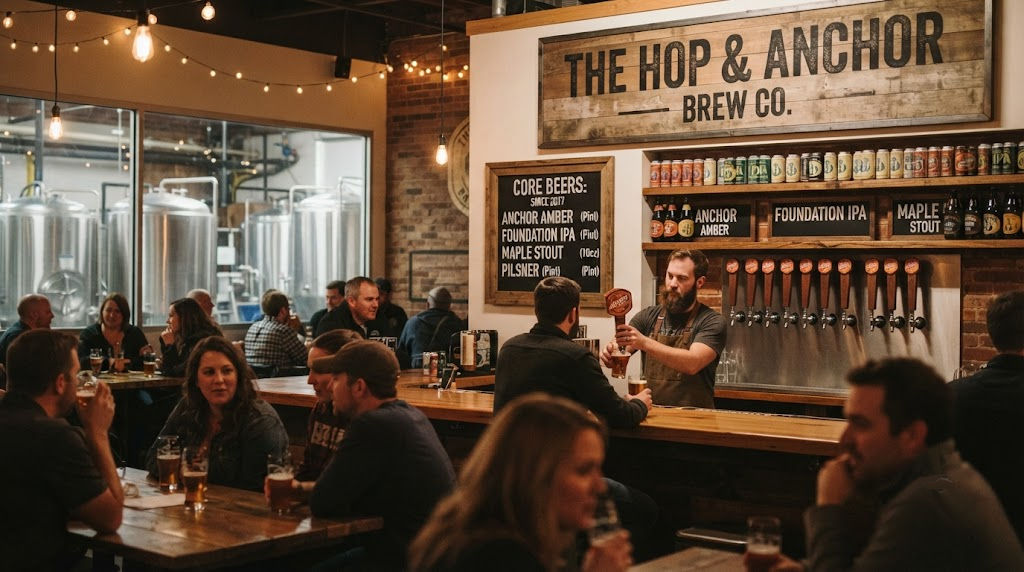
If your taproom is cold, purely transactional, or focused solely on the “latest drop,” you are failing to provide that third space. The most successful breweries of 2026 are those that have leaned into this human-centric model. They have integrated high-quality food programs, hosted recurring community events that have nothing to do with beer launches, and designed spaces that encourage long-form social interaction rather than the “in-and-out” style of the hype-chaser.
Staffing: From Trivia to Hospitality
This shift requires a total transformation in how we train and value our staff. The era of the “beer geek” bartender—who prioritizes technical jargon and lecturing customers on IBU levels, is effectively over. While product knowledge is still important, the 2026 hospitality professional is a master of emotional intelligence. They are trained in reading the room, managing a crowd, and creating a welcoming environment that makes a guest feel like a regular within five minutes of walking through the door.
We must stop hiring based on resume-length knowledge of beer styles and start hiring based on the ability to connect with humans. A great bartender who knows how to make a guest feel heard is worth significantly more to your bottom line than a brewer who can explain the nuance of a decoction mash but cannot manage a customer service conflict.
The “Community-Anchored” Business Model
Finally, the “Third Space” model provides the ultimate protection against the whims of the market. When you build a brewery based on social utility, you are insulated from the “New Release” treadmill. If your community views your brewery as their “living room,” they will visit whether you have a new triple-dry-hopped release or not. They come for the trivia night, the local artisan pop-up, the family-friendly Sunday brunch, and the consistent, friendly service.
This is the “Community-Anchored” business model. It creates a recurring revenue stream that is significantly more stable than the peaks and valleys of hype-based drops. It fosters a level of brand loyalty that can survive economic downturns and market corrections. When you prioritize the social experience, you anchor your brand in the physical reality of your neighborhood. You are no longer competing with every other brewery in the country for a spot on a trending app; you are competing only to be the best possible space for your local community to gather.
Ultimately, the taproom identity crisis is resolved when we stop trying to be the “coolest” brewery in the region and start trying to be the most necessary one. The future belongs to those who view their taprooms not as points of sale, but as vital, beating hearts within their local landscapes. Consistency in your product gives people a reason to trust you; consistency in your hospitality gives them a reason to belong to you.
Section VI: The Survival of the Disciplined
As we look toward 2027 and beyond, the “identity crisis” that has rattled the craft beer industry is effectively acting as a necessary filter. For a decade, the barrier to entry was low, and the tolerance for chaos was high. Anyone with a pilot system and a social media account could claim a seat at the table. But the market has matured, and the era of the “chaotic hobbyist” is closing. We are entering the age of the disciplined operator.
The transition we have outlined, from the unsustainable “beer-first” treadmill to the hospitality-focused, community-anchored business model, is not merely a trend; it is the fundamental requirement for survival. The breweries that thrive in the coming years will be the ones that recognize the “Reliability Premium” for what it is: the most valuable currency in a saturated market. By replacing the frantic chase for the “next big hype” with the quiet, rigorous pursuit of perfect consistency, these brewers are reclaiming their identity.
This survival is predicated on a complete integration of modern technical standards and old-world hospitality. It is the understanding that flash pasteurization and lab-grade quality control are not “industrial compromises,” but the pillars of creative freedom. When you guarantee the quality of your core range, you earn the right to innovate without the fear of failure. You stop treating your consumer as an experiment and start treating them as a partner in your growth.
Ultimately, the goal of this industry-wide correction is not to homogenize beer, but to professionalize our approach to the business. We are moving away from an industry defined by its most extreme, one-off spectacles toward an industry defined by its reliable, high-quality anchors. The “Taproom Identity Crisis” is solved the moment a brewery stops trying to explain why they are different and starts demonstrating why they are essential.
The future belongs to the “Small-but-Mighty.” These are the breweries that value their core identity above all else, that understand that the taproom is a vital third space, and that know their beer shouldn’t be the hardest thing to understand about their business. The race to the bottom of the “new release” cycle has ended. In its place, we are building a foundation of operational rigor, community investment, and product integrity. The survival of the disciplined is not just about staying in business, it is about defining the next chapter of craft beer as one of stability, purpose, and lasting success.
Frequently Asked Questions (FAQ)
Q: Is moving to a “core-focused” menu a sign that a brewery has lost its creative spark? A: Not at all. It is a sign of maturity. By mastering core brands, you create a stable financial foundation that allows for more effective and intentional experimentation on pilot systems.
Q: Can a small brewery really afford to invest in technologies like pasteurization? A: With the 2026 market offering modular, small-scale equipment solutions, these technologies are more accessible than ever. The cost of equipment is far lower than the long-term cost of lost product, ruined reputations, and wasted labor.
Q: Does focusing on “hospitality” mean the quality of the beer is less important? A: Quite the opposite. Exceptional hospitality is built on the foundation of a product that never lets the guest down. Hospitality is the experience; the beer is the quality benchmark that keeps them returning to that experience.
Q: Why is the “Reliability Premium” more important now than five years ago? A: Five years ago, the market was expanding. Today, it is correcting. In a saturated, price-conscious market, consumers gravitate toward brands they trust to provide a consistent, high-quality return on their spending.
zzubreebym



Comments 0
No Readers' Pick yet.