






Smart Tanks and Lean Data: How Craft Breweries Are Using Automation to Protect Margins in 2026
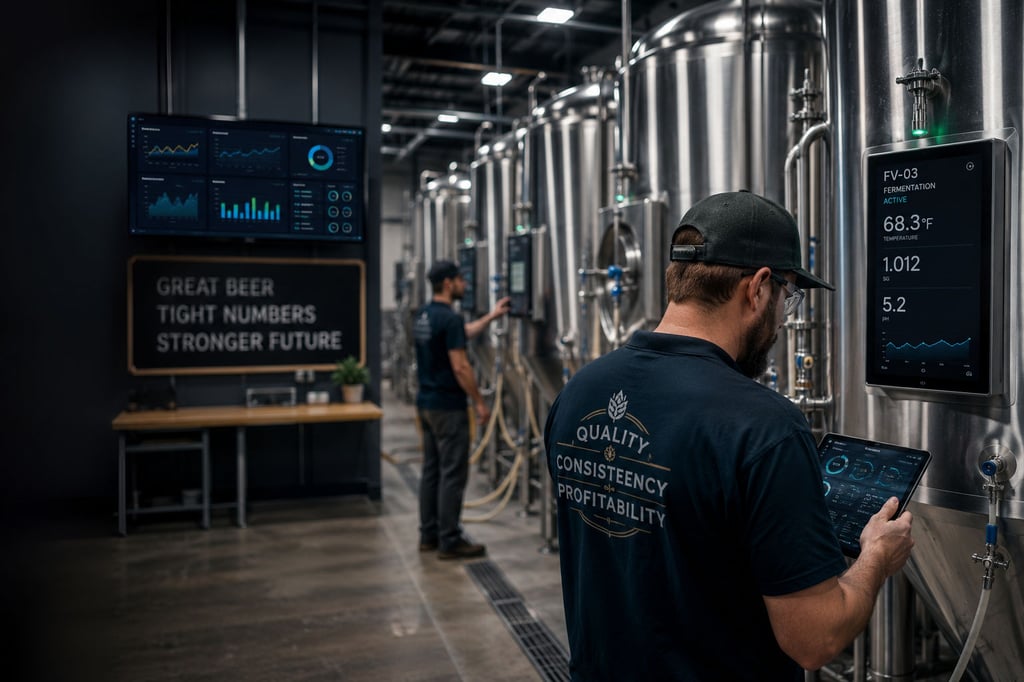
 Story by:
Bil Corcoran
Story by:
Bil Corcoran
Table of Contents
- Introduction & Key Takeaways: From Intuition-Led Brewing to Precision Data
- The Economics of Error: Why Manual Monitoring Destroys Craft Margins
- The Automated Solution: How Real-Time Data Transforms Brewhouse Profitability: Maintaining Precision Temperature, pH, and Yeast Health
- IoT Integration and Real-Time Tank Monitoring: Managing Cellar Operations Remotely
- Predictive Maintenance: Eliminating Catastrophic Equipment Failures Before They Happen
- Lean Inventory & Raw Material Optimization: Minimizing Waste with Predictive Analytics
- Implementation Roadmap: Scaling Up Smart Brewing Systems on a Craft Budget
- Frequently Asked Questions (FAQ)
1. Introduction: From Intuition-Led Brewing to Precision Data
The modern independent craft beer landscape is undergoing a permanent structural evolution. As the industry moves past the hyper-growth expansion era into a highly competitive, margin-sensitive market, traditional trial-and-error brewing methods are no longer financially sustainable. Rising ingredient costs, tightening wholesale channels, and unpredictable consumer demands mean that small misses, such as minor temperature fluctuations, extra days spent in a fermentation tank, or batch inconsistencies, can quietly compound into lost capacity, wasted product, and severe margin compression. To thrive in this climate, forward-thinking craft breweries are shifting away from purely intuition-led production and embracing automated, data-driven manufacturing.
At the center of this transformation is the integration of smart sensors, real-time analytics, and Internet of Things (IoT) connectivity directly into the brewhouse and cellar. Once viewed as capital-intensive luxuries reserved exclusively for macro-breweries, automated process controls have scaled down into modular, accessible tools designed specifically for independent producers. By gaining continuous, remote visibility into critical metrics like specific gravity, pH levels, and precise vessel temperatures, brewers can eliminate costly blind spots. This comprehensive guide explores how implementing smart tanks, automated loop controls, and predictive maintenance protocols protects profitability, standardizes batch repeatability, and builds the operational authority required to earn high-value organic backlinks from industry trade journals and business analysts.
Key Takeaways
- The Hidden Costs of Manual Monitoring: Relying on manual hydrometers, clipboards, and analog thermometers introduces human error, leading to missed temperature spikes, stuck fermentations, ruined batches, and wasted labor.
- Real-Time Cellar Visibility: IoT integration connects fermenters, bright tanks, and glycol loops to centralized dashboards, giving head brewers instant mobile alerts and remote oversight capabilities.
- Predictive Maintenance: Machine learning algorithms track vibration and thermal data on pumps and compressors weeks in advance, stopping catastrophic equipment failures before they halt production.
- Lean Inventory & Raw Material Optimization: Predictive analytics dynamically adjust safety stock levels and anticipate how agricultural variations in malt and hops will impact final beer quality.
- Scalable Implementation on a Craft Budget: Breweries can modernize incrementally using modular, retrofitted wireless sensors that typically deliver a full financial return on investment within 12 to 18 months.
2: The Economics of Error: Why Manual Monitoring Destroys Craft Margins
In the hyper-competitive craft beverage landscape, margins are razor-thin. While commercial scale brings purchasing power, independent and regional breweries rely heavily on operational efficiency to protect their bottom line. Yet, many operations inadvertently sabotage their own profitability by clinging to legacy, manual monitoring practices. When brewers rely on clipboards, manual hydrometer readings, and analog thermometers, they introduce a cascade of hidden costs that quietly erode craft margins.
The Hidden Costs of Human Error
Fermentation is a delicate, biological dance. A variance of just a few degrees or a missed gravity trend can spell disaster for a high-value batch. Manual monitoring inherently leaves a wide window for human error:
- Missed Interventions: Spot-checking temperatures twice a day means critical thermal fluctuations during overnight shifts often go unnoticed until it is far too late to correct them.
- Stuck Fermentations and Off-Flavors: Delayed reactions to temperature stalls frequently lead to diacetyl spikes, undesirable phenolic off-flavors, or completely stuck fermentations that require costly yeast repitching.
- The Ultimate Loss: When a batch is unsalvageable, the financial hit goes far beyond raw ingredients. Breweries lose projected revenue, packaging materials, and valuable tank capacity during peak seasonal demand. Dumping a single 30-barrel batch of specialty IPA can easily cost thousands of dollars in direct write-offs alone.
Labor Efficiency in the Brewhouse
Time is arguably a head brewer’s most valuable asset, yet countless hours are routinely squandered on repetitive, low-value tasks. Walking the cellar to pull manual samples, sanitize sample ports, and log temperatures consumes hours that should be dedicated to growth.
- Opportunity Cost: When skilled personnel spend their shifts acting as data-collection clerks, recipe innovation, sensory panel execution, and strategic operational planning are severely sidelined.
- Burnout and Turnover: Repetitive manual routines contribute to operator fatigue. In an industry where creative talent drives brand differentiation, tying up master brewers in administrative grunt work limits both team morale and long-term enterprise value.
Resource Waste and Legacy Tools
Legacy monitoring tools don’t just waste time and finished product; they also drain utilities through sheer inefficiency. Precise thermal control requires significant energy and water, and analog oversight inevitably leads to over-correction.
- Utility Inefficiencies: Without continuous, real-time data, glycol chillers and heating jackets work harder and longer than necessary, driving up monthly electric bills.
- Water and Chemical Consumption: Manual verification steps and excessive manual sampling lead to unnecessary water usage and chemical waste across every production cycle.
Transitioning away from manual monitoring is not merely an upgrade in convenience; it is a fundamental economic necessity for modern craft breweries striving to safeguard their margins in an increasingly demanding market.
3: The Automated Solution: How Real-Time Data Transforms Brewhouse Profitability
Eliminating the vulnerabilities of manual oversight requires shifting from reactive tracking to proactive, continuous intelligence. Modern automated monitoring systems, featuring real-time digital sensors, cloud-based telemetry, and automated alert protocols, transform how independent breweries manage their cellar operations, directly protecting margins and elevating product consistency.
Real-Time Visibility and Instant Alerts
The primary advantage of automated monitoring is the elimination of blind spots. Instead of discovering a temperature spike or a stalled fermentation during a morning walk-through, cellar teams receive instant notifications the moment parameters deviate from target ranges.
- Immediate Corrective Action: Automated alerts sent directly to mobile devices allow brewers to intervene within minutes rather than hours, preventing minor thermal drift from escalating into a ruined batch.
- Predictive Analytics: Continuous data streams track gravity progression and temperature trends with high precision, offering predictive insights into when a fermentation will finish, optimizing tank turnaround times.
Maximizing Labor and Operational Efficiency
Automation frees skilled brewers from the tedious cycle of manual logging, allowing them to redirect their expertise toward revenue-generating initiatives.
- Optimized Workflows: Eliminating routine manual checks saves hours of labor every week, streamlining cellar operations and refocusing staff on recipe development, quality assurance, and packaging efficiency.
- Data-Driven Consistency: Automated systems maintain a comprehensive digital history for every batch, enabling brewers to replicate successful profiles flawlessly and eliminate batch-to-batch variance.
Sustainable Resource Management
Smart automation drives significant savings in utility and material consumption by eliminating the guesswork inherent in analog tools.
- Precision Glycol Control: Automated temperature regulation optimizes the duty cycles of chillers and heating blankets, drastically reducing unnecessary energy consumption.
- Reduced Waste: Minimizing manual sampling reduces beer loss, wastewater generation, and chemical usage associated with constant port sanitization.
Embracing automated monitoring transforms the brewhouse from a reactive, labor-intensive environment into a streamlined, high-efficiency operation, securing long-term profitability in a competitive market.
4: IoT Integration and Real-Time Tank Monitoring: Managing Cellar Operations Remotely
The modern craft beverage revolution is built on a foundation of passion, but long-term survival demands precision engineering and smart technology. As independent breweries scale their operations, traditional cellar management methods quickly become bottlenecks. Bridging the gap between artisanal craftsmanship and industrial efficiency requires harnessing the power of the Internet of Things (IoT). By connecting cellar hardware to intelligent digital ecosystems, breweries can achieve unprecedented control, visibility, and operational agility.
The Connected Cellar: Unified Digital Ecosystems
At the heart of modern brewery automation is the connected cellar. IoT-enabled sensors embedded in fermenters, bright tanks, and glycol chilling loops continuously communicate with centralized cloud dashboards.
- Seamless Integration: Instead of isolated analog dials and fragmented data points, every critical variable—temperature, pressure, and gravity, is fed into a single, unified interface.
- Automated Oversight: This continuous data stream eliminates the need for manual transcription, creating a frictionless environment where hardware and software work in tandem to maintain ideal brewing conditions around the clock.
Mobile Oversight for Head Brewers
Fermentation does not pause for weekends, holidays, or overnight shifts. Historically, this meant head brewers were perpetually tethered to the physical brewery floor, conducting round-the-clock checks to ensure processes remained on track. IoT integration shatters this limitation by putting the cellar directly into the brewer’s pocket.
- Instant Mobile Alerts: When parameters deviate from target thresholds, such as an unexpected temperature spike or a pressure drop, automated alerts are sent directly to mobile devices.
- Proactive Intervention: Brewers can analyze live fermentation curves from anywhere, allowing them to diagnose issues and dispatch cellar staff to implement corrective measures within minutes rather than hours. This level of responsiveness safeguards high-value batches from irreversible damage.
Multi-Site and Multi-Tank Visibility
As successful craft brands grow, expansion often introduces complexity. Adding new fermentation capacity, opening second production facilities, or scaling distribution makes maintaining brand consistency a formidable challenge.
- Enterprise-Wide Uniformity: IoT platforms provide centralized visibility across expanding facility footprints. A head brewer can monitor tanks in the primary production facility just as easily as those in a satellite taproom or regional facility.
- Standardized Quality Control: Centralized dashboards ensure that recipes are executed with uniform precision regardless of location, protecting brand reputation and streamlining multi-site management.
Embracing IoT integration is no longer a futuristic luxury for forward-thinking breweries; it is an essential strategy for modern operations seeking to protect their margins, empower their brewing teams, and secure scalable growth.
 5: Predictive Maintenance: Eliminating Catastrophic Equipment Failures Before They Happen
 5
5In a commercial craft brewery, downtime is the ultimate enemy of profitability. When a critical piece of equipment, such as a glycol compressor, wort pump, or packaging line motor, fails unexpectedly, the operational impact ripples across the entire facility. Fermentation schedules are thrown into disarray, packaging windows are missed, and thousands of dollars in product can be jeopardized. Traditional maintenance strategies rely on reactive repairs or rigid, calendar-based servicing, both of which leave breweries vulnerable to unexpected breakdowns. The future of brewhouse reliability lies in predictive maintenance driven by intelligent automation.
From Reactive Repairs to Proactive Care
For decades, industrial maintenance has operated on a “run-to-failure” or rigid preventative schedule. Neither approach is well-suited to the fast-paced, high-demand environment of a modern craft brewery.
- The Cost of Reactivity: Waiting for a machine to break down guarantees emergency repair costs, rushed shipping fees for replacement parts, and severe production bottlenecks.
- The Shift to Intelligence: Predictive maintenance shifts the paradigm from guesswork to certainty. By continuously monitoring the health of core mechanical systems, breweries can address developing issues during scheduled downtime, entirely avoiding catastrophic in-process failures.
Vibration and Thermal Monitoring
At the core of predictive maintenance are advanced IoT sensors that track the invisible markers of mechanical wear long before a human operator could notice a change.
- Early Detection: Machine learning algorithms analyze continuous streams of vibration data and thermal imaging from motors, pumps, and chillers. A subtle shift in bearing vibration or an abnormal thermal signature can indicate friction, misalignment, or electrical stress weeks before a traditional mechanical failure occurs.
- Targeted Interventions: Instead of tearing down equipment blindly for routine checks, maintenance teams receive precise insights detailing exactly which component is wearing out and when it requires service.
Inventory and Spare Parts Integration
Predictive maintenance extends beyond simple machine health; it optimizes the entire supply chain within the brewery.
- Automated Part Ordering: Advanced monitoring systems integrate directly with inventory software. When an algorithm detects an accelerating wear pattern on a specific pump seal or compressor valve, the system can automatically flag or order the necessary replacement component.
- Minimizing Carrying Costs: Breweries no longer need to tie up capital maintaining an expensive, overstocked spare parts room “just in case.” Parts arrive precisely when needed, keeping inventory carrying costs low while ensuring zero lag time between fault detection and repair.
By embracing predictive maintenance, breweries insulate themselves from the chaos of unexpected equipment failures, protecting their production schedules, reducing maintenance overhead, and ensuring seamless, uninterrupted operations.
6: Lean Inventory & Raw Material Optimization: Minimizing Waste with Predictive Analytics
In the craft beverage sector, managing raw materials and finished goods inventory is a delicate balancing act. Overstocking ties up valuable working capital and risks ingredient degradation, while stockouts bring active brewing schedules to a grinding halt. Traditional inventory management relies on static spreadsheets and historical averages, leaving operations vulnerable to supply chain volatility and seasonal demand swings. Modern brewhouses are solving this challenge through lean inventory practices powered by predictive analytics, turning raw material management into a precision science.
Dynamic Safety Stock Calculation
Static inventory models—which rely on fixed reorder points and generalized safety buffers—fail to account for the fluid nature of the modern supply chain.
- Real-Time Adaptation: Predictive analytics dynamically adjust safety stock levels based on live variables, including current lead times, supplier reliability data, seasonal consumption spikes, and brewing schedule shifts.
- Capital Efficiency: By continuously recalculating buffer quantities, breweries eliminate the excess raw material hoarding that drains cash flow, maintaining a lean, agile inventory without risking sudden supply shortages.
Incoming Ingredient Quality Integration
Agricultural inputs like malt and hops are inherently variable from harvest to harvest. Small discrepancies in grain modification, moisture content, or hop alpha acid profiles can dramatically alter the final flavor, bitterness, and attenuation of a beer.
- Proactive Recipe Adjustments: Advanced data platforms ingest incoming certificate-of-analysis data and correlate it with historical batch records. This enables brewers to anticipate how raw material variations will impact the final product before mashing in.
- Consistent Quality: Instead of discovering inconsistencies post-packaging, brewhouse teams can dynamically adjust boil times, hop additions, or mash temperatures on the fly, guaranteeing uncompromised product consistency across every single release.
Shelf Stability and Distribution Timing
Inventory optimization does not stop when the beer enters the brite tank; it extends all the way through packaging, warehousing, and wholesale distribution.
- Predictive Aging Models: By tracking environmental exposure data during storage—such as warehouse temperatures and dissolved oxygen levels—predictive tools forecast real-time flavor stability and shelf-life degradation curves.
- Optimized Rotation: Logistics teams receive actionable data indicating optimal packaging windows and distribution timing, ensuring that distributors and retail partners always receive the freshest possible product while drastically reducing inventory write-offs from expired stock.
Integrating predictive analytics into inventory and raw material management transforms the brewhouse supply chain from a reactive expense center into a strategic engine of efficiency, protecting operating margins and maximizing asset utilization.
7: Implementation Roadmap: Scaling Up Smart Brewing Systems on a Craft Budget
For independent craft breweries operating on tight financial constraints, investing in cutting-edge automation can feel daunting. The misconception that digital transformation requires replacing an entire facility with turn-key industrial hardware often keeps smaller operations stuck in legacy workflows. In reality, modern smart brewing technology is designed for scalable integration. By adopting a strategic, phase-based implementation roadmap, craft breweries can modernize their cellars incrementally, maximizing impact while protecting cash flow.
Modular Upgrades for Independent Breweries
Upgrading a brewhouse does not require a massive capital expenditure or a total facility shutdown.
- Retrofitting Existing Assets: Breweries can easily install wireless IoT sensors, digital thermowells, and clamp-on flow meters onto their existing fermentation tanks, bright tanks, and glycol lines.
- Phased Rollouts: Operations can begin small, perhaps instrumenting a single pilot fermenter or the primary glycol loop, before expanding sensors across the entire cellar. This modular approach allows teams to test the technology, build internal familiarity, and spread costs over several operating quarters.
Calculating Return on Investment (ROI)
Smart brewery investments quickly pay for themselves when measured against traditional operating losses. Calculating ROI involves looking at three primary financial levers:
- Product Loss Prevention: Eliminating just one dumped 30-barrel batch per year through early thermal intervention can cover the hardware and software subscription costs for an entire cellar.
- Utility and Labor Savings: Optimizing chiller duty cycles slashes monthly electric and water bills, while automated data logging saves dozens of manual labor hours weekly. These combined efficiencies typically deliver a full financial payback within 12 to 18 months.
Building an Internal Data Culture
Technology is only as effective as the team operating it. Transitioning to a smart brewhouse requires fostering a culture where data enhances, rather than replaces, traditional brewing intuition.
- Empowering the Team: Comprehensive training ensures that cellar staff and head brewers feel comfortable interpreting real-time dashboards, setting custom alert thresholds, and tracking predictive metrics.
- Translating Insights to Craft: By viewing data as a tool to support sensory evaluation and recipe development, breweries empower their teams to experiment with greater confidence, driving continuous quality improvement from batch to batch.
Embracing a phased implementation roadmap proves that smart brewing technology is not reserved for macro-breweries. By modernizing modularly, calculating clear financial returns, and empowering staff, independent craft operations can successfully scale into the future of efficient, high-margin production.
8: Frequently Asked Questions (FAQ)
Q1: What is the typical ROI timeline for installing IoT fermentation sensors?
For most independent craft breweries, the return on investment (ROI) for IoT fermentation monitoring is remarkably fast, typically realized within 12 to 18 months. The financial payback is primarily driven by risk mitigation: preventing just a single ruined batch due to an overnight temperature spike or stuck fermentation can instantly cover the hardware and software costs for an entire cellar. Additional savings accumulate rapidly through reduced utility consumption from optimized glycol chiller cycles and significant labor hours saved by eliminating manual data logging.
Q2: Can smart monitoring systems be retrofitted onto older, non-automated brewery tanks?
Yes, absolutely. Modern IoT brewing solutions are specifically designed with modularity in mind. Breweries do not need to purchase an entirely new cellar setup to leverage digital tools. Wireless sensors, digital thermowells, clamp-on flow meters, and battery-powered transmitters can be easily retrofitted onto existing single-wall or jacketed tanks, bright tanks, and legacy piping systems. This allows operations to upgrade incrementally at a fraction of the cost of a full industrial overhaul.
Q3: How does automated temperature control directly reduce off-flavors in craft beer?
Yeast is highly sensitive to thermal stress. When manual monitoring leads to missed temperature fluctuations—especially during peak exothermic phases of fermentation—yeast can become stressed and prematurely flocculate or autolyze. This biological stress directly produces unwanted volatile compounds, such as diacetyl (butterscotch notes), excessive fusel alcohols, and acetaldehyde (green apple flavors). Automated systems maintain strict, real-time control within fractions of a degree, ensuring yeast remain healthy and clean throughout the entire fermentation cycle.
Q4: What is the difference between traditional PLC automation and AI-driven autonomous fermentation?
Traditional Programmable Logic Controller (PLC) automation relies on hardcoded, static rules—for example, opening a glycol valve strictly when a tank hits a pre-set upper temperature limit. In contrast, AI-driven autonomous systems utilize machine learning and continuous data streams to look at the broader fermentation curve. They anticipate thermal momentum, adapt to shifting ambient room temperatures, and dynamically adjust cooling or heating profiles ahead of time, preventing over-correction and optimizing attenuation without requiring constant manual intervention from head brewers.
Q5: How do predictive maintenance systems reduce long-term capital expenditures for small craft producers?
Predictive maintenance shifts a brewery away from costly “run-to-failure” repairs or wasteful calendar-based servicing. By using vibration analysis and thermal imaging sensors on critical assets like wort pumps, compressors, and glycol chillers, machine learning algorithms detect microscopic mechanical wear weeks before a part fails. This allows maintenance teams to order inexpensive replacement components ahead of time and service equipment during scheduled downtime, eliminating emergency repair fees, rush shipping costs, and catastrophic production halts.
zzubreebym



Comments 0
No Readers' Pick yet.