




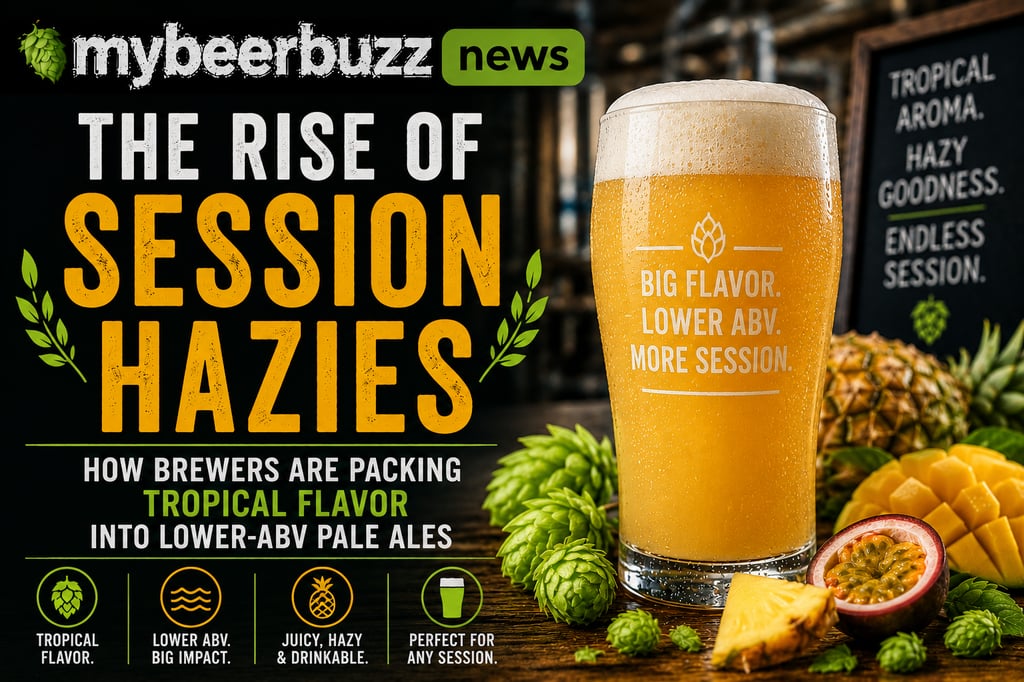
The Rise of Session Hazies: How Brewers Are Packing Tropical Flavor into Lower-ABV Pale Ales
 Story by:
Bil Corcoran
Story by:
Bil Corcoran
Table of Contents – The Rise of Session Hazies
- Introduction
- Quick Facts: The Session Haze Phenomenon
- The Hazy Evolution: From Heavyweight Juice Bombs to Day-Drinking Pours
- Anatomy of a Session Hazy Pale Ale
- The Brewing Physics: Overcoming the Body Deficit at Low ABVs
- Hop Selection and Dry-Hopping Techniques
- The Taproom Impact and Retail Shelf Shift
- Conclusion
- Frequently Asked Questions
Introduction
When the hazy IPA movement first took the craft beer world by storm, it was defined by excess. Brewers pushed density, sweetness, and alcohol content to the limit, resulting in 8% double and triple hazies that drank more like liquid milkshakes than refreshing pints. But as consumer habits shift toward moderation and active lifestyles, the market has demanded a pivot. Enter the session hazy pale ale: a style that captures the explosive, tropical fruit-forward aromatics of New England-style brewing while reining the alcohol back into a casual, day-drinking-friendly window.
Quick Facts: The Session Haze Phenomenon
| Feature | Description |
| Primary Category | Session-Strength Hazy Pale Ales / Low-ABV IPAs |
| Key Characteristics | Opaque/hazy appearance, soft mouthfeel, explosive tropical fruit aroma, low bitterness |
| Common ABV | 4.0% – 4.8% |
| Core Hops | Citra, Mosaic, El Dorado, Galaxy, Idaho 7 |
| Market Driver | Demand for vibrant hop flavor without the high-ABV heaviness or fatigue |
| Significance | Proves that explosive tropical character can coexist with total sessionability |
The Hazy Evolution: From Heavyweight Juice Bombs to Day-Drinking Pours
The early days of the hazy craze were thrilling, but they came with a built-in limitation. Drinking a heavy, 7.5% juice bomb on a warm afternoon or during a long social outing quickly leads to palate exhaustion and physical sluggishness.
Drinkers loved the low bitterness and heavy mango-and-pineapple notes of hazy beers, but they wanted a version they could enjoy multiple times without writing off the rest of their day. Brewers responded by scaling down the grain bills. By stripping away the massive malt foundations required for high ABVs, they unlocked a new subclass of beer: the session hazy pale ale, which delivers 90% of the sensory impact at a fraction of the strength.
Anatomy of a Session Hazy Pale Ale
Crafting a successful session hazy requires navigating a delicate tightrope. You cannot simply water down a standard double IPA recipe; doing so results in a thin, watery liquid that tastes hollow and uninspired. A well-crafted session hazy maintains specific architectural pillars:
- The Soft Mouthfeel: Even at lower gravities, the beer must retain a pillowy, velvety texture that coats the palate gently.
- Vibrant Aromatics: A nose bursting with ripe citrus, passionfruit, peach, and stone fruit, achieved through aggressive cold-side hop management.
- Zero Astringency: Total absence of harsh hop burn or lingering bitter bite, keeping the finish clean and ultra-refreshing.
The Brewing Physics: Overcoming the Body Deficit at Low ABVs
The greatest challenge in brewing a session hazy pale ale is maintaining body. Alcohol and heavy residual sugars naturally contribute to the perceived “thickness” or viscosity of a beer. When you drop a beer down to 4.2% ABV, those elements vanish, risking a watery body.
To combat this, contemporary brewers utilize adjuncts like malted oats, wheat, and flaked barley. These proteins and starches interact with specialized yeast strains to build a haze-stable, soft matrix that tricks the palate into perceiving a much fuller, richer body than the alcohol content would otherwise suggest.
Hop Selection and Dry-Hopping Techniques
Because the malt bill is intentionally restrained, the hops carry the entire weight of the drinking experience. Brewers lean heavily into modern, fruit-forward varietals known for high thiol content and tropical ester output—such as Citra, Mosaic, and El Dorado.
Furthermore, advanced techniques like modern biotransformation dry-hopping allow yeast and hop oils to interact during active fermentation, unlocking complex peach, citrus, and berry notes without extracting unwanted green, vegetal bitterness.
The Taproom Impact and Retail Shelf Shift
Walk into any forward-thinking taproom today, and you will notice that session hazies occupy prime real estate on draft lists. They are the go-to choice for outdoor seating areas, music festivals, and post-hike gatherings.
Conclusion
The session hazy pale ale is far more than just a diet version of a heavy IPA; it is an independent style born from technical ingenuity and changing social habits. By proving that low-ABV beers can still burst with tropical character, brewers have given craft enthusiasts an ideal companion for long, social days where flavor and moderation matter equally.
Frequently Asked Questions
Q: What makes a hazy pale ale a “session” beer?
A: Generally, a session hazy falls under 5.0% ABV (usually between 4.0% and 4.8%), allowing drinkers to enjoy multiple servings over an extended period while maintaining a lighter physical footprint.
Q: Does a lower ABV mean less hop flavor?
A: Not necessarily. While the malt backbone is smaller, brewers use heavy, late-stage dry-hopping and biotransformation techniques to ensure the hop aroma and flavor remain intensely tropical and vibrant.
Q: Are session hazies the same thing as session IPAs?
A: While very similar, session hazies specifically lean into the soft mouthfeel, opaque appearance, and tropical fruit profile of New England-style brewing, whereas traditional session IPAs often prioritize a clearer appearance and a slightly crisper, more bitter finish.
zzubreebym



Comments 0
No Readers' Pick yet.