






When The Tap Runs Dry: Understanding And Preventing Equipment Failure In Brewing
 Story by:
Bil Corcoran
Story by:
Bil Corcoran
A brewery runs on motion. Grain moves, liquid flows, pressure builds, temperature shifts. Everything works together until, suddenly, it doesn’t. A valve sticks. A motor hesitates. The process slows down, as if at first subtly, then more noticeably. For brewing, these instances can flow through the process, from fermentation to carbonation levels, and affect the beer’s consistency. Minor mechanical issues can lead to inconsistencies in the packaged beer, and emphasise the need for controlled processes from the brewhouse to the distribution centre. When equipment fails, it’s not sudden. It enters in subtle signs, easily overlooked. The cost is never just mechanical. It spreads.
The Chain Reaction of Failure
One failing component rarely stays contained. A stalled pump delays transfer. That delay affects fermentation timing. Timing affects flavor. Flavor affects consistency, and consistency is everything in brewing. What began as a minor issue turns into a full production disruption. The financial side follows quickly: idle staff, wasted ingredients, missed distribution windows. Structured upkeep reduces these cascading failures, though many operations still rely on reactive fixes. It is not the breakdown that hurts most. It is the ripple.
Why Equipment Breaks Down
Machines wear down. That part is obvious. Bearings grind, seals weaken, and motors lose efficiency. Yet failure often comes from neglect rather than age. Skipped inspections. Rushed cleaning. Slight misalignments that seem harmless until they are not. Contamination adds another layer. Brewing demands cleanliness, yet residue builds in hidden places. Over time, this affects flow, pressure, and performance in ways that are difficult to trace. Even installation matters more than expected. A poorly aligned component, such as a right-angle servo gearbox, may function at first. Then slowly, quietly, it drifts toward failure.
Preventive Maintenance as a Habit
Preventive maintenance is not dramatic. It is repetitive, structured, and almost boring. And that is exactly why it works. Regular checks, scheduled replacements, consistent cleaning. These actions do not feel urgent, which is why they are often delayed. Yet early intervention changes everything. A worn part replaced today prevents a shutdown tomorrow. A minor adjustment avoids a full system halt. Industry research shows that preventive maintenance optimizations reduce equipment failure by 30-50%. The pattern is clear. Consistency beats reaction.
Watching the Data, Not Just the Machine
In modern systems, information is generated continuously, just like modern brewing. Information in terms of temperature graphs, pressure differences, and flow rates. Numerical figures reveal a story, but not always an obvious one. Any small change detected today could mean a system breakdown after several weeks. Monitoring devices facilitate making such signals apparent. Sensors measure performance in real-time. Alarms draw attention to any deviations before they develop into something serious.
It almost seems like predicting something in advance, when all that happens is attentiveness. Data alters the way people think. Maintenance takes a proactive turn. Decisions become smoother and more accurate. In brewing processes, it helps the team detect and adapt to any potential disruptions early on to ensure consistency in fermentation, pressure, and general timing.
Equipment Choices Shape Outcomes
The equipment itself matters. Build quality, design simplicity, service access. These factors influence how often systems fail and how quickly they recover. Cheaper options may work in the short term, but then demand constant attention later. Well-designed systems reduce friction. Fewer moving parts. Easier cleaning. Faster repairs. Smart equipment selection lowers downtime and improves long-term efficiency. It is not about perfection. It is about reliability.
The Human Element
Machines do not fail alone. People interact with them, adjust them, and sometimes misuse them. Training matters more than most teams expect. A well-trained operator notices small changes. A rushed one overlooks them. Sound becomes a signal. Vibration becomes a clue. A slight delay in response may point to something deeper. These observations cannot be automated completely. Awareness spreads through teams. When everyone pays attention, problems surface earlier.
Planning for the Inevitable
Even the best systems fail eventually. Planning for that moment reduces impact. Keep spare parts stored on site. Make clear and concise repair strategies. Invest in sensors that monitor a machine’s efficiency. Set defined roles during a breakdown. Scheduled downtime also plays a role. With planned pauses, there will be more opportunity for analysis, but not at the expense of the continuity of production. It sounds paradoxical to plan downtime, but that is what will prevent unplanned downtimes. Preparing does not eliminate disruption. It mitigates it. Brewing needs rhythm. Heat. Pressure. Timing. Flow. When the machines fail, there is a disruption of the rhythm.
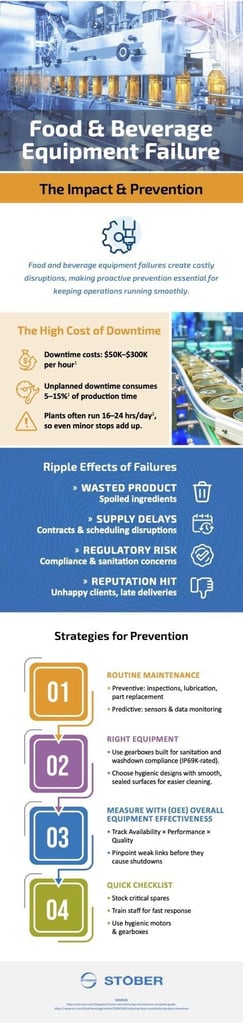
There is no question that this results in reduced output, which is one thing. However, it also means losing control. Consistency. Time. Disruptions in the brewing environment can lead to a compromised batch of products, delays in packaging, and even gaps in the delivery of the product to the consumer that cannot easily be overcome. With a systematic maintenance process, driven by data, training, and equipment selection, there can be a sustained rhythm. Not perfect rhythm. No such thing. Just close enough to guarantee consistency in the process and the product delivered to consumers. To gain a better understanding of how this all fits together, see the attached resource.
Sources:
https://oxmaint.com/blog/post/food-manufacturing-maintenance-complete-guide-
https://www.ien.com/food-beverage/article/22867000/reducing-food-manufacturing-plant-downtime



Comments 0
No Readers' Pick yet.