





5 Ways Smart Equipment Choices Can Cut Downtime In Brewery Operations
 Story by:
Bil Corcoran
Story by:
Bil Corcoran
Every brewery suffers downtime, regardless of whether it is a small-batch startup or a big operation. Brewing stops due to equipment failures. Unexpected delays cause a backlash in delivery and shrink profit. There are some shortcomings that are inevitable, but many of them can be avoided through better planning.
The proper equipment selections count a lot:
- High-quality material is far more stress-resistant.
- More intelligent design removes cleaning time.
- Time-reducing repair design.
The beer and the money flow through a well-designed system. Five tactics to minimize downtime, accelerate maintenance, and scale your brewery are presented in this article. These tips apply to seasoned professionals, as well as home brewer who thinks he or she is a seasoned professionals.
Strategy 1: Invest In High-Quality, Corrosion-Resistant Materials
Brewing is tough on equipment. Between acidic wort, high heat, and harsh cleaning chemicals, low-quality materials break down fast. Corrosion, cracks, and leaks are common in systems built with subpar metals or poor welds. That’s why many breweries rely on 316L stainless steel. It offers higher corrosion resistance, especially in high-temperature and low-pH environments. And unlike lower-grade alloys, 316L holds up under repeated cleaning cycles and doesn’t pit or degrade as quickly over time.
Valves, pumps, and gaskets take the most abuse. If one of these fails, it can shut down the entire process. A weak seal or a corroded valve can mean lost time, lost beer, and lost revenue. Choosing a trusted sanitary valves manufacturer helps ensure these parts won’t become the failure point in your operations. A strong system starts with components built to survive the daily demands of brewing.
Strategy 2: Prioritize Equipment Designed For Easy Maintenance
Delays are not only caused by the failure of equipment. In some cases, how difficult it is to access what has to be fixed is the problem. When the entire operation can be summed up by timing, temperature, and consistency, as it is in a brewery, this will disrupt an entire batch. Quick-disconnect fittings, tool-free access, and standard parts make equipment easy to service by a team that must be able to service critical parts fast. When seals and valves on pumps are readily accessible and modular actuators are used, then maintenance is but a one-off affair-it is not day-long.
Design matters. The Trappin beer and the money pass through a system that is well-designed system. The easy-to-inspect and repair systems stand a high chance of receiving frequent attention. This implies reduced breakages, reduced idle time, and improved long-term performance. In a factory where time is money, and hygiene is no option, machinery that is easy to maintain is a direct asset to a productive brewery that processes wonderful beer without any hitch.
Strategy 3: Optimize For Clean-in-Place (CIP) Efficiency
Cleaning is one of the most frequent and time-consuming sources of planned downtime in a brewery. Each cycle pulls tanks and transfer lines out of commission, adding idle time and labor hours.
That’s why CIP-compatible systems are worth the investment. Features like self-draining pipework, crevice-free welds, and high-impact spray balls speed up cleaning and ensure full coverage. They eliminate the need for disassembly, reduce the risk of contamination, and make faster batch turnover possible.
Simplified, repeatable cleaning also improves consistency across operations. More importantly, it supports food safety and regulatory compliance. The FDA’s food safety rule for human food processing requires facilities to implement sanitary preventive controls, which CIP systems help fulfill. For brewers, this means faster resets, safer beer, and fewer headaches at inspection time.
Strategy 4: Integrate Smart Sensors And Predictive Monitoring
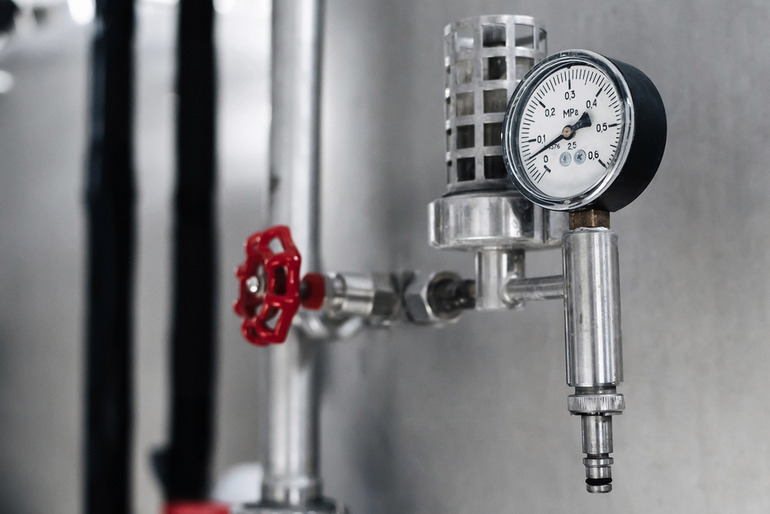
The unexpected breakdowns hardly occur. Nevertheless, it is necessary to create certain tools to catch these signals in time. Intelligent sensors monitor such variables as rate of flow, pressure, temperature, and vibration on a real-time basis. Programmable logic controllers (PLCs) send alerts or shut down the affected zone before things go out of spec, incurring heavy damages. Such automation is not only clever in the brewing world, but it is also necessary.
The taste, clarity, and shelf life may be influenced by a small change in temperature and pressure during the fermentation process. Brewers have increased control by being early to the issues and safeguarding every batch against the expensive mistakes when using real-time data. Predictive maintenance helps prevent small problems before they become total system failures. Brewers are also able to plan around breakdowns rather than responding to them.
Others can even be remotely accessed so that the lean teams can have the opportunity to observe equipment processes within any location. In the majority of industries, automation may be used to limit the number of errors made by people, decrease repetitions, and increase consistency. In the process of brewing production, smart systems can be used to automate the working process, alert in the event of unexpected troubles, and offer staff members even more precise quality and uptime management.
Efficiency and performance do not only concern equipment but also the brewer. During long days of production, it is necessary to be awake, have energy, and stay hydrated. The increase in the popularity of wellness tools, including the Gary Brecka hydrogen water bottle, which nurtures cellular hydration and energy metabolism, is finding more professionals embracing its usage to ensure that they are able to maintain the competitive advantage even in dynamic workplaces.
Strategy 5: Choose Modular, Scalable Systems
Downtime isn’t always caused by failure. Sometimes it’s the result of success. When demand outpaces capacity, brewers often face major disruptions just to keep up. Choosing modular, scalable equipment helps avoid these bottlenecks.
Brewhouses designed for vessel additions, packaging lines that support more filler heads, and stackable fermenters all allow production to grow in stages. That means fewer shutdowns, less rework, and more flexibility as your operation expands.
Planning also means accounting for more than just the equipment. Teams should lay out glycol, steam, and drainage lines to support future growth. Designing the system for expansion helps avoid costly retrofits later. Scalable infrastructure gives breweries the freedom to grow without grinding production to a halt.
Brewery Success Built Into The Equipment
Even brewing beer cannot be an exception when it comes to the efficiency of equipment. Properly selected smart equipment, instead of flashy equipment, can reduce downtime greatly and keep the breweries operating at full capacity. Longevity, simple maintenance, efficient cleaning, real-time intelligence, and modularity cannot be a luxury in craft beer production; quite on the contrary, these characteristics are critical. When working in an industry where the timing is essential and reputation is made of quality, these aspects influence consistency and yield directly.
Between the construction of new breweries and the expansion of existing facilities, downtimes can be prone to undermining a brewery right out of the gate. Uptime planning also allows first-time brewers to turn their potential into a reality; thinking about uptimes on day one means that every pint can be poured not only to expectations, but up to its full potential.
Author Bio: Stephanie Bruce is a successful Marketing Manager at Steel & O Brien, which is one of the famous manufacturers of sanitary fittings, valves, pumps, etc. With almost two decades of experience in spearheading strategic work whenever it comes to B2B manufacturers, Stephanie is an expert in go-to-market (GTM) campaigns, SEO, content creation, and brand management. She is good at developing comprehensive marketing strategies that are perfectly synchronized to meet the aims of the business, together with market needs, to ensure our successful engagement in every channel.




Comments 0
No Readers' Pick yet.