




Pabst Brewing Ceases Production of Schlitz Beer After 177 Years – Timeline
 Story by:
Bil Corcoran
Story by:
Bil Corcoran
For decades, Schlitz Beer stood as one of the most recognizable names in American brewing a powerhouse brand that once rivaled the largest breweries in the country and proudly carried the nickname “The Beer That Made Milwaukee Famous.” Yet the story of Schlitz is also one of the most dramatic declines in U.S. beer history, a cautionary tale about rapid expansion, shifting consumer tastes, and the consequences of compromising quality in a fiercely competitive market.
At its peak in the mid‑20th century, Schlitz was a dominant force, producing millions of barrels annually and competing head‑to‑head with giants like Anheuser‑Busch. The brand’s crisp, approachable lager became a staple in bars, ballparks, and refrigerators across America. But by the early 1970s, the brewery began making a series of decisions that would ultimately lead to its downfall. In an effort to cut costs and increase production speed, Schlitz altered its brewing process, changed ingredients, and leaned heavily into automation. These changes resulted in a beer that tasted noticeably different from the classic Schlitz drinkers had loved for generations.
As word spread about the declining flavor and consistency, loyal customers began turning to other brands. Compounding the problem, a disastrous batch in 1976, caused by a stabilizer reaction that produced a cloudy, unappealing beer, forced Schlitz to recall millions of bottles. The damage to the brand’s reputation was immediate and severe. What had once been a symbol of American brewing pride was now associated with shortcuts, quality issues, and corporate missteps.
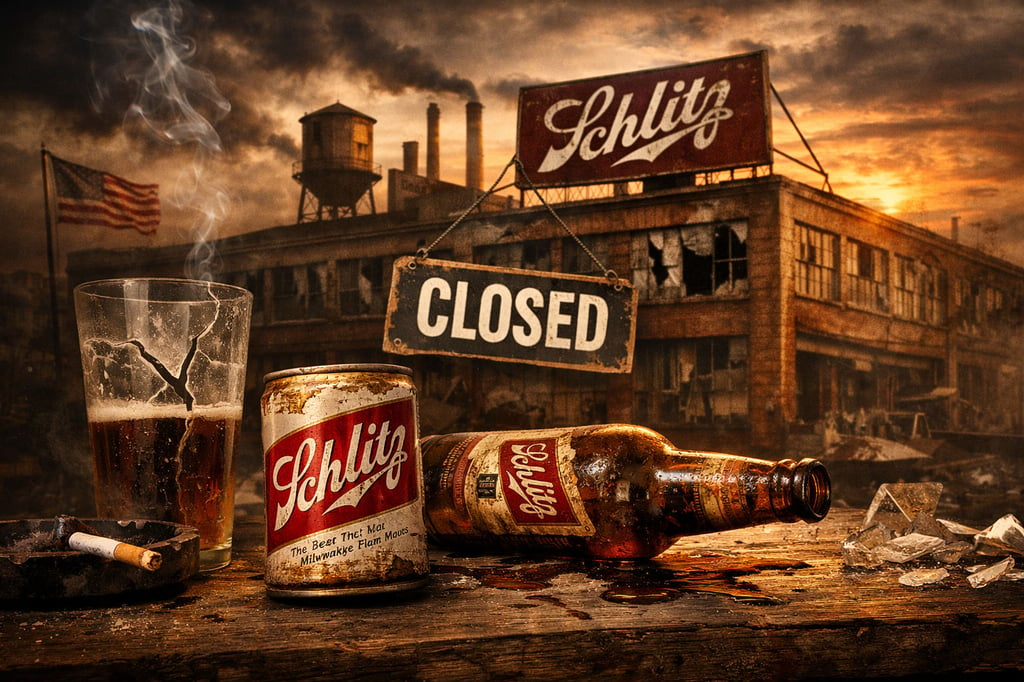
By the early 1980s, Schlitz could no longer compete with the rising dominance of Budweiser, Miller, and Coors. The brewery closed its massive Milwaukee facility in 1981, and the brand was eventually acquired by Stroh Brewery Company and ultimately Pabst Brewing Company. Production continued, but the magic was gone. The beer that had once defined a generation faded from shelves, overshadowed by modern lagers, light beers, and the emerging craft beer movement.
Today, the story of the end of Schlitz Beer remains one of the most studied chapters in American brewing history. It serves as a reminder that even the biggest brands can fall when quality slips and consumer trust erodes. While Schlitz has seen small‑scale revivals and nostalgic nods in recent years, its legacy is forever tied to its meteoric rise and dramatic collapse, a brand that shaped American beer culture before ultimately becoming a symbol of how quickly a brewing empire can crumble.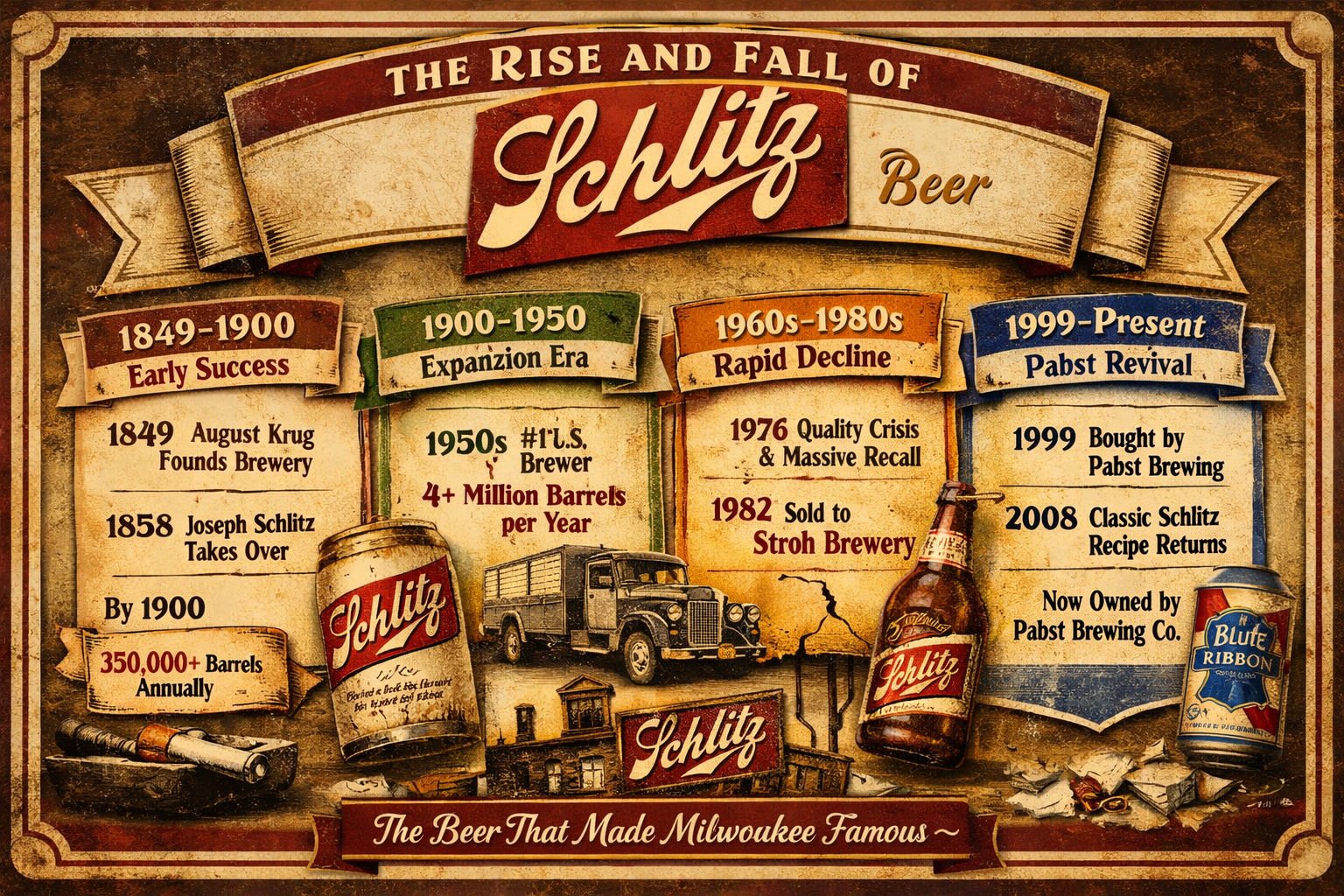
1849–1900: The Beginning and Rise
- 1849: German immigrant August Krug opens a small brewery in Milwaukee, Wisconsin.
- 1858: After Krug’s death, Joseph Schlitz, who had been managing the brewery, marries Krug’s widow and renames the business Joseph Schlitz Brewing Company.
- Late 1800s: Schlitz grows rapidly thanks to Milwaukee’s brewing boom and the city’s German heritage.
- 1871: Schlitz sends beer to Chicago after the Great Fire, earning the slogan “The Beer That Made Milwaukee Famous.”
- By 1900: Schlitz ranks among the largest breweries in the United States, producing over 350,000 barrels annually.
1900–1950: Expansion and Dominance
- Early 1900s: Schlitz expands nationally, building plants and distribution networks across the U.S.
- Prohibition (1920–1933): The brewery survives by producing malt syrup and soft drinks.
- Post‑Prohibition: Schlitz rebounds quickly, becoming one of America’s top beer brands.
- 1950s: Schlitz is the #1 beer in America, producing over 4 million barrels per year, rivaling Anheuser‑Busch and Pabst.
1960–1970s: The Decline Begins
- 1960s: Schlitz continues to grow but faces rising competition from Budweiser and Miller.
- Early 1970s: To cut costs and speed production, Schlitz changes its brewing process—reducing fermentation time and altering ingredients.
- 1976: A chemical stabilizer issue causes millions of bottles to spoil, forcing a massive recall.
- Result: Consumer trust collapses, and sales plummet from over 12 million barrels in 1973 to under 6 million by 1980.
1980–1990s: Collapse and Ownership Changes
- 1981: Schlitz closes its Milwaukee brewery, ending an era.
- 1982: The brand is sold to Stroh Brewery Company, which continues limited production but fails to revive its former glory.
- 1980s–1990s: Stroh struggles financially; Schlitz becomes a nostalgic regional brand rather than a national powerhouse.
1999–Present: Revival and Current Ownership
- 1999: Pabst Brewing Company acquires the Schlitz brand when Stroh Brewery dissolves.
- 2008: Pabst revives Schlitz Classic, brewed using the original 1960s recipe to appeal to nostalgic drinkers.
- Today: Schlitz is owned by Pabst Brewing Company, which itself operates under Blue Ribbon Intermediate Holdings, LLC.
- Current production: Schlitz remains a heritage label with limited distribution, primarily in the Midwest, with annual sales estimated in the hundreds of thousands of barrels, far below its historic peak.
Legacy
Schlitz’s story mirrors the evolution of American beer, from immigrant ingenuity to industrial dominance, corporate missteps, and nostalgic revival. Once the nation’s top‑selling beer, its fall remains one of the most studied examples of how quality, perception, and loyalty can make, or break a brewing empire.
zzubreebym



Comments 0
No Readers' Pick yet.