



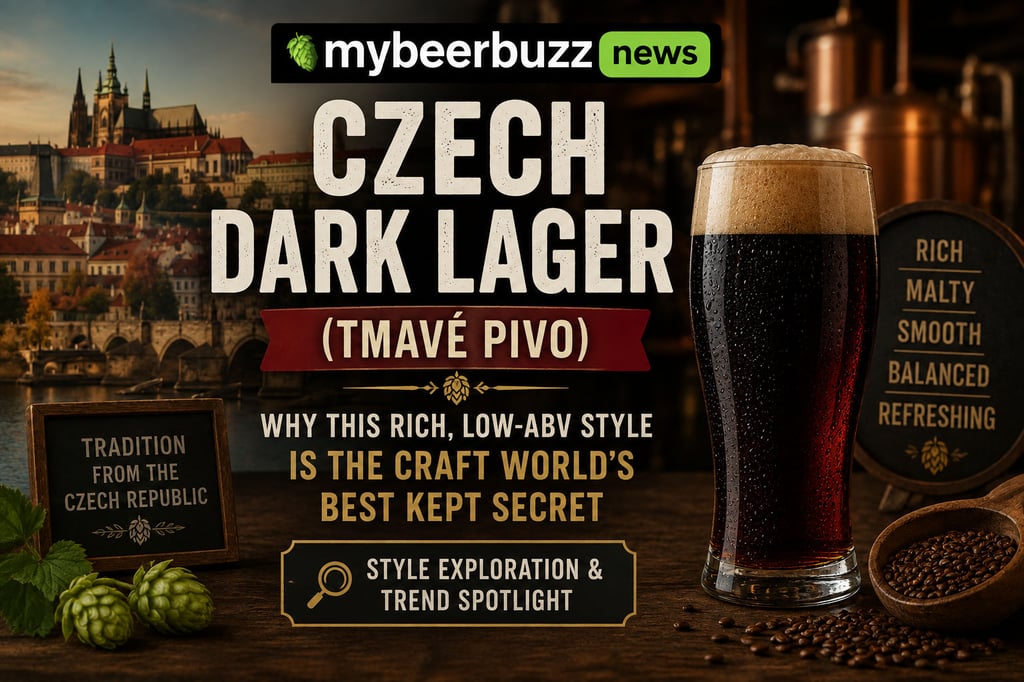
Czech Dark Lager (Tmavé Pivo): Why This Rich, Low-ABV Style Is the Craft World’s Best Kept Secret” (Style Exploration & Trend Spotlight)
 Story by:
Bil Corcoran
Table of Contents – Czech Dark Lager
- Introduction: Unlocking the Secret of Czech Dark Lager
- Quick Facts Table: Czech Dark Lager at a Glance
- What Is Tmavé Pivo? Exploring the Rich Heritage of Czech Dark Lagers
- The Brewing Science: Bottom Fermentation Meets De-Bittered Roasted Malts
- Sensory Profile: Cocoa, Caramel, and Crisp Finish
- Czech Dark Lager vs. Stout: Understanding the Structural Divide
- Global Craft Adaptations and Commercial Benchmark Releases
- Food Pairings: Elevating Meals with Sessionable Dark Lagers
- Conclusion: Raise a Glass to the Ultimate Session Dark
- Reader Discussion & Comments
- Frequently Asked Questions (FAQ)
1. Introduction: Unlocking the Secret of Czech Dark Lager
For years, craft beer shelves and tap lists have been dominated by two extremes: aggressively hopped IPAs and heavy, high-alcohol stouts loaded with residual sugar. While these styles built the modern craft beer revolution, a growing number of drinkers are experiencing severe palate fatigue. Enter Czech dark lager, a style that bridges the gap between deep, complex malt flavors and clean, refreshing drinkability.
Often referred to in its homeland by its traditional name Tmavé Pivo, Czech dark lager pours as dark as midnight yet finishes with the crisp, snappy refreshment of a pale pilsner.
As modern craft breweries race to brew authentic interpretations of Czech dark lager, understanding the history, brewing mechanics, and unique sensory profile of this style is essential for any true beer enthusiast.
2. Quick Facts Table: Czech Dark Lager at a Glance
For readers looking for an immediate technical breakdown, the comparison matrix below outlines the key parameters of Czech dark lager:
| Feature | Czech Dark Lager (Tmavé Pivo) | Traditional American Stout |
| Primary Classification | Bottom-fermented dark European lager | Top-fermented dark ale (Ale family) |
| Origin & Tradition | Czech Republic (Bohemian brewing heritage) | British Isles and United States |
| Yeast Behavior | Bottom-fermenting (Saccharomyces pastorianus) | Top-fermenting (Saccharomyces cerevisiae) |
| Fermentation Temp | Cold (45°F to 55°F / 7°C to 13°C) | Warm (65°F to 72°F / 18°C to 22°C) |
| Typical ABV | 4.0% to 5.0% | 5.5% to 9.0%+ |
| Bitterness (IBUs) | Moderate (20–35 IBUs) | Moderate to high (35–60+ IBUs) |
| Malt Profile | Pilsner malt combined with de-bittered dark malts | Roasted barley, chocolate malt, crystal malts |
| Mouthfeel & Finish | Light-to-medium body, crisp, dry finish | Full-bodied, creamy, often sweet or heavy |
3. What Is Tmavé Pivo? Exploring the Rich Heritage of Czech Dark Lagers
To truly appreciate Czech dark lager, one must look past modern marketing and examine Central European brewing traditions. In the Czech Republic, beer is categorized by Plato scale (original gravity) and color: Světlé (pale), Polotmavé (amber/semi-dark), and Tmavé (dark).
Historically, dark lagers were some of the very first beers brewed in Bohemia before modern malting technology allowed for the creation of pale pilsner malts in 1842.
While pale lagers eventually stole the global spotlight, Czech brewers never abandoned their dark brewing roots. Tmavé Pivo remained a beloved local staple in Prague beer halls—treasured for its ability to deliver warming, toasted flavors during chilly Central European winters without weighing down the drinker. Today, appreciation for Czech dark lager has exploded globally, championed by international collaborations and local craft innovators alike.
4. The Brewing Science: Bottom Fermentation Meets De-Bittered Roasted Malts
The magic behind a world-class Czech dark lager lies in a delicate balancing act between raw ingredients and cold-fermentation mechanics. Unlike stouts that rely on heavily roasted, highly acidic barleys, traditional Czech dark lagers utilize specialized de-bittered dark roasted malts, caramel malts, and a base of high-grade Bohemian pilsner malt.
- The Water Profile: Traditional Czech brewing water is famously soft, containing very low levels of dissolved minerals. This soft water profile prevents dark roasted grain husks from releasing harsh astringency or acrid bitterness into the boil.
- Hop Integration: Noble hop varieties, specifically Czech Saaz, are layered into the kettle to provide an earthy, herbal, and spicy counterweight to the sweet caramel and chocolate notes of the specialty malts.
- The Lagering Process: After primary fermentation with bottom-fermenting yeast, the beer undergoes weeks of cold conditioning near freezing temperatures. This extended rest rounds out sulfur compounds and creates the signature pristine clarity and clean snap of a Czech dark lager.
5. Sensory Profile: Cocoa, Caramel, and Crisp Finish
Pouring a proper Czech dark lager often catches first-time drinkers completely off guard. Visually, the beer displays a stunning deep ruby-brown or jet-black hue topped by a thick, creamy tan head.
- Aroma: The nose opens with gentle aromas of fresh crusty dark bread, subtle milk chocolate, roasted coffee beans, and a delicate floral hint of noble hops.
- Flavor Profile: On the palate, the beer delivers rich layers of caramel, toffee, and mild cocoa. However, unlike a heavy pastry stout, there is zero cloying sweetness.
- The Finish: The experience concludes with a clean, snappy, dry finish that invites you to take another sip immediately. As brewers often describe it: It walks and talks like a dark stout, but drinks crisp like a refreshing lager.
6. Czech Dark Lager vs. Stout: Understanding the Structural Divide
A common point of confusion among casual craft drinkers is how a Czech dark lager differs from a traditional stout or porter. While all three share a dark appearance, their internal mechanics are fundamentally different.
Stouts and porters are ales, meaning they utilize top-fermenting yeasts that operate at warmer temperatures, producing fruity esters and heavy, viscous bodies. They often feature high terminal gravities that leave residual sugars coating the palate.
In contrast, Czech dark lager utilizes cold-fermenting lager yeast and long cold storage. This technical distinction strips away heavy esters and residual sugars, resulting in a sessionable beverage clocking in between 4.0% and 5.0% ABV. You can enjoy multiple pints of a Czech dark lager during an evening out without experiencing the palate fatigue or heaviness associated with high-octane stouts.
7. Global Craft Adaptations and Commercial Benchmark Releases
The surging popularity of Czech dark lager has prompted independent craft breweries worldwide to try their hand at the style. Producers ranging from regional craft stalwarts to legendary macro-indie houses have embraced the style.
- Founders Brewing Czech Dark Lager: A prime example showcasing how American craft pioneers have embraced the style, offering deep cocoa and coffee complexity wrapped in a smooth, 5% ABV sessionable package.
- Collaborative Releases: High-profile international partnerships—such as Mikkeller teaming up with historic Czech producers like Budvar for #YearoftheLager—have brought traditional dark lagers back to the forefront of global taprooms.
- Craft Taproom Variations: Across the United States and Europe, microbreweries frequently utilize specialty dark malts and Saaz hops to put their own localized spin on classic Tmavé Pivo.
8. Food Pairings: Elevating Meals with Sessionable Dark Lagers
Because Czech dark lager balances robust malt flavor with high carbonation and a dry finish, it serves as an exceptional culinary companion across a wide variety of dishes.
- Smoked Meats and Barbecue: The subtle caramel and roast characteristics complement the charred bark of Texas brisket, smoked pork ribs, and roasted sausages, while the clean carbonation cuts through heavy fats.
- Hearty Stews and Roasted Root Vegetables: Pair a chilled pint with beef bourguignon, goulash, or roasted root vegetables to mirror the earthy, savory depth of the food.
- Chocolate and Caramel Desserts: The mild cocoa notes in a Czech dark lager elevate desserts like flourless chocolate torte, bread pudding, or salted caramel brownies without overwhelming your palate with excess sweetness.
9. Conclusion: Raise a Glass to the Ultimate Session Dark
The rise of Czech dark lager proves that the craft beer world does not always need extreme, over-the-top adjuncts to create an unforgettable drinking experience. By honoring centuries-old brewing traditions, combining delicate de-bittered malts with cold-conditioning mechanics, and prioritizing drinkability, brewers have unlocked a style that satisfies both hop heads and stout lovers alike.
Whether you are hunting down limited seasonal releases or pouring a fresh pint at your local craft taproom, Czech dark lager stands out as an essential style for every beer enthusiast’s rotation.
Related news from mybeerbuzz.com:
Explore more breaking updates, craft beer releases, and industry trends from across the beverage landscape right here on mybeerbuzz.com:
Catch up on limited brewery drops and seasonal highlights in our Beer News archive. Read about classic style profiles and special releases like the Founders Czech Dark Lager Coming To Kosmicki’s Collection.
10. Reader Discussion & Comments
We want to hear from our community of craft beer enthusiasts and homebrewers!
- Have you tried an authentic Czech dark lager (Tmavé Pivo) recently?
- Do you prefer the rich, roasty complexity of a traditional dark lager, or do you still find yourself reaching for a classic pilsner or stout?
Drop your thoughts, favorite commercial examples, and tasting notes in the comments.
11. Frequently Asked Questions (FAQ)
Is a Czech dark lager the same thing as a black IPA?
No. A black IPA combines dark roasted malts with massive quantities of American or tropical hop varieties and top-fermenting ale yeast, often resulting in a resinous, highly bitter hybrid. A Czech dark lager relies on bottom-fermenting lager yeast, European noble hops, and clean, smooth malt flavors without aggressive hop bitterness.
Why doesn’t Czech dark lager taste bitter like a stout?
Traditional Czech dark lager recipes utilize specialized de-bittered dark malts combined with very soft brewing water. This prevents the harsh, acidic roasted grain flavors and astringency commonly found in the heavy roasted barleys used for traditional stouts.
What is the typical alcohol content (ABV) of a Czech dark lager?
Most authentic versions range between 4.0% and 5.0% ABV, making them exceptionally sessionable and designed for enjoying multiple pints in a single sitting without heavy alcoholic warmth.
zzubreebym




Comments 0
No Readers' Pick yet.