





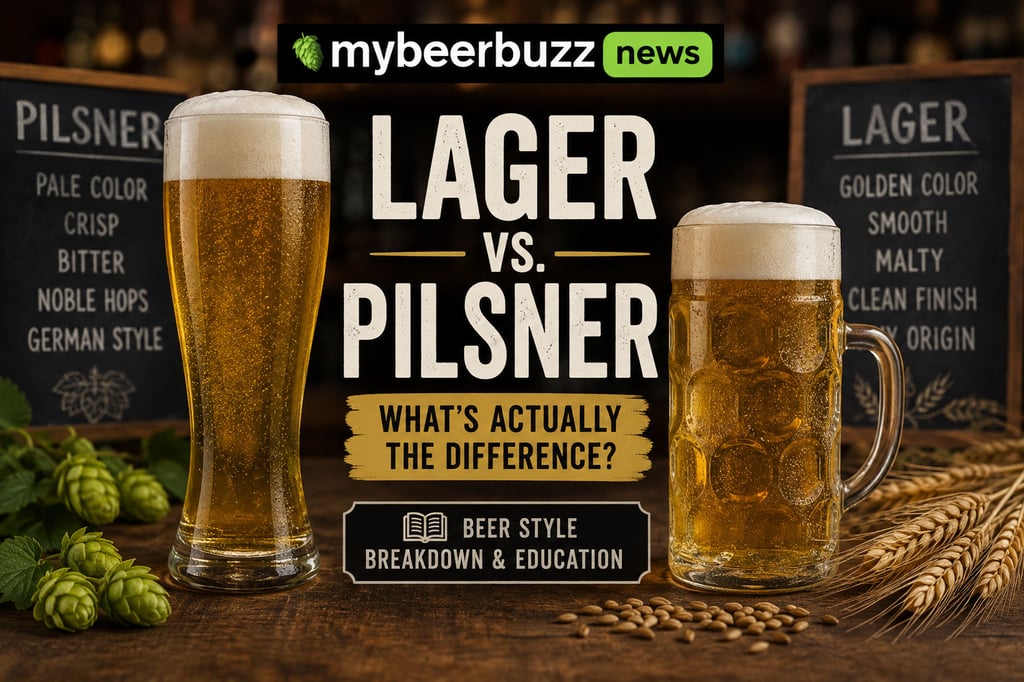
Lager vs. Pilsner: What’s Actually the Difference?” (Beer Style Breakdown & Education)
 Story by:
Bil Corcoran
Table of Contents – Lager vs Pilsner
- Introduction: Unraveling the Ultimate Beer Style Confusion
- Quick Facts Table: Lager vs. Pilsner at a Glance
- What Is a Lager? The Broad Family Tree of Cold-Fermented Beers
- What Is a Pilsner? The Iconic Bohemian Pale Lager Breakthrough
- The Core Technical Differences: Yeast, Water, and Fermentation Mechanics
- Ingredient Profiles: Noble Hops, Malts, and Mineral Profiles
- Taste, Appearance, and Mouthfeel: A Side-by-Side Sensory Breakdown
- Global Variations: Czech, German, American, and European Styles
- Culinary Pairings: How to Match Food With Lagers and Pilsners
- Conclusion: Choosing Your Next Pint
- Reader Discussion & Comments
- Frequently Asked Questions (FAQ)
1. Introduction: Unraveling the Ultimate Beer Style Confusion
When walking down the craft beer aisle or scanning a busy taproom menu, casual drinkers and seasoned connoisseurs frequently encounter some classic beer terminology confusion. The debate of lager vs pilsner is one of the most searched queries in the entire beer universe.
Many beer lovers wonder: Is a pilsner a type of lager, or are they entirely separate beverages?
To understand lager vs pilsner, one must recognize that beer classification is built on a family tree structure. Just as all bourbons are whiskeys, but not all whiskeys are bourbons, every single pilsner is fundamentally a lager, yet countless lagers exist far outside the pilsner category.
Achieving clarity on lager vs pilsner requires breaking down complex brewing science, historical milestones, ingredient profiles, and regional adaptations. This comprehensive guide examines every dimension of lager vs pilsner comparison to elevate your appreciation for these crisp, refreshing, cold-conditioned creations.
2. Quick Facts Table: Lager vs. Pilsner at a Glance
For readers seeking an immediate snapshot of lager vs pilsner, the side-by-side comparison matrix below highlights core specifications, characteristics, and brewing parameters:
| Feature | Standard Lager (Pale Lager) | Pilsner (Pale Lager Subtype) |
| Primary Classification | Broad category of cold-fermented beers | Specific pale lager sub-style |
| Origin & History | Developed in Central Europe (Germany/Austria) | Invented in 1842 in Plzeň, Bohemia (Czech Republic) |
| Yeast Behavior | Bottom-fermenting (Saccharomyces pastorianus) | Bottom-fermenting (Saccharomyces pastorianus) |
| Fermentation Temp | Cold (45°F to 55°F / 7°C to 13°C) | Cold (45°F to 55°F / 7°C to 13°C) |
| Lagering Duration | Weeks to months near freezing | Weeks to months near freezing |
| Typical ABV | 4.0% to 5.0% | 4.5% to 5.5% |
| Bitterness (IBUs) | Low to moderate (8–20 IBUs) | Moderate to high (25–45 IBUs) |
| Hop Profile | Subtle, balancing, mild noble or modern hops | Prominent, spicy, floral, herbal (e.g., Saaz hops) |
| Visual Appearance | Straw, pale gold, amber, to dark brown | Brilliant, gleaming pale gold to deep straw |
3. What Is a Lager? The Broad Family Tree of Cold-Fermented Beers
To truly master the nuances of lager vs pilsner, we must first explore the vast domain of lagers. The word lager originates from the German verb lagern, which translates directly to “to store.” Historically, medieval Bavarian monks and brewers stored their fermented vats in cool alpine caves during the warm summer months, inadvertently discovering that cold storage revolutionized beer clarity and stability.
Unlike ales, which rely on top-fermenting yeast strains operating at warm ambient temperatures, lagers depend on bottom-fermenting yeast (Saccharomyces pastorianus). These resilient yeast strains thrive in chilly environments, slowly consuming sugars over extended durations and producing a remarkably clean, crisp flavor profile free from the heavy fruity esters common in ales.
The broad lager family encompasses an incredible diversity of styles that go far beyond basic commercial light beer. Prominent variations include:
- Helles: A bright, bready, malt-forward German lager.
- Dunkel: A rich, dark Bavarian lager featuring toasted caramel and chocolate notes.
- Vienna Lager: An amber-colored style highlighting toasted malt complexity.
- Bock & Doppelbock: Strong, high-alcohol heavyweights engineered to sustain monks during fasting periods.
Within this expansive ecosystem, pale lagers dominate global volume, yet it was a specific nineteenth-century innovation that birthed our modern obsession with crisp golden beers.
4. What Is a Pilsner? The Iconic Bohemian Pale Lager Breakthrough
The history of pilsner is a legendary tale of innovation, civic pride, and technical precision. Prior to 1842, most beers consumed across Europe were dark, cloudy, and inconsistent. Citizens of Plzeň, Bohemia (modern-day Czech Republic), grew so frustrated with subpar local brewing that they pooled their resources to build a state-of-the-art municipal brewery called The Bürgersrauerei.
They hired a visionary Bavarian brewmaster named Josef Groll. Armed with newly available pale malts, exceptionally soft local water, and freshly harvested regional Saaz hops, Groll deployed bottom-fermenting lager yeast to create the world’s first true pale lager on October 5, 1842.
The resulting beverage stunned drinkers. It featured a brilliant, crystal-clear golden hue, a thick billowy white head, a soft bready malt core, and an assertive yet clean floral bitterness that danced across the palate. This historic breakthrough ignited a global revolution, making pilsner the most copied and adapted beer blueprint in human history.
5. The Core Technical Differences: Yeast, Water, and Fermentation Mechanics
When evaluating the technical side of lager vs pilsner, scientists and master brewers look closely at cellular biology and thermodynamic controls. Both beer styles utilize the exact same family of bottom-fermenting yeast, meaning the primary divergence does not stem from microscopic organisms alone, but rather from the raw materials and environmental variables applied during production.
- Water Chemistry: Traditional Czech pilsners rely on exceptionally soft water containing very few dissolved minerals. This allows delicate hop bitterness and pale malt sweetness to shine without harsh astringency. General lagers, conversely, are brewed across the globe in regions with hard or treated water profiles, necessitating adjustments to mash chemistry.
- Thermal Conditioning: Both lagers and pilsners require long weeks of cold maturation (lagering) near freezing temperatures. This extended rest allows unwanted compounds like diacetyl (which tastes like buttery popcorn) and sulfur notes to settle out of suspension, resulting in the pristine clarity that defines both styles.
6. Ingredient Profiles: Noble Hops, Malts, and Mineral Profiles
The sensory battleground of lager vs pilsner is defined entirely by ingredient selection. While a standard industrial pale lager prioritizes high-efficiency adjunct grains like corn or rice to maximize neutrality, traditional pilsners demand uncompromising agricultural specificity.
- The Malt Bill: General lagers can range from pale pilsner malt to dark Munich and roasted malts. Authentic pilsners utilize 100% high-grade Bohemian or German pilsner malt, providing a light, cracker-like, or subtle honey-bready sweetness.
- The Hop Component: This is where lager vs pilsner differences become most pronounced. Standard lagers use minimal bittering hops just to offset malt sweetness. Pilsners, however, showcase Noble hops—specifically Czech Saaz, German Hallertau, Tettnang, or Spalt. These hops impart a signature spicy, herbal, earthy, and floral aroma that lingers pleasantly on the palate.
7. Taste, Appearance, and Mouthfeel: A Side-by-Side Sensory Breakdown
Pouring a standard pale lager next to a crisp craft pilsner reveals striking visual and sensory contrasts. Even though both are brilliantly clear and served ice-cold, their flavor trajectories diverge sharply upon the first sip.
- Appearance: A standard lager can range from pale straw to deep amber depending on the specific sub-style. A pilsner strictly occupies the pale golden spectrum, shining with diamond-like brilliance under studio or sunlight.
- Aroma: Lagers typically offer clean, subdued aromas with faint cereal grain notes. Pilsners explode out of the glass with aggressive herbal spice, freshly cut grass, and floral bouquet aromas driven by heavy hop additions
. - Mouthfeel and Finish: Lagers tend to lean soft, rounded, and mellow. Pilsners hit the tongue with a snappy, highly attenuated, crisp carbonation bite that quickly transitions into a dry, refreshing, moderately bitter finish.
8. Global Variations: Czech, German, American, and European Styles
As pilsners and lagers spread outward from Central Europe, regional brewers modified recipes to suit local palates and agricultural realities. Navigating lager vs pilsner requires recognizing these distinct regional expressions:
- Czech Pilsner (Bohemian Style): Richer malt profile, deep golden color, utilizing Saaz hops with a softer water profile, yielding a rounded, bready, slightly sweet finish.
- German Pilsner (Pils): Lighter in body, paler in color, and noticeably drier and sharper in bitterness than its Czech counterpart, showcasing Hallertau or Tettnang hops.
- American Lager & Pilsner: Historically light, crisp, and refreshing, often incorporating corn or rice adjuncts for high drinkability, though modern craft brewers are reviving historic pre-prohibition all-malt variations.
- European Pale Lager: Balanced, highly approachable, mass-produced macro lagers designed for global distribution and maximum consumer refreshment.
9. Culinary Pairings: How to Match Food With Lagers and Pilsners
Because of their clean carbonation, scrubbing acidity, and absence of heavy phenols, both lagers and pilsners rank among the most versatile food-pairing beverages on Earth. Understanding lager vs pilsner flavor mechanics allows home cooks and culinary enthusiasts to elevate everyday meals.
- Pairing with Standard Lagers: Smooth, malt-forward lagers excel alongside roasted chicken, mild grilled sausages, burgers, and classic wood-fired pizzas. Their gentle malt sweetness cuts through mild spice and enhances savory Maillard reactions.
- Pairing with Pilsners: The crisp, hoppy bite and higher bitterness of a true pilsner act as a palate cleanser against rich, fatty, or fried foods. Pair a German or Czech pilsner with fish and chips, spicy tacos, soft pretzels with sharp mustard, or grilled bratwurst. The herbal hop bitterness slices straight through grease, refreshing your palate between every bite.
10. Conclusion: Choosing Your Next Pint
The ongoing conversation surrounding lager vs pilsner ultimately boils down to a matter of nuance and personal preference. Remembering that every pilsner is a lager untangles the hierarchical confusion, allowing you to appreciate the sprawling family of cold-conditioned beers while celebrating the specific, hop-forward brilliance of a world-class pilsner.
Whether you crave the mellow, relaxed drinkability of a traditional pale lager or the sharp, aromatic bite of a properly poured Bohemian pilsner, both styles represent the absolute pinnacle of brewing craftsmanship.
11. Reader Discussion & Comments
We want to hear from our community of beer enthusiasts and homebrewers!
- Where do you stand in the lager vs pilsner debate?
- Do you lean toward the crisp, spicy herbal snap of a traditional Czech pilsner, or do you prefer the smooth, mellow malt balance of a classic German Helles lager?
Drop your thoughts, favorite local brewery pours, and tasting notes in the comments section!
12. Frequently Asked Questions (FAQ)
Is a pilsner stronger than a standard lager?
Not necessarily. Both styles typically range from 4.5% to 5.5% ABV, though strength varies depending on the specific commercial brand or sub-style. Strength is determined by original gravity and sugar content rather than yeast type or hop volume.
Can you substitute pilsner for lager in cooking recipes?
Yes. Because pilsners are a direct subtype of lager, they work exceptionally well as substitutes in beer-braised brats, beer cheese soups, or batter mixes. Keep in mind that pilsners feature higher hop bitterness, which may impart a slightly sharper herbal bite to delicate dishes compared to a neutral pale lager.
Why are pilsners more expensive than mass-market lagers?
Traditional craft pilsners require high-cost ingredients like imported European noble hops (such as Saaz) and 100% specialty pilsner malt, combined with extended cold-conditioning tank times of up to six to eight weeks. Mass-market macro lagers often utilize cheaper cereal adjuncts (like corn syrup or rice) and accelerated high-gravity brewing methods to reduce production costs.
zzubreebym




Comments 0
No Readers' Pick yet.