



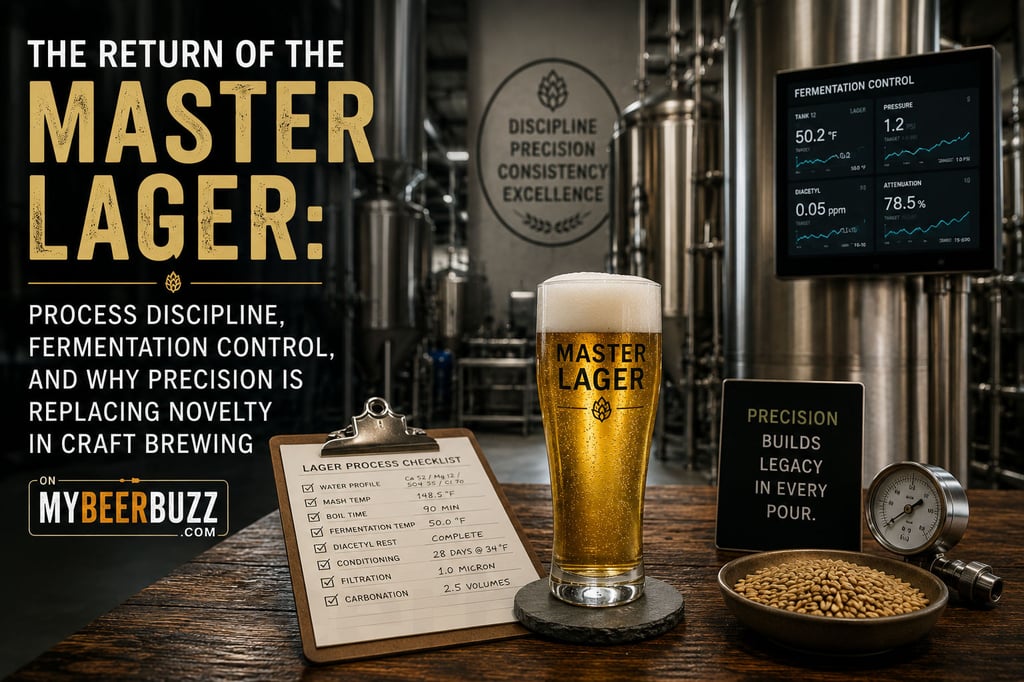
The Return of the Master Lager: Process Discipline, Fermentation Control, and Why Precision is Replacing Novelty in Craft Brewing
 Story by:
Bil Corcoran
Story by:
Bil Corcoran
Section 1: Introduction, Table of Contents, and Key Points Table
Table of Contents
- 1. Introduction, Table of Contents, and Key Points Table
- 2. The Macro Shift: Moving Away from Adjunct Overload Toward Technical Refinement
- 3. The Science of Lager Fermentation Control: Temperature, Pitch Rates, and Pressure
- 4. Cellar Management and Modern Maturation Techniques: Cutting Dwell Time Without Compromising Clarity
- 5. Raw Material Selection: Sourcing European Malts, Noble Hops, and High-Performance Yeasts
- 6. Quality Assurance, Sensory Evaluation, and Eliminating Process Flaws
- 7. Commercial Viability: Yield Optimization, Taproom Economics, and Market Positioning
- 8. Frequently Asked Questions (FAQ)
Key Points Table
| Metric / Focus | Novelty-Driven Ale Model | Precision Master Lager Model |
| Primary Production Focus | High adjuncts, heavy dry-hopping, high ABV | Clean flavor profiles, process discipline, high attenuation |
| Fermentation Complexity | Short, warm cycles prone to off-flavors (diacetyl, esters) | Rigorous lager fermentation control, strict temperature zoning |
| Cellar Turnaround Time | Fast turnaround, high raw material loss | Optimized cold-conditioning, reduced tank occupancy |
| Consumer Demand Alignment | Declining niche experimentation | Sober-curious moderation, premium sessionability |
Introduction
The independent craft brewing industry is undergoing a profound structural correction. After years of hyper-focus on novelty, pastry stouts, and aggressively saturated hazy IPAs, commercial breweries are returning to the ultimate benchmark of brewing competence: the master lager. Driven by changing consumer demographics, economic pressures on raw materials, and a cultural shift toward mindful moderation, independent foundries are discovering that process discipline and rigorous lager fermentation control are essential for survival. This comprehensive guide analyzes the technical, scientific, and economic frameworks required to produce world-class lagers that satisfy discerning drinkers and elevate a brewery’s market authority.
Section 2: The Macro Shift: Moving Away from Adjunct Overload Toward Technical Refinement
The era of chasing fleeting social media trends through pastry-laden adjuncts and mind-bending hop rates is hitting a wall. Industry data indicates that while overall volume growth for craft beer has faced headwinds, consumer preference is concentrating heavily around approachable, highly drinkable, sessionable styles. Younger cohorts and seasoned craft enthusiasts alike are rejecting cloying sweetness and palate fatigue in favor of crisp, clean, impeccably executed lagers. This structural pivot requires head brewers to transition from creative recipe formulation to absolute technical mastery.
For independent breweries, shifting production toward lagers is not merely a stylistic choice; it is an economic necessity. Producing heavy, highly hopped IPAs ties up valuable cellar space and incurs massive raw material costs for hops and specialty adjuncts that face compressed profit margins. In contrast, crafting pristine pilsners, helles, and traditional dark lagers exposes every single flaw in the brewery’s system, demanding total adherence to process hygiene and operational precision. Breweries that successfully navigate this transition are finding that a well-executed lager builds fierce brand loyalty and provides a reliable baseline of high-volume sales.
Furthermore, the operational discipline required to brew world-class lagers elevates the entire technical competency of a production team. When a brewery eliminates the masking effect of heavy adjuncts, sanitation protocols, dissolved oxygen (DO) management, and cellar hygiene must operate at peak performance. This culture of excellence resonates across the entire portfolio, transforming the brewery from a novelty-chasing experiment into a respected institutional craft producer.
Section 3: The Science of Lager Fermentation Control: Temperature, Pitch Rates, and Pressure
Achieving perfection in lager production requires master-level execution of lager fermentation control, where minute variations in temperature, yeast health, and vessel pressure dictate the ultimate success of the batch. Unlike ale strains that tolerate warmer fermentation schedules and mask minor ester imbalances, Saccharomyces pastorianus demands strict thermal management. Cellar managers must program precise temperature ramp schedules, maintaining rigorous cooling control throughout primary fermentation and the subsequent diacetyl rest to ensure a pristine flavor profile free of unwanted buttery or solvent-like defects.
Yeast cell count, viability, and pitching rate represent the next critical threshold of lager fermentation control. Under-pitching lager strains leads to prolonged lag phases, sluggish attenuation, and an excess production of sulfur compounds and higher alcohols. Professional cellar operators utilize automated cell counters and strict propagation protocols to ensure a healthy, robust pitch rate—typically ranging between 1.5 to 2.0 million cells per milliliter per degree Plato. Maintaining these exact metrics guarantees rapid, clean fermentation cycles that protect wort integrity and minimize undesirable byproducts.
Modern lager fermentation also increasingly incorporates controlled tank pressure (spunding) to capture natural carbonation and suppress ester formation. By sealing cylindroconical tanks at specific gravity thresholds, brewers can naturally carbonate the beer while driving down residual diacetyl levels more efficiently. Mastering these advanced parameters of lager fermentation control allows commercial foundries to shorten tank turnover times without compromising the delicate, crisp characteristics that define world-class lagers.
Section 4: Cellar Management and Modern Maturation Techniques: Cutting Dwell Time Without Compromising Clarity
Traditional lager brewing historically demanded weeks or months of cold lagering (storage near freezing temperatures) to precipitate yeast, proteins, and polyphenols, resulting in brilliant clarity and smooth flavor integration. In a modern commercial setting, tying up a fermentation vessel for eight weeks creates significant financial drag. Consequently, progressive craft breweries are implementing advanced cellar management techniques and accelerated maturation protocols to optimize tank velocity without sacrificing quality.
The foundation of modern cellar acceleration relies on precise terminal gravity management and managed diacetyl rests, followed by controlled crash cooling and the strategic use of specialized fining agents such as silica hydrogels or protein-selective centrifuges. By utilizing high-efficiency inline centrifuges or automated filtration systems, brewers can strip out suspended yeast and haze-active compounds rapidly, reducing cold-conditioning dwell times from six weeks down to fourteen days. This operational efficiency drastically increases annual barrel output per tank, maximizing capital utilization.
However, accelerating the lagering phase requires meticulous dissolved oxygen (DO) control during transfer and packaging. When tank dwell times are shortened, the beer has less natural time to scavenge oxygen through slow chemical reduction. Cellar operators must utilize state-of-the-art optical DO meters, counter-pressure purging, and rigorous bottling or canning line maintenance to ensure packaged oxygen levels remain below 15 parts per billion (ppb). Protecting the beer during this high-velocity cellar transfer ensures long-term shelf stability and crisp flavor retention.
 Section 5: Raw Material Selection: Sourcing European Malts, Noble Hops, and High-Performance Yeasts
 Section 5: Raw Material Selection: Sourcing European Malts, Noble Hops, and High-Performance Yeasts
The minimalist ingredient deck of a traditional lager, water, malt, hops, and yeast, means there is nowhere to hide subpar raw materials. Craft breweries pursuing world-class lager programs must establish direct relationships with elite maltsters, agricultural hop producers, and specialized yeast labs. Sourcing premium continental malts, such as floor-malted Bohemian pilsner or carefully kilned German Munich malts, provides the complex, bready, and honeyed malt backbone essential for authentic flavor profiles.
Hop selection in lager brewing requires a delicate balance of subtle bitterness and refined aroma rather than the explosive, fruit-forward punch of modern IPA hops. Brewers rely on traditional Noble hop varieties, such as Saaz, Hallertau Mittelfrüh, Tettnang, and Spalt, to impart earthy, floral, and spicy notes that complement rather than overwhelm the malt profile. Sourcing these delicate hops demands careful logistics, cold-chain storage, and rigorous alpha and beta-acid lot analysis to ensure consistent bitterness and aroma extraction across production cycles.
Yeast selection acts as the final anchor of raw material excellence. Different strains of Saccharomyces pastorianus exhibit distinct attenuation limits, sulfur production tendencies, and ester profiles. Whether utilizing a classic Munich strain known for its malty roundness or a ultra-clean Pilsen strain that emphasizes crisp, dry hop snap, master brewers must manage yeast health through generational serial repitching carefully. By maintaining rigorous genetic purity and vitality in the yeast bank, breweries guarantee consistent batch-to-batch execution.
Section 6: Quality Assurance, Sensory Evaluation, and Eliminating Process Flaws
Executing a flawless lager program requires an institutionalized commitment to quality assurance (QA) and rigorous sensory evaluation. Because lagers are exceptionally clean, even trace amounts of process flaws, such as diacetyl (butter), acetaldehyde (green apple), dimethyl sulfide (cooked corn), or hydrogen sulfide (rotten eggs), are immediately perceptible to the consumer. Implementing a multi-tiered QA protocol ensures that any deviation from the flavor standard is identified and corrected long before the product reaches distribution channels.
Analytical testing laboratories within the brewery must monitor key performance indicators daily, including gravity, pH, carbonation volumes, and dissolved oxygen levels. Furthermore, routine forced-aging (forced-ferment) tests help predict flavor stability and shelf-life performance under thermal stress. Pairing these hard analytics with a trained internal sensory panel allows the production team to detect threshold-level off-flavors during early maturation, giving cellar operators time to execute corrective interventions such as extended lagering or yeast re-absorption phases.
Establishing this culture of uncompromising quality control transforms the brewery’s operational mindset. Rather than relying on guesswork or subjective tasting, cellar masters operate with scientific precision. This dedication to eliminating process defects safeguards the brand’s reputation, guarantees exceptional customer experiences, and positions the brewery as an elite producer capable of standing shoulder-to-shoulder with historic European brewing institutions.
Section 7: Commercial Viability: Yield Optimization, Taproom Economics, and Market Positioning
Transitioning production focus toward master lagers offers profound economic advantages for independent craft breweries navigating a tightening market. From a brewing economics standpoint, lagers utilize cost-effective grist bills compared to heavily hopped IPAs, reducing raw material expenditure per barrel. Furthermore, efficient lager fermentation control and optimized cellar rotation times maximize annual production capacity, lowering overhead costs per unit and strengthening bottom-line profitability.
In the taproom environment, premium lagers serve as exceptional volume drivers and universal crowd-pleasers. While niche styles attract targeted enthusiast segments, a crisp, brilliantly clear pilsner or helles appeals to every demographic—from casual drinkers to hardcore beer geeks. This broad drinkability encourages longer dwell times, higher on-premise consumption, and increased repeat visits. Additionally, because taproom and direct-to-consumer sales yield higher margins than traditional three-tier wholesale distribution, high-volume lager sales directly bolster the brewery’s financial resilience.
Ultimately, positioning the brand around technical mastery and lager excellence builds long-term market equity. As industry consolidation continues, independent breweries that distinguish themselves through flawless execution, heritage styles, and uncompromising quality will capture consumer loyalty. By treating lager production not as a retro novelty, but as the ultimate test of brewing science, independent foundries can secure enduring commercial success in a competitive landscape.
Section 8: Frequently Asked Questions (FAQ)
Why is lager fermentation control more critical than ale fermentation control?
Lager strains (Saccharomyces pastorianus) operate at significantly lower temperatures and are highly sensitive to thermal fluctuations, making strict lager fermentation control essential to prevent the formation of off-flavors like diacetyl and sulfur compounds.
How do modern craft breweries reduce long lagering times without losing quality?
Breweries utilize automated temperature management, high-efficiency filtration, and selective fining agents to accelerate maturation while maintaining brilliant clarity and low dissolved oxygen levels.
Why are independent craft breweries shifting focus from IPAs to lagers?
Changing consumer preferences toward moderation, coupled with rising raw material costs and the need for high-volume, approachable session styles, have made precision lagers a more economically viable and refreshing product category.
What role do Noble hops play in traditional master lagers?
Noble hops provide a refined, delicate balance of earthy, floral, and spicy bitterness that complements malt sweetness without overpowering the clean, crisp palate profile characteristic of classic lagers.
zzubreebym




Comments 0
No Readers' Pick yet.