




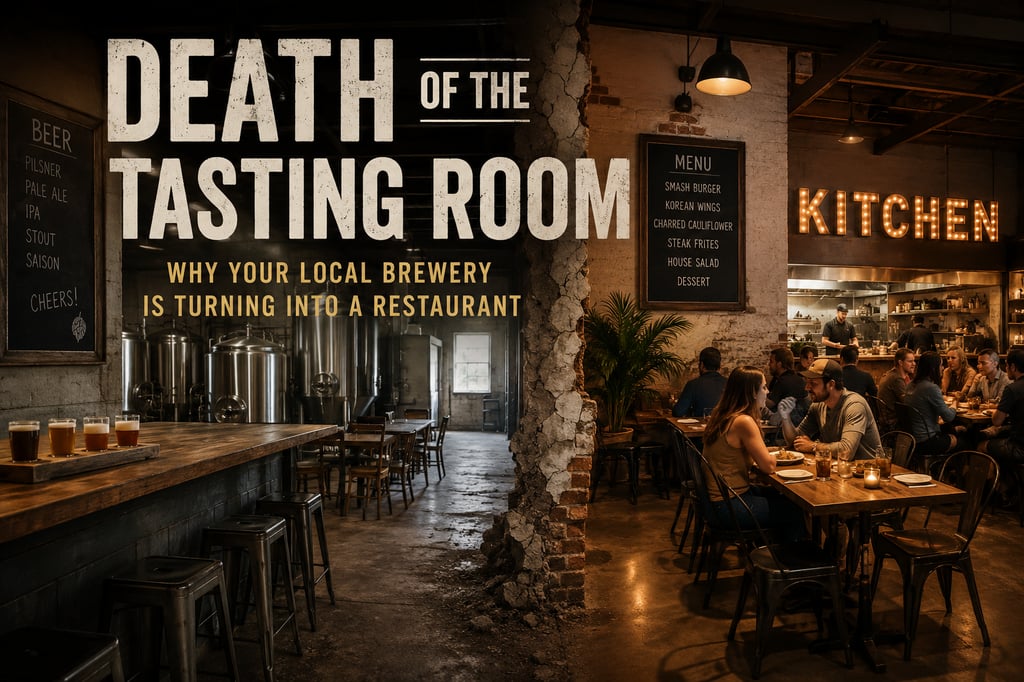
Death of the Tasting Room: Why Your Local Brewery is Turning Into a Restaurant
 Story by:
Bil Corcoran
Story by:
Bil Corcoran
Introduction: The Taproom Identity Crisis: Why the “Beer-First” Model is Losing the War for Survival
The “glory days” of craft beer, that exhilarating window between 2015 and 2019, were defined by a singular, seductive promise: if you brewed it, they would come. In that era, technical innovation and rapid-fire releases were the undisputed engines of growth. The taproom was a temple of production, a place where beer nerds lined up for the latest hazy IPA, and a brewery’s success was measured almost entirely by the liquid in the glass. It was a golden age of maximalism, where the “beer-first” model felt not just viable, but invincible.
By 2026, the industry’s landscape has been seismically altered. We are no longer living in a world of endless growth; we are navigating a period of “new normalcy.” With total alcohol participation down and consumers becoming increasingly selective, the old playbook, chasing hype through constant spectacle, is actively fueling brewery closures. Today’s craft beer market is fracturing into two distinct paths. On one side are the “Beer-First” operators, struggling to justify the high overhead of production-only models in an environment where volume is declining. On the other are the “Hospitality-First” innovators, who have realized that beer is no longer the sole focus of the evening.
These survivors are shifting away from the product-centric obsession of the 2010s toward a broader, experience-driven model. By treating the taproom as a “third space”, integrating food, community events, and intentional atmosphere, they are successfully pivoting from simple retail to essential hospitality. In 2026, the question for every independent brewery is no longer “what new beer are you brewing?” but “why should a customer choose your space over their own couch?” Survival in this era depends on recognizing that the taproom has evolved: it is now a community hub, and the breweries that treat hospitality as a core strategy are the ones winning the war for survival.
Article Table of Contents
- I. Introduction: The Shift from Hype to Hospitality
- II. The “Beer-First” Fallacy: Why Production-Only Models are Faltering
- III. The Hospitality Pivot: Converting Taprooms into “Third Spaces”
- IV. The Consumer Backlash: Navigating Price Sensitivity and Value
- V. Survival Strategies: The Hybrid Future and the Role of Pasteurization
- VI. Conclusion: The Future of the Independent Craft Brewery
- VII. FAQ
- VIII Appendix: Survival In Practice
Industry Quick Facts: 2026 Landscape
| Metric | 2026 Status / Data |
| Craft Production (2025) | −5.1% decline |
| Net Brewery Change | −2.9% (Closures outpacing Openings) |
| Brewpubs (with food) | −1.7% (High resilience) |
| Microbreweries (no food) | −8.9% (Significant struggle) |
| Primary Survival Driver | Hospitality & On-site Experience |
| Key Market Headwind | Declining Alcohol Consumption |
II. The “Beer-First” Fallacy: Why Production-Only Models are Faltering
For over a decade, the “beer-first” philosophy acted as the industry’s North Star. It was a romantic, product-obsessed mandate: focus exclusively on the liquid, obsess over the hop saturation, perfect the fermentation curve, and the market would inevitably reward you with undying loyalty. In that world, marketing was secondary to the beer itself. If you produced the best-rated IPA, you had a guaranteed audience. But the economic and cultural shift of 2026 has exposed this mindset as a dangerous fallacy, a business model that optimized for hobbyist approval rather than long-term commercial sustainability.
The “beer-first” model often fell into the Hype-Release Loop. This was a cycle defined by constant, resource-heavy innovation: new yeast strains, exotic fruit additives, and a relentless need to offer “something new” every single week to drive taproom foot traffic. While this fostered an engaged core of enthusiasts, it created a massive, often invisible, overhead. The costs associated with small-batch testing, ingredient waste, and the labor required to constantly rebrand and re-market are staggering. For many small-to mid-sized breweries, the time and energy spent chasing the “perfect” new release meant they were spending more time in the brewhouse and less time nurturing the customer experience.
Furthermore, the “Beer-First” model is inherently fragile because it ignores the Technical Reality of Consistency. In 2026, the market has matured. Consumers are less interested in the “luck of the draw” when they buy a $9 pint or a $20 four-pack. They demand a product that tastes exactly as it did the last time. This is where the anti-pasteurization sentiment of the previous decade has come back to haunt many independent brewers. By viewing pasteurization, or any form of heavy-duty quality control, as a “soul-killing” compromise, many breweries left themselves vulnerable to quality degradation.
When a beer is unpasteurized, it has a shelf life that is effectively a ticking clock. If that beer doesn’t sell in the taproom within a short window, the quality drops, the flavor profile shifts, and the brand equity erodes. When this happens at scale, the business isn’t just selling beer; it’s managing a daily crisis of inventory spoilage.
The financial reality is equally sobering. The “beer-first” brewery usually operates with thin margins because the cost of goods sold (COGS) for high-end craft beer is exceptionally high. When your only profit driver is the beer itself, you are trapped. If you don’t sell every barrel you produce at a high margin, the business model collapses. Compare this to a diversified operation: if the beer sales have a slow Tuesday, a “hospitality-first” brewery is still making money on food, event space rentals, or non-alcoholic craft sodas.
The “Beer-First” fallacy is the belief that the quality of the beer is the only variable that matters to the consumer. In 2026, we know this to be false. The consumer’s decision-making process has shifted. They are choosing breweries based on how the space makes them feel, how easy it is to bring their families, and how reliable the venue is as a “third space.” The breweries that are filing for bankruptcy today are rarely the ones with “bad” beer; they are the ones that had “great” beer but no business model capable of supporting the high cost of production in an era of declining volume. They were so focused on the liquid that they forgot they were running a business, not a laboratory.
III. The Hospitality Pivot: Turning Breweries into “Third Spaces”
As the “beer-first” model loses its ability to anchor a sustainable business, the industry is seeing a seismic shift toward the “Third Space” concept. In 2026, a successful brewery is no longer defined merely by the quality of its fermentation or the rarity of its hop bill; it is defined by its utility as a social sanctuary. Consumers are increasingly fatigued by the performative nature of the “hype-beer” era. They are voting with their feet, opting for venues that function as a reprieve from the stresses of work and the isolation of home.
The “Third Space” transformation is rooted in a fundamental psychological shift. Modern drinkers, particularly Gen Z and younger Millennials, are not looking to “hunt” for beer in a warehouse. They are looking for environments that feel lived-in, welcoming, and inclusive. This explains the move away from the “garage aesthetic”, cold concrete floors, metal chairs, and deafening acoustics, which often felt exclusionary or “insider-only.” Today’s top-performing taprooms are embracing warmth. We are seeing furniture that invites lounging, lighting that suggests relaxation rather than industrial sterility, and layouts designed to accommodate diverse groups, from families with children to remote workers seeking a daytime workspace.
Diversification is the operational engine behind this pivot. The most resilient breweries are those that have successfully expanded their revenue streams beyond the pint glass. By integrating high-margin food programs, curated non-alcoholic options, and flexible event spaces, these operators are stabilizing their cash flow. The “Dual-Revenue Stream” model is becoming the gold standard: segmenting floor plans into zones that can host private corporate events or micro-gatherings without disrupting the daily taproom experience. A 20-person birthday party or a small networking event creates a baseline of predictable, prepaid income that shields the business from the volatility of “slow” Tuesdays.
Events in 2026 are also evolving from complex spectacles to “uncomplicated rituals.” The most effective breweries are leaning into activities that spark organic conversation, trivia nights, watch parties for sports, or community-focused pop-ups, rather than forcing customers to engage with the beer as an intellectual exercise. The beer is there, of course, but it plays a supporting role. It cements the mood, matches the meal, and fuels the social interaction, becoming a seamless part of the “vibe” rather than the main attraction.
This shift also addresses the reality of declining alcohol consumption. By offering high-quality non-alcoholic alternatives and sessionable, lower-ABV lagers, breweries are expanding their accessible market. They are no longer competing just with other beer bars; they are competing with coffee shops, restaurants, and activity-based social hubs. When a brewery effectively positions itself as a “third space,” it becomes part of the city’s social infrastructure. It becomes a destination that patrons return to because they feel “at home,” not because they are chasing the next limited-edition release. In this landscape, the winner is the venue that makes the customer feel comfortable, confident, and welcome.
Check out this video for more context on the 2026 industry climate: 2026 is the best year to start a brewery. This video provides a high-level look at why entrepreneurs are shifting their focus toward community and location-based business models in the current economic environment.
IV. The Consumer Backlash: Navigating Price Sensitivity and Value
For years, the craft beer industry operated under the assumption of “elastic loyalty”, the belief that craft drinkers were immune to price increases because they were buying an identity, not just a beverage. By 2026, that assumption has been dismantled. Consumers are no longer willing to pay a 40% to 55% premium for craft beer compared to domestic options without a clear, tangible justification. This price sensitivity is not merely a byproduct of inflation; it is a fundamental shift in how the modern drinker perceives the value of their discretionary spending.
The core of the problem lies in the “Premiumization Gap.” During the growth years, breweries pushed prices higher to signal quality and exclusivity. Today, that strategy is backfiring. When a consumer stands in a retail aisle comparing an $8 craft single to a high-quality, familiar domestic lager, the economic disparity has become too wide to ignore. If the brewery cannot articulate, through branding, consistency, or experience, why that $8 is worth the extra cost, the consumer defaults to the lower-priced alternative.
This is compounded by the “commodification of style.” When every shelf is crowded with indistinguishable hazy IPAs, the unique selling proposition of the independent craft brand evaporates. Craft beer was once a discovery; today, it is often seen as a commodity. When the liquid in the can feels interchangeable with a dozen other local options, the consumer stops asking about the quality and starts asking about the price. This has led to a “trading down” effect, where even dedicated craft drinkers are gravitating toward value-oriented macro lagers or simply reducing their overall alcohol intake to save money.
Furthermore, the industry’s own past tactics have devalued the product. The constant, rapid-fire release of “limited” cans, many of which were marketed as scarce but were effectively omnipresent, trained consumers to view new releases as fleeting and perhaps not worth the investment. If a consumer knows that a newer, “better” release is dropping next week, why commit to paying a premium today? This cycle destroyed the scarcity and anticipation that once justified higher price points.
For breweries in 2026, the path forward requires a “Return to Value.” This does not mean cutting prices to compete with mass-market lagers, a race to the bottom that small breweries cannot win, but rather restoring the perceived value. This involves disciplined SKU management, focusing on core products that offer consistent, high-quality experiences, and transparency in why the price matches the craftsmanship. The breweries winning this battle are those that understand their customer’s budget discipline and prioritize “velocity” over “margin per unit.” They recognize that in 2026, a loyal customer who buys a moderately priced core beer every week is far more valuable than a “hype-chaser” who pays a premium once and never returns.
V. Survival Strategies: The Hybrid Future
In the current market, the line between a “production-focused” brewery and a “hospitality-first” venue is blurring. The most successful breweries of 2026 are not choosing one or the other; they are embracing a “Hybrid Future.” This model integrates disciplined, data-driven production with flexible, guest-centric service. It is a philosophy of “mindful innovation,” where operational efficiency acts as the foundation that allows for creative freedom in the taproom.
The Pasteurization Paradigm Shift
Perhaps the most significant technical pivot is the normalization of pasteurization. For years, “raw” beer was a badge of honor, but in 2026, it is increasingly viewed as a logistical liability. Flash pasteurization (High-Temperature Short-Time) has become the gold standard, allowing breweries to lock in flavor profiles and extend shelf-life from a few weeks to several months.
This isn’t just about “selling beer to grocery stores.” It is an internal survival strategy. By minimizing the risk of secondary fermentation and off-flavors, breweries drastically reduce the single greatest expense in the industry: product waste. In an era of high energy and ingredient costs, a dump-drain is a business failure. Pasteurization provides the financial cushion that allows breweries to experiment with high-risk, high-reward taproom exclusives. When the “core” portfolio is stabilized, the brewery can afford the creative risks that keep enthusiasts coming back to the taproom.
Data-Driven Brewing
The hybrid model is fueled by a new commitment to data. Gone are the days when a brewery’s production schedule was dictated by the “gut feeling” of the head brewer. Modern successful breweries are utilizing integrated brewery management software to track real-time consumption patterns. They are analyzing what sells on a Tuesday versus a Saturday, understanding the margins of different styles, and adjusting production to match actual consumer demand rather than aspirational output.
This data-driven approach also enables the “And, Not Or” philosophy. A brewery can maintain its core, high-volume lager line, produced with precision and stabilized for quality, while simultaneously running a small-batch program for experimental IPAs or functional non-alcoholic beverages. This dual-track production ensures that the brewery remains relevant to both the casual drinker who wants consistency and the aficionado seeking something new.
Integrating Service Flexibility
Finally, the “Hybrid” model extends to the guest experience. The 2026 leader is blending traditional, high-touch hospitality with digital efficiency. Technologies like hybrid ordering—combining POS-driven table service with mobile “Easy Tabs”, are seeing massive success. By removing friction in the ordering process, breweries are increasing check sizes and guest retention.
These hybrid service models allow breweries to scale their labor more effectively. During slow periods, they can operate with a leaner, more efficient staff; during peak times or event days, they can activate mobile ordering to handle high volume without the guest feeling “lost in the crowd.”
The hybrid future is ultimately about operational integrity. It’s the realization that if a brewery wants to remain an independent, creative force, it must first be a proficient beverage company. By stabilizing their production and diversifying their service, these breweries are building a buffer against economic volatility. They are proving that the most “authentic” path to survival is not by clinging to the dogma of the past, but by embracing the tools that allow them to keep their doors open for the future.
VI. Conclusion: The Future of the Independent Craft Brewery
The taproom identity crisis is not a death sentence for craft beer; it is a necessary evolution. The transition from the hyper-growth, “beer-first” era of the 2010s to the structured, experience-driven market of 2026 represents the industry’s maturation. For years, independent brewing thrived on novelty and enthusiasm, but today’s economic climate demands rigorous operational discipline and a deep commitment to hospitality. The breweries that are closing their doors are not victims of a dying industry, but rather casualties of an outdated business model that assumed great liquid alone was enough to sustain a business.
Moving forward, the independent breweries that thrive will be those that view themselves as community infrastructure. They will master the logistics of production, utilizing tools like flash pasteurization to protect their margins—while simultaneously leaning into their role as a neighborhood “third space.” The future belongs to the operators who understand that the value of a brewery lies not just in the alcohol by volume (ABV), but in the environment, the inclusivity, and the connection it provides.
For the consumer, this shift brings a new responsibility. Supporting your local brewery in 2026 means moving beyond the hunt for rare, limited cans. It requires engaging with the taproom as a complete venue, bringing your families, attending events, trying the food programs, and valuing the consistency of core styles. When you purchase a pint at a modern, hybrid brewery, you are not just buying a beverage; you are investing in a local business model that contributes to the social fabric of your community. Craft beer is no longer a subculture defined by exclusivity; it is a mainstream hospitality sector where the ultimate mark of quality is how well a space serves its people.
Frequently Asked Questions (FAQ)
Why are so many local craft breweries closing right now? Many local breweries are closing because the traditional “beer-first” business model, which relied entirely on heavy beer production and constant new releases, faces high overhead, rising ingredient costs, and declining overall alcohol consumption. Breweries without food programs or experiential “third space” appeal are struggling to survive on beer sales alone.
Is the craft beer industry dying? No, the craft beer industry is not dying; it is undergoing a market correction and structural reset. While production-only microbreweries are facing steep declines, brewpubs with full kitchens and hospitality-focused taprooms are showing remarkable resilience by diversifying their revenue.
Does pasteurizing craft beer ruin its flavor? Modern flash pasteurization does not ruin beer flavor. Instead, it stabilizes the liquid, locks in the intended flavor profile, and drastically extends shelf life. This prevents inventory spoilage and ensures the consumer gets a consistent, high-quality product every time.
How can I best support independent breweries? The best way to support independent breweries is to visit their taprooms directly, purchase core beers that sustain their daily operations, participate in community events, and support their food or non-alcoholic beverage options. Direct on-site spending provides the highest margins for small brewers.
Appendix: Survival in Practice
To illustrate the concepts discussed, we examine real-world adaptation examples and provide profiles of two breweries that represent the “Hybrid Future” of the industry.
Brewery Profiles: The Hybrid Model in Action
The following profiles highlight two distinct approaches to the “Third Space” concept, emphasizing how different business models are thriving in the 2026 economic landscape.
| Feature | Fait La Force Brewing | Windmills Craftworks |
| Primary Concept | “Living Room” Hospitality | “Experience-Driven” Entertainment |
| Atmosphere | Victorian-inspired, soft, inclusive. | Vibrant, fusion, and high-energy. |
| Key Revenue Strategy | Focus on approachable comfort to increase dwell-time. | Cultural integration (live jazz & global cuisine). |
| Survival Pillar | Inclusive environment vs. “insider-only” vibes. | Broadening “beer-drinking occasions” through events. |
1. Fait La Force Brewing (The Comfort-First Model)
Fait La Force emphasizes the “Third Space” by rejecting the cold, industrial “garage” aesthetic of the 2010s. By curating a soft, Victorian-inspired interior with couches and warm lighting, they have successfully pivoted from a product-focused brewery to a community-focused sanctuary. Their business logic is simple: when guests feel relaxed, they stay longer, order more, and return more frequently. Their success demonstrates that “beer-first” quality is meaningless if the environment excludes the casual drinker.
2. Windmills Craftworks (The Cultural Integration Model)
Windmills takes the hybrid model to the next level by treating beer as one component of a holistic cultural experience. By pairing their brewing operations with high-end live jazz and global culinary programs (e.g., authentic Indian cuisine), they attract a demographic that extends far beyond the traditional “beer geek.” They have mastered the art of “broadening the occasion,” ensuring that a Tuesday night visit is as engaging as a weekend festival, thereby insulating their revenue from the volatility of craft beer hype cycles.
Strategic Takeaway: Both breweries prove that survival in 2026 is no longer about the “rarest” beer. It is about intentionality. Whether through technical upgrades like flash pasteurization or experiential investments like global cuisine, these breweries are winning because they have transformed from simple manufacturers into essential community hosts.
zzubreebym



Comments 0
No Readers' Pick yet.