





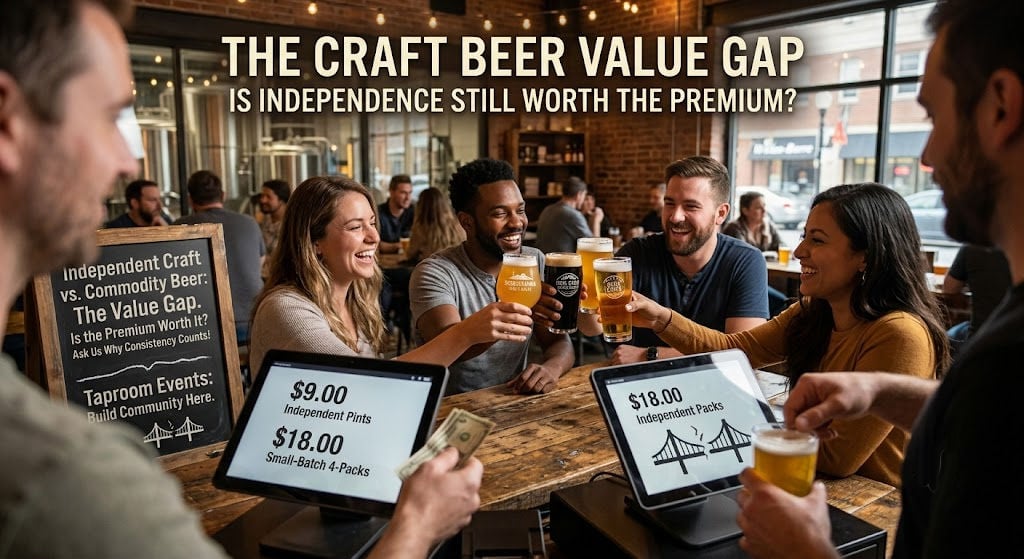
The Craft Beer Value Gap: Is Independence Still Worth the Premium?
 Story by:
Bil Corcoran
Story by:
Bil Corcoran
Table of Contents
- Introduction: The Pricing Paradox
- The Anatomy of the Value Gap
- The Erosion of “Specialness”
- What Still Commands a Premium?
- Defining Value in 2026
- The Path Forward: Closing the Gap
- Conclusion: Earning the Price Tag
- Frequently Asked Questions
Quick Facts: The 2026 Market Landscape
| Metric | Status | Trend/Impact |
| Market Saturation | Peak | Price sensitivity is at an all-time high. |
| Consumer Priority | Reliability | “Consistency” beats “constant variety.” |
| Primary Value Driver | Taproom Experience | Physical connection justifies the markup. |
| Independence Status | Decoupled | Consumers no longer pay for “Indie” alone. |
Section I: Introduction
Walk into any high-end bottle shop in 2026, and you are greeted by a dizzying, colorful wall of options. A decade ago, this wall represented the pinnacle of consumer choice. Today, for many, it represents the “Paradox of Choice”, a state of decision paralysis amplified by a harsh, cold reality: the price tag. As inflation, labor costs, and raw ingredient expenses have climbed, the retail price of a four-pack of independent craft beer has pushed into luxury territory. Meanwhile, global macro-brands and regional stalwarts have mastered the art of “craft-adjacent” quality at a significantly lower price point.
We are currently witnessing a profound widening of the “Value Gap.” For years, the seal of the Independent Brewers Association was a sufficient signal to command a premium; the inherent value was assumed simply because the beer was small-batch and locally owned. That assumption has shattered. In the current market, the premium is no longer a birthright of the independent sector, it is a hurdle that must be cleared.
The core of this issue is not that consumers have lost their taste for quality, but that they have lost their appetite for paying for “story” when the liquid in the glass, or the experience behind the purchase, doesn’t fundamentally distinguish itself from cheaper, high-quality alternatives. If the independent craft beer movement is to survive this correction, it must move past the defensive posture of simply asking for more money. It must reclaim its value proposition by proving that its independence is not just a label, but a catalyst for superior quality, deeper community connection, and a tangible experience that a commodity product simply cannot replicate. Independence is still worth the premium, but the premium is no longer guaranteed; it must be rigorously earned.
Section II: The Anatomy of the Value Gap
To understand why the “craft premium” is currently failing to resonate with a broad swathe of the market, we must first dissect the economic and behavioral shift that has occurred over the last few years. The value gap is not merely a reflection of increased operational costs; it is the result of a fundamental disconnect between the producer’s pricing model and the consumer’s current economic reality.
The Death of the “Automatic Price Hike”
Throughout the 2010s and early 2020s, the craft beer industry operated under a predictable, albeit aggressive, inflationary pricing model. As demand for craft surged, breweries grew accustomed to passing incremental cost increases directly to the consumer. Because craft beer was viewed as an affordable luxury, this strategy went largely unchallenged.
However, we have reached an inflection point. In 2026, the cumulative effect of those annual price adjustments has pushed premium four-packs into a psychological “danger zone.” When the price of an independent IPA approaches the cost of a premium spirit or a bottle of decent wine, the consumer’s internal rubric for “value” changes. The automatic pass-through of costs is no longer viable in a market where consumers have become hyper-aware of their discretionary spending.
The Commoditization of Niche
The primary culprit behind the erosion of this pricing power is market saturation. With over 9,500 breweries in the United States, the “craft” label has transitioned from a mark of exclusivity to a generic descriptor. When every grocery store shelf is overflowing with local options, the sheer volume of supply has commoditized the category.
Independence, once a powerful badge of honor, now struggles to differentiate products in a crowded field. When a consumer faces a wall of fifty different IPAs, the independent seal on the can is often invisible against the noise of eye-catching labels and aggressive price-point competition from large-scale “craft-style” brands. The “value” has been diluted by the ubiquity of the category itself.
The Friction of Comparison
The gap is most visible at the register, where a customer performs a split-second, binary calculation: Is this $8 pint worth three times the price of a standard macro lager?
Historically, the answer was a reflexive “yes” based on brand loyalty or the desire to support local business. Today, that decision is increasingly pragmatic. If the independent brewery fails to provide a compelling reason for the markup, whether through superior flavor stability, a unique brand narrative, or the promise of a superior taproom experience, the consumer opts for the cheaper alternative.
This friction point is where the “Value Gap” lives. It is the distance between what breweries need to charge to remain solvent in a high-cost environment and what the average consumer is willing to pay for a product that increasingly feels like a commodity. Closing this gap requires breweries to stop viewing price as a function of their internal P&L (Profit & Loss) statements and start viewing it as a component of the total value proposition they offer their customers.
Section III: The Erosion of “Specialness”
The industry’s struggle to maintain a premium price is inextricably linked to how it managed, or mismanaged, the concept of “specialness” over the past decade. For the craft beer boom to sustain itself, breweries relied on the “event” model: rare releases, limited-run collaborations, and seasonal hype. However, in the race to keep shelves stocked and social media feeds buzzing, many brewers inadvertently traded their “specialness” for a state of constant, exhausting variety.
The Commodity Trap: Innovation as Fatigue
The industry spent years trapped in an arms race of novelty. Every new ingredient, from adjunct-heavy pastry stouts to hyper-experimental fruit combinations, was marketed as an essential “new release.” While this initially drove excitement, it eventually created a “commodity trap.” When consumers are trained to expect a new product every week, they lose the ability to appreciate the craftsmanship behind a core, consistent product.
When everything is a “limited release,” nothing is truly limited. The constant churn of SKUs effectively commoditized the entire category; breweries were no longer building brands, they were running manufacturing cycles of fleeting fads. This rapid cycle desensitized the consumer to the “craft premium,” as the value of a single can dropped the moment the next “must-have” release hit the shelf.
The “Hazy IPA” Paradox
The rise of the Hazy IPA serves as the perfect case study for the erosion of premium status. Once a sought-after, regional phenomenon that could command long lines at a brewery, the style became the industry’s standard bearer. Because it was so profitable and popular, every brewery, from the smallest neighborhood garage to the largest regional powerhouse, began producing it.
When a style reaches this level of ubiquity, it loses its “event” status. It ceases to be a specialized product that justifies a premium price and instead becomes a table-stakes commodity. Consumers began to compare these beers not against other premium experiences, but against every other generic version on the shelf. The magic of the “craft” experience evaporated, replaced by the mundane reality of a grocery store beer run.
Portfolio Bloat and the Death of Identity
Perhaps the most damaging strategy of the last several years has been “portfolio bloat.” In a desperate attempt to catch every consumer trend, breweries expanded their catalogs to absurd lengths. A brewery with a flagship lineup that was once recognizable for quality and precision suddenly found itself trying to maintain a dozen or more rotating taps.
This expansion had two catastrophic effects on value. First, it diluted the brand. When a brewery is known for “everything,” they are ultimately known for nothing. The brand identity becomes a blur, making it impossible to communicate why their specific liquid is worth the premium over the competitor next door. Second, it compromised quality. Maintaining consistency across a vast, rotating array of experimental brews is technically difficult and expensive. When the product fails to deliver a perfect, consistent experience every time, the consumer’s willingness to pay a premium vanishes.
Training the Consumer to Devalue
By focusing on the “new” rather than the “excellent,” the craft industry inadvertently taught the consumer that beer is a short-lived experience. If a product is not meant to be remembered, why should it be valued at a premium price?
The industry effectively shifted the consumer’s focus away from the artistry, the stable, long-term mastery of process, and toward the spectacle. In 2026, the market is correcting for this. The “specialness” that once defined craft beer can no longer be summoned by a clever label or a new ingredient list. It must be rooted in a reputation for excellence that spans years, not weeks. The breweries that are struggling are those still clinging to the belief that the next “new thing” will restore their pricing power, while those succeeding are those that have pruned their portfolios, rediscovered their identity, and reminded the consumer why their specific craft is worth the cost.
Section IV: What Still Commands a Premium?
In 2026, the marketplace has decisively rejected the notion that independence alone warrants a higher price point. However, the premium has not vanished; it has simply migrated. It is no longer found in the mere existence of a “craft” label, but in the delivery of a superior, reliable, and multi-dimensional experience. The breweries that successfully command a premium today are those that have stopped competing on the “arms race” of constant novelty and have instead pivoted toward three core pillars: the “Third Space” experience, the discipline of the flagship, and technical precision.
The “Third Space” Advantage
As the novelty of the “tasting room” has faded, the most resilient breweries have transformed their physical locations into essential social infrastructure. In a world where digital isolation is common, these breweries function as a “third space”, that vital environment between home and work.
These high-performing venues treat hospitality as a core competency rather than an afterthought. They understand that a customer isn’t paying a premium just for a pint; they are paying for the atmosphere, the acoustics, the comfort, and the sense of community. By integrating service, thoughtful design, and a calendar of “uncomplicated rituals”—such as watch parties, trivia, or community-focused pop-ups, these breweries create a destination that justifies the price of a visit. When a brewery effectively positions itself as a sanctuary, the beer becomes a component of a larger, positive memory. In this context, the premium is not an annoyance; it is the price of admission to a space that improves the consumer’s day.
The Power of Flagships and Consistency
The era of the “rotating-everything” brewery is, for many, a relic of the past. Today, the most successful brands have rediscovered the power of the flagship. Consistency is the ultimate luxury. When a consumer walks into a store or a bar, they are often performing a mental calculation of risk versus reward. A well-known, high-quality flagship reduces that risk.
Breweries that have trimmed their portfolios to focus on a few perfectly executed, core styles—often leaning into approachable, sessionable options like crisp lagers or balanced pale ales—have regained their pricing power. By narrowing their focus, these breweries not only achieve operational efficiencies but also build a distinct brand identity that consumers can actually remember. A flagship provides a “north star” for the brand, giving the consumer a reliable reason to return and a tangible product to advocate for.
Quality as the Ultimate Differentiator
In a saturated market, technical precision has become the new hallmark of craft. As drinkers become more discerning, “good enough” is no longer good enough to command a premium. The breweries currently winning are those that have invested heavily in quality control, filtration, and flavor stability.
This isn’t about chasing the next trend; it’s about mastering the classics to a degree that a macro-competitor cannot match. When a brewery delivers a beer that tastes exactly as it did the last time, clean, expressive, and technically flawless, they build an unbreakable trust with their customer. In 2026, quality is not just a brewing requirement; it is a sophisticated marketing tool. It signals to the consumer that the brewery respects their palate and their wallet. By delivering a consistently superior product, these breweries transform the “craft premium” from an arbitrary markup into a value-based investment that the customer is happy to make.
Ultimately, the breweries that command a premium today have stopped trying to sell beer and started selling reliability and place. They have recognized that in a world of endless, cheap options, the only way to earn a premium is to be the best, or the most essential, part of the consumer’s week.
Section V: Defining Value in 2026
If the previous decade was defined by “hype,” 2026 is defined by “intentional consumption.” As the economic climate has tightened, the definition of value has shifted from the superficial appeal of a trendy label to a pragmatic, multi-faceted assessment of worth. For the modern drinker, the decision to pay $18 for a four-pack or $9 for a pint is no longer a knee-jerk support of “local,” but a conscious decision based on where the product fits into their life.
Price vs. Worth: The Pragmatic Shift
Consumers are more price-sensitive than ever, but they are not necessarily “cheap.” There is a vital distinction between price and worth. Price is a number; worth is the benefit received relative to that cost. In 2026, the “Value Gap” exists wherever the benefit fails to scale with the price.
Independent breweries are realizing that they cannot compete with macro-brands on price, so they must compete on relevance. A consumer will happily pay a premium for a beer that enhances a specific “occasion.” Whether it is a refreshing, high-quality lager for a backyard social or a complex, barrel-aged stout for a quiet evening of reflection, the value is tied to how well the product serves the moment. Breweries that fail to market their beers as “tools for the occasion” find themselves stranded in the middle ground, where they are too expensive to be a casual everyday beer and not special enough to be a treat.
Alignment with Occasion
The most successful brands have begun segmenting their lineups not just by style, but by utility. This means acknowledging that a consumer’s “beer budget” is not a monolith. The same drinker who buys a thirty-rack of inexpensive lager for a casual beach weekend is the same person who will willingly drop $25 on a single bottle of local wild ale for a dinner party.
The mistake many breweries made was attempting to make every product perform both roles. By forcing their entire portfolio into a high-price-point, “premium” bucket, they alienated the consumer who needed an everyday option. The breweries winning in 2026 are those that offer a clear “value ladder”, entry-level beers that are priced competitively and high-end offerings that lean into the luxury experience.
The Rise of the “Mindful” Consumer
Finally, the definition of value in 2026 is increasingly filtered through the lens of personal health and transparency. The modern drinker is more informed than ever about ingredients, calorie counts, and ABV. “Value” now includes the peace of mind that comes from knowing exactly what is in the glass.
Transparent labeling, lower-ABV options, and an emphasis on clean, high-quality ingredients are now value-adds. The “craft premium” is increasingly being paid for the health-conscious consumer who views beer as part of a mindful lifestyle rather than a vehicle for excess. When a brewery positions itself as a partner in that lifestyle, offering clarity, consistency, and a lighter touch, the price tag becomes secondary to the benefit. In this new landscape, value is earned by respecting the consumer’s desire for quality, balance, and honesty.
Section VI: The Path Forward: Closing the Gap
The “Value Gap” is not a terminal diagnosis for independent craft beer; rather, it is a necessary market correction that demands a shift in operational philosophy. To bridge the divide between cost and perception, breweries must move away from the unsustainable “growth at all costs” mentality and embrace a strategy of disciplined intentionality.
Operational Efficiency as a Virtue
The industry’s historical reliance on aggressive annual price hikes to cover inefficiencies is no longer a viable strategy. In 2026, the path to value begins on the production floor. Breweries must prioritize lean, scalable operations that focus on yield, consistency, and supply chain stability. By optimizing production cycles and reducing the overhead associated with maintaining bloated, experimental portfolios, breweries can stabilize their margins without consistently pushing the price burden onto the consumer. Efficiency is not just a financial necessity; it is a prerequisite for maintaining a price point that stays within the “consideration zone” of the modern, budget-conscious drinker.
Reclaiming the Narrative of Independence
“Independent” is a status, but it is not a benefit in itself. To justify a premium, the label must be tethered to tangible value. Consumers are increasingly asking: What does my support of this local brewery actually do for me or my community?
Breweries must pivot their marketing from abstract claims of “craft” to concrete demonstrations of impact. This means highlighting local sourcing, sustainable brewing practices, and the direct role the brewery plays as a community hub. When independence is linked to a visible, positive ripple effect in the immediate neighborhood, the premium is no longer seen as a surcharge, it is viewed as an investment in the local economy and social fabric.
The Strategic Pivot: Reliability Over Novelty
Perhaps the most critical shift is the move away from the “arms race” of constant innovation. Breweries should stop competing to see who can produce the most radical ingredient combination and start competing to be the most reliable, high-quality producer in their market.
The industry must pivot toward the “Reliability Model.” In a world of chaos and uncertainty, a consumer wants to know that their favorite pint will be just as crisp, balanced, and fresh as it was the last time they purchased it. By reclaiming the focus on core styles and technical perfection, breweries can rebuild the trust that was lost during the era of portfolio bloat. When a brewery becomes a reliable constant in a customer’s life, they have effectively closed the value gap, ot by lowering their price, but by making their value undeniable.
Section VII: Conclusion
The “Value Gap” is not a death knell for the independent craft beer movement; it is a necessary, albeit painful, maturation. For years, the industry thrived on the assumption that the “independent” label carried an intrinsic, bulletproof premium. That era has officially concluded.
In 2026, the market is governed by a more discerning, pragmatically minded consumer. Independence remains a noble and important pursuit, but it no longer guarantees market dominance. To survive and thrive, breweries must abandon the frantic search for “the next new thing” and return to the foundational virtues of the craft: technical consistency, genuine hospitality, and an unwavering commitment to the community.
The premium is not a birthright; it is a promise. It is the assurance that when a customer chooses an independent pint, they are receiving an experience, whether in quality or atmosphere, that is fundamentally better than the commodity alternative. Those who bridge this gap by focusing on reliability and true connection will find that their customers are more than willing to pay for the privilege. For the rest, the market has sent a clear message: evolve or become obsolete.
Frequently Asked Questions (FAQ)
Q: Is “Independence” still a selling point for beer drinkers? A: Yes, but only when paired with quality. Consumers still value local ownership, but they are no longer willing to pay a “premium price for a sub-par pint” just to support a label.
Q: How can a small brewery compete with macro-brand pricing? A: By focusing on the “Third Space” experience. Macro-brands sell volume; independent breweries sell community, atmosphere, and a destination that cannot be replicated in a grocery store aisle.
Q: Why does “consistent quality” matter more than “innovation” now? A: The market is saturated with experimental, one-off brews. In 2026, a perfectly executed, consistent flagship beer provides the reliability that modern consumers crave in an unpredictable world.
Q: Should I cut my prices to close the value gap? A: Not necessarily. Cutting prices often hurts margins without increasing volume. The better strategy is to justify your current price through better service, product reliability, and a tighter, more focused portfolio.
zzubreebym


Comments 0
No Readers' Pick yet.