



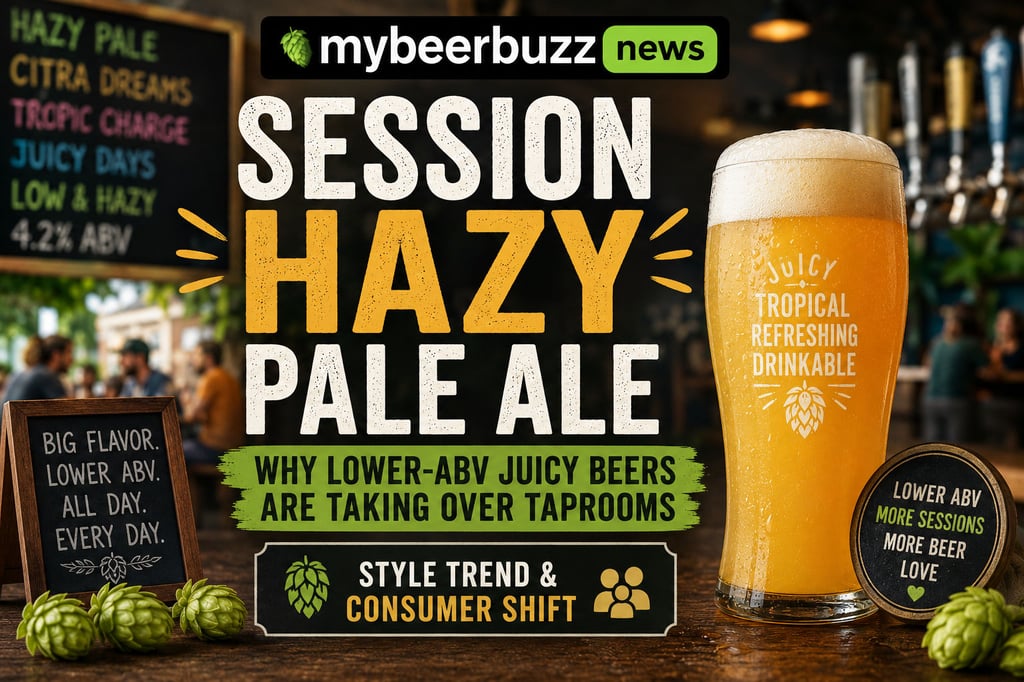
Session Hazy Pale Ale: Why Lower-ABV Juicy Beers Are Taking Over Taprooms” (Style Trend & Consumer Shift)
 Story by:
Bil Corcoran
Table of Contents – Session Hazy Pale Ale
- Introduction: The Rise of the Sessionable Juice Bomb
- Quick Facts Table: Session Hazy Pale Ale vs. Double IPA
- What Is a Session Hazy Pale Ale?
- Brewing Science: Maintaining Mouthfeel at Lower ABV
- The Hop Profile: Tropical Aromas Without the Harsh Bitterness
- Consumer Shift: Why Drinkers Are Choosing Sessionability
- Culinary Pairings: Matching Juicy Hops with Food
- Commercial Benchmarks and How to Find Them
- Conclusion: The Future of Your Fridge
- Reader Discussion & Comments
- Frequently Asked Questions (FAQ)
1. Introduction: The Rise of the Sessionable Juice Bomb
The craft beer landscape is undergoing a massive structural shift. For years, the industry was locked in a race to see who could pack the most hops, the most sugar, and the highest alcohol by volume into a single can of Hazy Double IPA. While those heavy-hitters defined a generation of craft exploration, they left many drinkers experiencing severe palate fatigue. Today, a new champion has emerged to reclaim the taproom: the session hazy pale ale.
This style represents the perfect synthesis of modern “juicy” hop aromatics and classic, crushable drinkability. By dialing back the alcohol content, brewers have unlocked a beer that keeps the tropical punch intact while allowing the consumer to enjoy more than just a single glass. Whether you are a fan of Citra-forward aromatics or Mosaic-heavy fruit bombs, understanding the session hazy pale ale is the key to navigating the modern craft aisle.
2. Quick Facts Table: Session Hazy Pale Ale vs. Double IPA
For readers looking for an immediate technical breakdown, the comparison matrix below outlines the key parameters of a session hazy pale ale versus a traditional double IPA:
| Feature | Session Hazy Pale Ale | Hazy Double IPA |
| Typical ABV | 4.0% – 5.5% | 7.5% – 9.0%+ |
| Mouthfeel | Light to medium, soft | Full, creamy, viscous |
| Bitterness (IBUs) | Very Low (15–25) | Moderate (40–60) |
| Focus | Drinkability & refreshment | Intensity & complexity |
| Occasion | All-day, social, lunch/hike | Nightcap, slow-sipping |
3. What Is a Session Hazy Pale Ale?
At its core, a session hazy pale ale is a beer designed for maximum flavor and minimum ABV. It utilizes the same hazy brewing techniques—heavily flaked oats, unmalted wheat, and expressive yeast strains—that define the New England IPA (NEIPA) style.
However, the brewer stops the fermentation at a lower alcohol threshold, resulting in a beer that remains opaque, soft, and vibrant without the heavy “burn” or saturation of a higher-ABV counterpart. It bridges the gap between light macro lagers and heavy-duty craft IPAs, giving drinkers the best of both worlds.
4. Brewing Science: Maintaining Mouthfeel at Lower ABV
The biggest challenge for brewers crafting a session hazy pale ale is maintaining the signature “pillowy” mouthfeel without the heavy body normally provided by high alcohol content. If a beer is low in alcohol and low in body, it can quickly taste watery or thin.
To achieve a velvety texture, brewers utilize high proportions of flaked oats and malted or unmalted wheat, which increase protein content and starch complexity, creating a smooth, creamy sensation on the tongue. By carefully controlling the mash temperature, brewers ensure a touch of residual sugar remains, providing enough structural backbone to carry massive tropical hop loads without feeling heavy.
5. The Hop Profile: Tropical Aromas Without the Harsh Bitterness
In a session hazy pale ale, hop additions are heavily concentrated in the whirlpool and late-stage dry-hopping phases. Because the alcohol level is lower, the hops have to work harder to shine through without the backing of strong ethanol warmth.
Brewers lean into high-intensity tropical varieties like Citra, Mosaic, El Dorado, and Galaxy. These specific hops provide vibrant notes of mango, pineapple, papaya, and stone fruit, ensuring that despite the lighter body, the sensory and aromatic experience remains just as intense as any heavy IPA.
6. Consumer Shift: Why Drinkers Are Choosing Sessionability
The move toward lower-ABV beers is not just a passing trend; it is a fundamental lifestyle evolution. Modern craft enthusiasts are increasingly conscious of their physical intake, balancing their love for complex flavor profiles with their desire to remain active, clear-headed, and functional.
A session hazy pale ale allows the social ritual of enjoying a craft beer to continue during long afternoons, post-hike gatherings, or casual mid-week meals without the debilitating impact of an 8% ABV hazy double IPA.
7. Culinary Pairings: Matching Juicy Hops with Food
Because these beers are citrus-forward and carry a soft, creamy body, they pair beautifully with a wide range of casual cuisines. Try pairing a session hazy pale ale with:
- Spicy Tacos: The tropical sweetness of the hops tempers the heat of habanero or jalapeño salsas.
- Grilled Seafood: The bright citrus notes mirror the zest used on grilled shrimp or white fish.
- Casual Sandwiches: A classic chicken salad or a turkey club finds its ideal match in the refreshing, fruity lift of a sessionable hazy.
8. Commercial Benchmarks and How to Find Them
Many of the most respected craft breweries now feature a permanent session hazy pale ale in their core lineup. When shopping, look for beers marketed as “Pale Ale,” “Session IPA,” or “Table Hazy.”
When reading labels, check the ABV; the sweet spot for this style is consistently between 4.5% and 5.2%. Because these beers rely heavily on delicate, fresh hop aromatics, they are designed to be consumed fresh—always check the canning date to ensure you are getting the full, vibrant experience.
9. Conclusion: The Future of Your Fridge
The era of the “bigger is better” beer arms race is fading, replaced by an appreciation for technical precision and sessionable quality. The session hazy pale ale is the ultimate expression of this craft maturity, delivering everything we love about the juicy hazy craze while respecting our need for balance and drinkability. Next time you are staring at a crowded fridge, look for these lower-ABV gems; your palate will thank you.
10. Reader Discussion & Comments
We want to hear from our community of craft beer enthusiasts!
- Have you started swapping your heavy 8% IPAs for sessionable hazy pale ales during long gatherings?
- What is your favorite commercial example of a sessionable juicy beer on the market right now?
- Do you notice a difference in quality when a brewer scales down a double IPA recipe into a session version?
Let us know what YOU think in the comments below!
11. Frequently Asked Questions (FAQ)
Is a session hazy pale ale the same thing as a session IPA?
Technically, they are very similar, as both aim for lower ABV and high drinkability. However, a “Session Hazy Pale Ale” specifically emphasizes the hazy appearance and soft mouthfeel achieved through wheat and oats, whereas some traditional “Session IPAs” may be clearer, lighter-bodied, and slightly more bitter.
How does the calorie count compare to double IPAs?
Because they have a significantly lower alcohol content, session hazy pale ales are generally much lower in calories than their Double IPA counterparts, making them a popular choice for health-conscious craft drinkers.
Why do some session hazy beers still taste “thin”?
Maintaining body in a low-ABV beer is a major technical challenge. If a session hazy tastes thin, the brewer may have missed the mark on mash temperature control or cereal adjunct ratios (oats and wheat), which are essential for creating that signature “juicy” mouthfeel.
zzubreebym



Comments 0
No Readers' Pick yet.