





Beyond the Buzz: How the Non-Alcoholic Craft Movement is Reshaping Taproom Economics and Brewery Valuations
 Story by:
Bil Corcoran
Story by:
Bil Corcoran
Table of Contents
- Introduction & Executive Summary: The Structural Pivot to Non-Alcoholic Craft (400 words)
- The Economics of the Sober-Curious Consumer: Margin Expansion and Dwell-Time Realities (450 words)
- Overcoming Technical Hurdles: Dealcoholization Tech vs. Specialised Brewing Methods (450 words)
- Taproom Integration and Food Service Synergy: Capturing the Designated Driver Market (400 words)
- Supply Chain, Distribution, and Retail Shelf-Space Optimization: Navigating the New Normal (400 words)
- Valuation Impact and M&A Activity: Why Investors Are Betting on Craft NA Brands (400 words)
- Implementation Roadmap for Independent Foundries: Launching Your First NA Line (400 words)
- Frequently Asked Questions (FAQ)
Key Points & Quick Reference Table
| Core Metric / Area | Key Industry Insight | Strategic Takeaway for Craft Brewers |
| Market Growth | Global non-alcoholic beer market size valued at over $24 billion, scaling rapidly toward a projected $38B–$50B milestone. | Represents the fastest-growing sub-segment in the beverage industry, offering crucial volume offsets for stagnant traditional beer sales. |
| Consumer Demographics | Gen Z and millennial consumers are driving a structural shift, with younger demographics drinking significantly less alcohol per capita. | Shifting from a niche novelty to a default lifestyle choice; non-alcoholic options attract a younger, highly loyal customer base. |
| Taproom Economics | High-end craft NA options extend consumer dwell times and increase per-capita spending without cannibalizing standard beer sales. | On-premise sales of premium functional and craft non-alcoholic beverages deliver exceptional profit margins per seat. |
| Production Innovation | Advanced vacuum distillation, reverse osmosis, and arrested fermentation techniques eliminate historical taste gaps. | Eliminating watery, uninspired flavor profiles allows craft producers to command premium price points comparable to traditional styles. |
| Valuation & M&A | Private equity and major beverage conglomerates are aggressively acquiring independent craft NA innovators to capture growth. | Integrating a robust non-alcoholic portfolio directly enhances overall company valuation metrics and exit attractiveness. |
1. Introduction: The Structural Pivot to Non-Alcoholic Craft
The global beverage landscape is experiencing a fundamental, permanent shift away from high-alcohol volume toward health-conscious, mindful consumption. No longer a temporary fad or an afterthought for designated drivers, the non-alcoholic (NA) craft beer movement has evolved into a multi-billion-dollar economic engine. Market data indicates that the global non-alcoholic beer sector has surged past $24 billion, with aggressive compound annual growth rates pushing toward a projected valuation of nearly $40 billion to $50 billion over the next decade. For independent craft breweries grappling with saturated retail shelves, rising input costs, and shifting consumer habits, embracing the non-alcoholic category is no longer optional—it is a vital operational survival strategy.
Driving this transformation is a generational shift in consumer behavior. Younger demographics, particularly Gen Z and younger millennials, are consuming less alcohol per capita than previous generations did at the same stage of life. Influenced by a pervasive wellness culture, increased mental health awareness, and social media accountability, these consumers frequently engage in “zebra-striping”—alternating between alcoholic and non-alcoholic beverages during social outings. For independent craft breweries, failing to cater to this audience means abandoning valuable taproom traffic and wholesale volume.
However, entering the non-alcoholic space requires overcoming historical obstacles. Early iterations of non-alcoholic beer suffered from severe taste and body deficits, as traditional dealcoholization methods stripped away essential aromatic compounds and mouthfeel. Today, sophisticated brewing techniques, specialized yeast strains, and advanced vacuum distillation have bridged the quality gap, allowing craft producers to release hazy IPAs, rich stouts, and crisp lagers that rival their alcoholic counterparts.
This comprehensive guide explores how independent craft breweries can successfully leverage the non-alcoholic movement. By examining taproom economics, production methodologies, retail integration, and the impact of NA portfolios on long-term business valuations, this article provides the strategic framework needed to capture high-margin growth and build digital authority that attracts valuable backlinks from industry trade journalists and beverage analysts.
2. The Economics of the Sober-Curious Consumer: Margin Expansion and Dwell-Time Realities
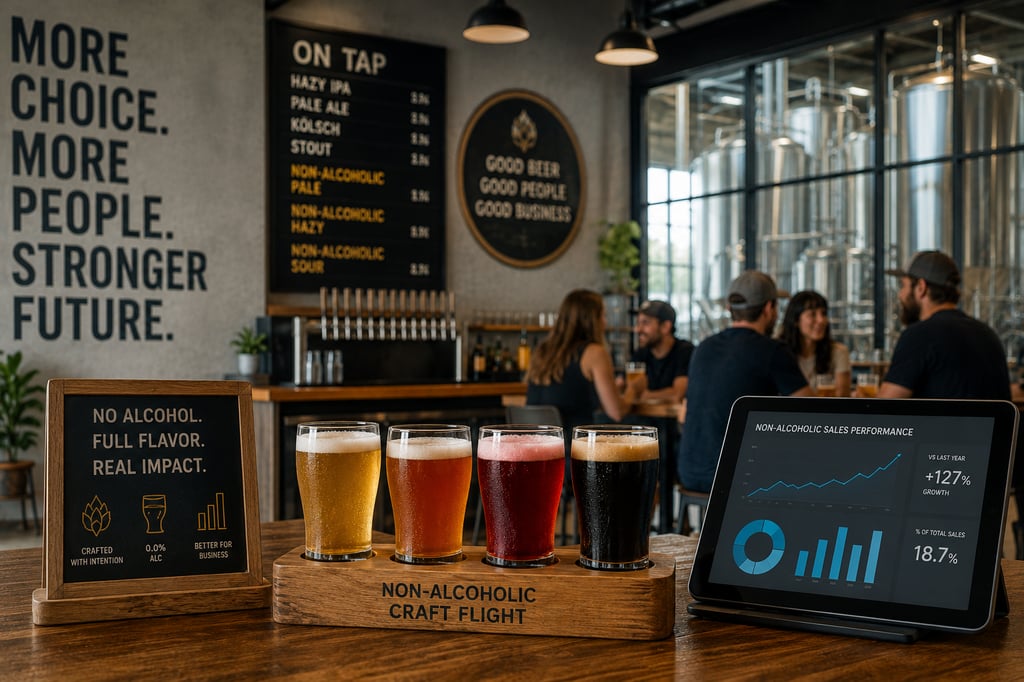
The rapid acceleration of the sober-curious movement has fundamentally transformed non-alcoholic (NA) options from a peripheral menu listing into a primary engine for taproom growth and operational profitability. With global non-alcoholic beer market valuations continuing their steep climb past $24 billion to $26 billion, consumer demographics are shifting permanently. Younger demographics, including Gen Z and health-conscious millennials, are actively reducing their alcohol consumption without abandoning social spaces or community hubs. For independent craft breweries, this cultural shift presents an immense financial opportunity. When groups visit a taproom, the inclusion of premium, flavorful non-alcoholic craft styles ensures that designated drivers, wellness-focused patrons, and moderating drinkers stay longer instead of cutting their visits short.
This extended dwell time directly correlates with higher per-capita spending on food, merchandise, and secondary rounds of beverages, driving overall taproom profitability upward. In traditional hospitality models, a customer who abstends from alcohol often transitions to water or low-margin sodas, effectively capping their spending contribution per seat. By contrast, a $7 or $8 craft non-alcoholic IPA commands a price point comparable to its alcoholic counterpart. Because the production of quality NA craft requires high consumer perceived value, breweries capture exceptional profit margins per seat while successfully catering to patrons who prioritize clarity, health, and moderation.
Furthermore, integrating robust non-alcoholic options safeguards independent breweries against shifting retail dynamics and changing consumer habits. Data consistently shows that offering stellar NA choices does not cannibalize traditional high-ABV sales; rather, it expands the total addressable market by welcoming new consumer segments into the fold. Groups of friends that include non-drinkers no longer need to compromise or choose alternative venues. Instead, they choose taprooms that cater comprehensively to every member of the party.
For independent craft breweries seeking to maximize revenue during peak operating hours, optimizing the taproom menu for the sober-curious consumer is a high-yield strategy. By capitalizing on extended dwell times, higher per-seat transaction values, and capturing previously lost foot traffic, breweries can protect their margins against rising operational costs and establish a resilient business model built for long-term survival in an evolving beverage economy.
3. Overcoming Technical Hurdles: Dealcoholization Tech vs. Specialised Brewing Methods
Historically, producing non-alcoholic beer meant compromising heavily on flavor, body, and mouthfeel. Early commercial iterations relied on rudimentary boiling or basic filtration techniques that stripped away essential volatile aromatics, leaving behind a thin, wort-heavy beverage that failed to satisfy craft beer enthusiasts. However, modern brewing technology and advanced process engineering have closed this quality gap entirely. Independent craft producers now have access to sophisticated methodologies that preserve the complex aromatic profile, mouthfeel, and structural integrity expected of a premium craft brew. Choosing the right production pathway is one of the most critical technical and financial decisions a brewery will face when entering this booming market.
The first major approach is post-fermentation dealcoholization. This method involves brewing a traditional, fully fermented craft beer and subsequently removing the alcohol using advanced systems such as vacuum distillation (like falling film evaporators) or gentle reverse osmosis. Vacuum distillation operates under significantly lowered atmospheric pressure, drastically reducing the boiling point of ethanol. This allows alcohol to flash off at much lower temperatures, protecting delicate hop aromatics and preventing the cooked-wort flavors that historically plagued non-alcoholic beers. Alternatively, reverse osmosis utilizes high-pressure membrane filtration to separate alcohol and water from the flavor compounds, after which the water and essence are recombined while the alcohol is discarded. While these capital-intensive systems deliver an authentic, fully fermented flavor profile, the initial equipment investment can be prohibitive for smaller independent craft foundries.
To bypass the steep capital costs of industrial dealcoholization machinery, many craft breweries utilize specialized biological brewing methods. These techniques focus on controlling the fermentation process from the outset rather than removing alcohol post-brew. Brewers employ specialized, low-attenuation yeast strains—such as specific strains of Maccharomyces or maltose-negative yeasts—that consume only simple sugars while leaving complex dextrins intact, naturally halting alcohol production below the 0.5% ABV threshold. Other brewers manipulate mash temperatures and enzymatic rest schedules to limit fermentable sugars entirely. When paired with high-protein malts and adjuncts like oats or wheat, these specialized brewing methods build back the crucial body and mouthfeel typically lost without alcohol.
Ultimately, whether an independent brewery chooses to invest in vacuum distillation infrastructure or master specialized low-attenuation fermentation, overcoming technical hurdles is essential. By eliminating historical taste deficiencies and delivering exceptional quality, craft producers can command premium retail and on-premise price points, cementing their reputation as innovative leaders in the evolving beverage economy.
 4. Taproom Integration and Food Service Synergy: Capturing the Designated Driver Market
 4. Taproom Integration and Food Service Synergy: Capturing the Designated Driver Market
Integrating non-alcoholic offerings directly into the taproom environment creates a seamless, inclusive hospitality experience that modern consumers increasingly demand. Rather than alienating patrons who choose not to consume alcohol on a given night—whether due to designated driving responsibilities, health goals, or personal preference—craft taprooms that stock high-end, craft-brewed non-alcoholic options capture an entirely vital segment of foot traffic. When a group of friends selects a weekend destination, their choice is frequently dictated by the venue that accommodates everyone. By providing sophisticated non-alcoholic IPAs, sours, and stouts alongside traditional flagships, independent breweries ensure that every member of the party feels valued and included.
Furthermore, this inclusive approach creates a powerful synergy with in-house food programs and rotating food truck partnerships. When designated drivers and wellness-focused patrons are treated to complex, craft-quality beverages rather than basic sodas or water, their overall dining experience is elevated. This drives extended dwell times, encourages patrons to order additional rounds of food, and boosts overall per-table transaction values.
Operationally, integrating non-alcoholic drafts or packaged options into the main bar flow requires minimal structural changes but yields significant dividends. Taproom staff should be trained to merchandise and pitch these products with the same enthusiasm as high-ABV offerings, framing them as premium craft choices rather than mere substitutes. By transforming the taproom into an inclusive social hub, independent craft breweries maximize per-seat financial yields, capture previously lost evening and weekend revenue, and build deep community loyalty—all without cannibalizing traditional high-margin beer sales.
5. Supply Chain, Distribution, and Retail Shelf-Space Optimization: Navigating the New Normal
As wholesale distributor networks grow increasingly selective and retail floor space faces intense competition, navigating the supply chain for non-alcoholic craft beer requires a strategic, data-driven approach. Retailers, grocery chains, and convenience stores are actively reallocating lucrative shelf space to accommodate the explosive growth of non-alcoholic categories, recognizing that health-conscious shoppers treat functional beverages and craft NA brands as reliable household staples rather than seasonal novelties. For independent craft breweries, securing placement in these reset planograms is essential for long-term volume growth, but it requires aligning packaging formats, cold-chain logistics, and distributor conversations with shifting retail demands.
Unlike traditional high-ABV beers that can sometimes sit comfortably in ambient warehouse environments for extended periods, non-alcoholic craft products demand meticulous quality assurance throughout the supply chain. Because many craft NA formulations rely on delicate hop profiles and lower alcohol or unfermented matrices, they are inherently more vulnerable to microbial spoilage if pasteurization protocols or sterile filtration standards are compromised. Independent breweries must work closely with distribution partners to ensure proper cold-chain management from the cold room to the retail cooler. Maintaining pristine product integrity protects brand reputation and prevents costly retail recalls that can damage hard-earned shelf space.
Furthermore, packaging optimization plays a pivotal role in wholesale success. Retailers favor four-packs and six-packs of 12-ounce cans that fit seamlessly into established craft beer cooler configurations while signaling a premium price point. When pitching distributors, independent breweries should present clear sales velocity data, demographic trends, and merchandising strategies that demonstrate how adding their NA portfolio will maximize category revenue per square foot. By mastering supply chain logistics, ensuring rigorous quality control, and optimizing packaging for high-demand retail channels, independent craft foundries can secure prime shelf space and outmaneuver legacy competitors in the evolving beverage marketplace.
6. Valuation Impact and M&A Activity: Why Investors Are Betting on Craft NA Brands
The strategic pivot toward non-alcoholic innovation carries profound implications for long-term company valuations and merger-and-acquisition (M&A) activity within the beverage sector. Private equity firms, institutional investors, and major beverage conglomerates are closely monitoring high-growth independent non-alcoholic innovators—such as Athletic Brewing Company, which captured a significant share of the expanding market—and actively acquiring agile brands to capture future upside. In an era where traditional craft beer growth has plateaued, brands with a thriving non-alcoholic portfolio demonstrate exceptional resilience and growth potential, making them prime targets for strategic investment and corporate consolidation.
For independent craft breweries, valuation metrics are heavily dictated by revenue diversification, risk mitigation, and market adaptability. Breweries that rely entirely on high-ABV taproom sales or saturated wholesale beer lines face compressed multiples due to rising operational costs and shifting consumer demographics. Conversely, introducing a high-margin, scalable non-alcoholic product line signals to investors that the business is future-proofed against evolving health trends and regulatory pressures. This lower risk profile translates directly into stronger valuation multiples during funding rounds or eventual exit negotiations.
Furthermore, strategic acquirers are willing to pay a premium for brands that own proprietary brewing methods or established distribution footprints within the functional beverage space. Traditional alcohol giants recognize that building an authentic craft NA brand from scratch is exceedingly difficult given the specialized technical expertise required. Consequently, acquiring independent breweries with proven non-alcoholic recipes and dedicated consumer followings offers an accelerated path to capturing the lucrative wellness demographic.
Ultimately, integrating a robust non-alcoholic portfolio is no longer just a tactical move for short-term taproom revenue; it is a fundamental valuation driver. By positioning the business at the intersection of craft quality and mindful consumption, independent founders can significantly enhance their market attractiveness, secure crucial capital investment, and build a resilient enterprise poised for long-term financial success.
7. Implementation Roadmap for Independent Foundries: Launching Your First NA Line
Successfully launching a non-alcoholic craft line requires a structured, step-by-step operational roadmap designed to mitigate financial risk and ensure maximum product quality from conception to commercial release. Independent founders must first evaluate their production model, determining whether to invest in internal dealcoholization equipment, partner with specialized contract brewing facilities, or utilize specialized yeast strains that naturally cap alcohol production under 0.5% ABV. This initial production feasibility assessment prevents costly missteps and aligns capital expenditure with the brewery’s long-term operational scale.
Next, breweries must meticulously reformulate their water profiles, hop schedules, and mash parameters. Because alcohol acts as a primary flavor carrier and structural backbone, removing it causes a noticeable loss of body and mouthfeel. Brewers must adjust mash temperatures, incorporate high-protein malts and adjuncts like oats or wheat, and experiment with specialized boiling techniques to reconstruct the rich mouthprint and aromatic pop characteristic of traditional craft styles. Small-batch pilot runs are essential during this phase to dial in flavor stability, haze retention, and carbonation levels before scaling up to commercial volumes.
Finally, operators should roll out the new product through an exclusive taproom preview. Launching on draft within your own tasting room allows you to gather direct, real-time consumer feedback on taste, packaging aesthetics, and pricing acceptance. This controlled environment also gives taproom staff the opportunity to refine their sales pitches, ensuring they can effectively market the new NA option to wellness-focused patrons and designated drivers. Once consumer sentiment is validated, founders can confidently commit to full-scale packaging in four-packs and six-packs, establish rigorous cold-chain distribution logistics, and secure prime retail shelf space. By executing this comprehensive roadmap, independent craft breweries can successfully diversify their product line, capture high-margin growth, and future-proof their business in an increasingly competitive beverage market.
8. Frequently Asked Questions (FAQ)
1. How has the global non-alcoholic beer market grown in recent years?
The global non-alcoholic beer market has expanded rapidly, valued at over $24 billion to $26 billion and scaling toward projected valuations between $38 billion and $57 billion over the next decade, driven by rising health consciousness and wellness trends.
2. Does selling non-alcoholic beer cannibalize traditional craft beer sales in a taproom?
Data shows that non-alcoholic options rarely cannibalize standard sales; instead, they attract new customer segments, such as designated drivers and wellness-focused patrons, while extending overall customer dwell times and increasing total per-capita spend.
3. What technical methods do craft breweries use to make non-alcoholic beer?
Modern craft producers use advanced techniques including vacuum distillation, reverse osmosis, and specialized low-attenuation yeast strains that naturally prevent high alcohol creation while preserving authentic hop flavors and mouthfeel.
4. How does adding an NA line impact a craft brewery’s business valuation?
Diversifying into the high-growth non-alcoholic category signals operational adaptability and future-proofs the business against shifting consumer habits, making the brewery significantly more attractive to private equity investors and strategic acquirers.
5. What ABV threshold defines non-alcoholic and alcohol-free craft beer?
Products typically fall under the non-alcoholic umbrella if they contain 0.5% ABV or less, with strict alcohol-free variants sitting at 0.0% ABV to accommodate zero-tolerance lifestyle, religious, or medical requirements.
zzubreebym



Comments 0
No Readers' Pick yet.