





Penn Brewery Files for Bankruptcy as Pittsburgh Beer Community Reacts
 Story by:
Bil Corcoran
Story by:
Bil Corcoran
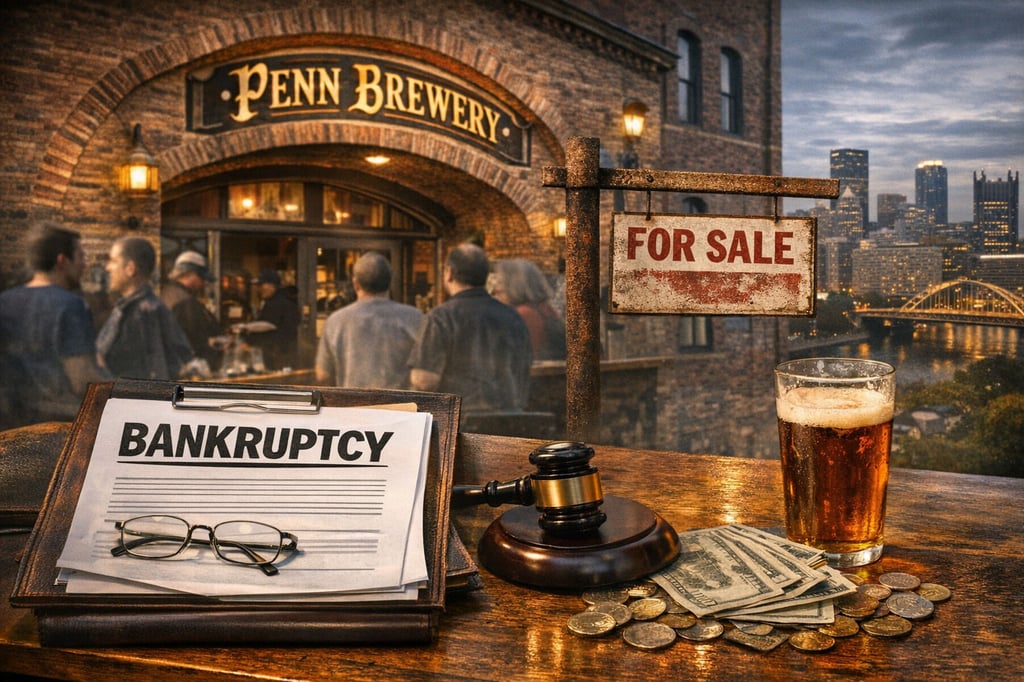
Penn Brewery, one of Pittsburgh’s most historic and recognizable craft breweries, has officially filed for bankruptcy, marking a major moment in the evolving landscape of Pennsylvania beer. Known for its traditional German‑style lagers, iconic North Side brewhouse, and decades‑long presence in the region, Penn Brewery’s bankruptcy filing has raised questions about the future of the brand, its taproom, and its distribution footprint across Pennsylvania and the Mid‑Atlantic.
According to early reports, the bankruptcy declaration stems from a combination of rising operational costs, post‑pandemic financial strain, and the increasingly competitive nature of the craft beer industry. Many breweries across the country have struggled with higher ingredient prices, increased labor costs, and shifting consumer preferences, factors that have hit legacy breweries especially hard. For Penn Brewery, which has long relied on its heritage identity and classic beer styles, the financial pressure appears to have reached a breaking point.
Founded in 1986, Penn Brewery helped pioneer the craft beer movement in Pennsylvania, producing award‑winning beers such as Penn Pilsner, Penn Dark, and St. Nikolaus Bock. Its historic brewhouse, located in the former E&O Brewery complex, became a cultural landmark and a cornerstone of Pittsburgh’s beer identity. The bankruptcy filing now places the future of that legacy in uncertain territory, prompting concern among longtime fans and local beer enthusiasts.
Industry analysts note that Penn Brewery’s situation reflects a broader trend: more established breweries are facing challenges as the market becomes saturated with new brands, rotating releases, and hyper‑local taproom models. While Penn Brewery maintained a strong regional presence, the shift toward taproom‑driven sales and constant innovation has made it harder for traditional breweries to compete.
At this stage, it remains unclear whether Penn Brewery plans to restructure, seek new ownership, or pursue a sale of assets. Bankruptcy does not necessarily mean closure, and many breweries have used the process to reorganize and emerge with a more sustainable business model. Still, the filing underscores the financial volatility facing even well‑known craft breweries in 2026.
As more details emerge, the Pittsburgh beer community will be watching closely. Penn Brewery’s legacy, its historic facility, and its lineup of classic German‑style beers remain deeply woven into the fabric of Pennsylvania brewing. Whether through restructuring or new investment, many hope this bankruptcy marks a turning point rather than an ending for one of the state’s most storied breweries.
About Penn Brewery:
Our Story
Penn Brewery began brewing craft beer back in 1986, making us one of the earliest pioneers in the American craft movement. We started out brewing classic lagers and German beer styles, adhering to the strict quality standards of the 16th-century Bavarian Reinheitsgebot purity laws. As we’ve expanded our lineup in recent years to include IPAs and other contemporary styles like chocolate and pumpkin beers, we’ve stayed true to our quality craftsmanship, brewing all of our beers by hand with top-tier barley and hops. We’re proud to say that Penn beers have won a total of twenty Great American Beer Festival® and World Beer Cup® medals.
Penn Brewery’s restaurant serves “ethnic-Pittsburgh” fare including wurst, schnitzel, pierogi, and goulash alongside contemporary Pittsburgh favorites, like the “French fry salad,” flatbreads, and sandwiches. In the spirit of our classic Pittsburgh theme, our menu emphasizes fresh, locally-sourced ingredients. A lovely cobblestone biergarten is open seasonally. Private party bookings are also available (Visit the Private Parties Page for more info).
You can also enjoy all of our beers, along with a full bar and breakfast, lunch, and dinner at our Pittsburgh International Airport location.
Penn Brewery is also the city’s biker-friendly brewery, and a proud Bike Pittsburgh business member! Our location is a great starting and stopping point for rides along the river trails, which are easily accessible via the adjacent pedestrian bridge over Route 28. We’ll be happy to fill your water bottle for free, and we keep a tire pump, patch kit and tools available for quick minor repairs in case of a breakdown.
Penn Brewery is proudly independently owned and operated.
Brewing Craft Before It Was Cool
Although the modern-day Penn Brewery was started in 1986, our roots actually lie far back in 1848, with the Eberhardt and Ober families, Germans who settled in the Deutschtown neighborhood in the City of Allegheny, now Pittsburgh’s NorthSide. Three breweries originally operated on the site where Penn Brewery exists today, and these underwent various mergers, acquisitions, and restructurings over the second half of the nineteenth century. Three of the buildings from the era of the Eberhardts and Obers remain as part of the present-day Penn Brewery complex. These buildings are listed on the National Register of Historic Places and boast many unique architectural features. Perhaps the most notable of these is a labyrinth of stone caves and tunnels which was constructed to chill, or “lager,” barrels of beer in the days before refrigeration became commonplace. Penn is one of just a handful of remaining US breweries that still has lagering caves.
The E&O and the Ober Bros. Breweries brewed beer at this location for several decades and eventually merged with a number of other regional breweries to become part of Pittsburgh Brewing Company in 1899. Beer production continued – with a break during Prohibition – until 1952, under such labels as E&O Pilsner and Dutch Club.
Today’s Penn Brewery beer brand was born in 1986, when the flagship Penn Pilsner variety was contract manufactured, first at Pittsburgh Brewing, and later at Jones Brewing Co. Penn opened its own brewing operation at the E&O site beginning in 1989, in the historic buildings that had been restored with the assistance of the North Side Civic Development Corporation. The restaurant also opened in 1989 as Allegheny Brewery & Pub and was renamed Penn Brewery in 1994. Notably, Penn Brewery was the first “tied house,” i.e., restaurant tied to a brewery, in Pennsylvania since Prohibition.
In addition to being the oldest and largest brewery in Pittsburgh, Penn is also one of the oldest craft breweries in the country. We’re more than just a brewery – we’re a piece of beer history.
zzubreebym





Comments 0
No Readers' Pick yet.