





Allagash Working On Coolship Camerise Bottles
 Story by:
Bil Corcoran
Story by:
Bil Corcoran
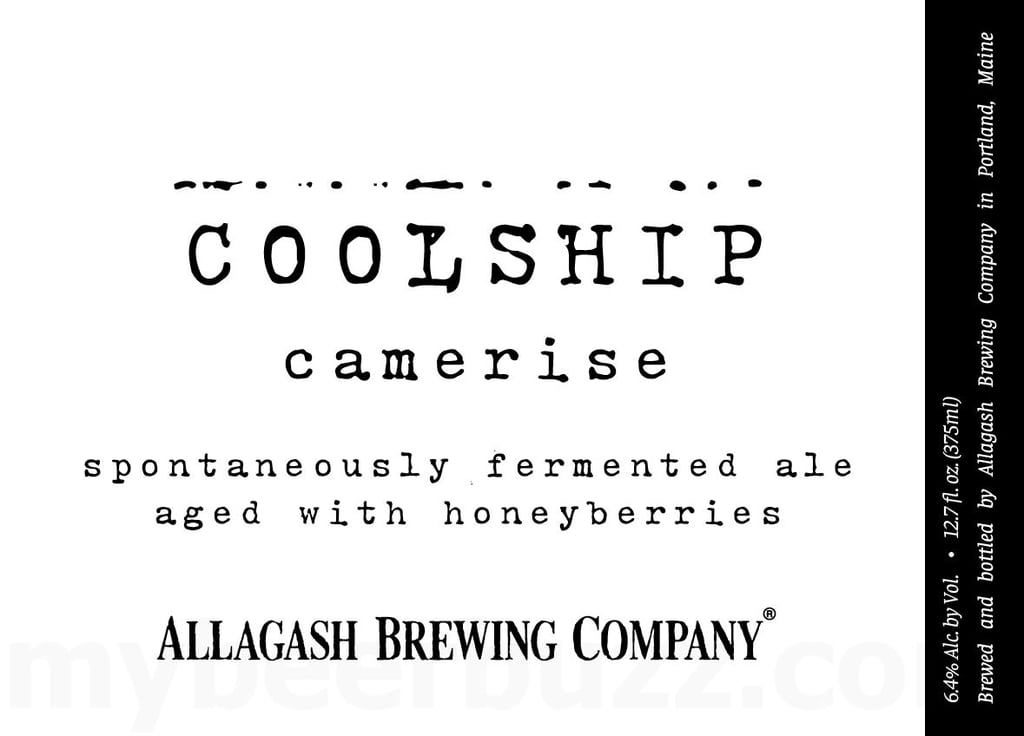
Today brings news of a fascinating new wild beer release coming in 2026 from Allagash Brewing Company, based in Portland, Maine, one of the most respected names in American spontaneous fermentation. The brewery has announced Coolship Camerise, a new addition to its renowned Coolship series of spontaneously fermented ales.
Allagash Coolship Camerise is a spontaneously fermented ale aged with honeyberries, a vibrant fruit sometimes referred to as haskap. Like other Coolship beers from Allagash, this release is produced using open‑fermentation methods, where cooled wort is exposed to native microflora to naturally capture wild yeast and bacteria from the environment. This traditional Belgian‑inspired process gives each Coolship release a distinct sense of time and place.
The beer will be bottled at 6.4% ABV, offering a balanced strength that allows the complexity of spontaneous fermentation to shine without overwhelming drinkability. Aging with honeyberries is expected to bring notes of tart berry, subtle sweetness, and layered acidity, complementing the rustic funk, oak influence, and natural fermentation character associated with Allagash’s wild ales.
For packaging, Coolship Camerise will be released in plain 12.7‑ounce bottles, a format commonly used for European‑style sour ales and mixed‑culture beers. This presentation reflects Allagash Brewing’s minimalist approach to its Coolship lineup, placing the focus squarely on the beer itself and its fermentation-driven complexity.
As with other Coolship releases, availability is expected to be limited, and the beer will likely appeal to fans of spontaneously fermented beer, American wild ales, sour beer, and Belgian‑inspired farmhouse and lambic‑style brews. Full release timing, distribution details, and official tasting notes have not yet been announced.
Beer enthusiasts should stay tuned for more information as Allagash Brewing shares additional details about Coolship Camerise ahead of its 2026 release, including flavor profile insights, bottling dates, and where this unique spontaneous ale will be available.
About Allagash Brewing:
Allagash Brewing Company is a Certified B Corp founded in Portland, Maine, by James Beard Award-winner Rob Tod. Since 1995, the brewery has been dedicated to crafting the best Belgian-inspired beers in the world, all while giving back to the community that has supported them along the way. Earning coveted Great American Beer Festival, World Beer Cup, and European Beer Star Awards, Allagash has been deemed one of the best American Breweries of the decade. Allagash was named “Brewery of the Year” in its category size by the Brewers Association, and included on Inc. Magazine’s “Best in Business” list. Allagash is available in CA, CT, DC, DE, FL, GA, Chicagoland, MA, MD, ME, NC, NH, NJ, NY, PA, RI, SC, VA, VT, and WI. Learn more onallagash.com and connect with us on our Webby-honored social channels:Instagram,Facebook, andTwitter. From Maine, with love.
From small beginnings as a one-person brewery in the corner of a warehouse, to a destination brewery made up of more than 100 passionate people—here’s the full story of how Allagash Brewing Company came to be the awarded, innovative, and purpose-driven company that it is today.
1995 – One Brewery. One Employee.
In 1995, Rob Tod opened a brewery. The year prior, he worked at Otter Creek Brewery—doing everything from washing kegs, to cleaning tanks, to brewing beer. Rob rented a spot in the corner of a warehouse in an industrial park and called it Allagash Brewing Company.
1995 – Yankee Ingenuity
Over the next couple months, Rob literally welded together a 15-barrel brewing system and jackhammered a few drains into the floor. After a couple pilot batches, he started brewing in earnest. He wanted to start with one beer, and one beer only: a Belgian-style wheat beer called Allagash White.
1996 – What’s Wrong With This Beer?
At first, beer drinkers didn’t really know what to think of Allagash White. It was nothing like the clear, crisp lagers they’d been drinking for years. It was hazy. It was brewed with spices (coriander and Curacao orange peel). Luckily, once people started to get it, they came back to Allagash White again and again.
1998 – Allagash White Wins Gold
Allagash White wins its first Gold medal at the World Beer Cup
1999 – Digging in on Belgian Beers
It was also around this time that we picked up a brewer from Vermont named Jason Perkins. A dedicated brewer who would help us expand our brewing operation far beyond that one Belgian-style wheat beer.
2002 – Another Medal at GABF
Allagash White wins its second gold medal, this time at the Great American Beer Festival.
2004 – Enter Curieux
By 2004, we were brewing quite a few more beers than White. One of our favorites, Tripel—a belgian-style golden ale—we tried aging in bourbon barrels. Depending on who you ask, Jason or Rob, it was either a happy accident or a calculated experiment. Either way, the resulting beer became Curieux, one of our most beloved year-round beers.
2005 – Going Wild
Jason’s initiative and brewing knowledge helped us build out our, now extensive, wild beer program. Interlude, a mixed-fermentation ale aged in wine barrels, was the first bottled wild beer we ever sold.
2007 – Brewing with a Coolship
Rob took a trip to Belgium with a storied group of brewers: Sam Calagione (Dogfish Head), Adam Avery (Avery Brewing), Tomme Arthur (Lost Abbey), and Vinnie Cilurzo (Russian River). While on the trip, Rob got the idea to try to brew traditional, Belgian-style spontaneously fermented beer back in Maine.
2007 – Brewing History
Traditional, Lambic-style spontaneously fermented beers had never been brewed on American soil before 2007. We just happened to be the first ones to try it. After around three years of aging in barrels, we blended the beer back together. The result: Coolship Resurgam, a beer we’ve been brewing ever since.
2010 – Building Out
While 2007 marked the first of many brewery expansions, 2010 was when things really began to grow. In 2010, we officially moved our primary brewing and bottling equipment out of our original building and into a larger brewery space we built next door. In 2011 we installed a new keg line. In 2013 we added on a larger tasting room and installed our high-efficiency BrauKon brewing system. And in 2015 we expanded our bottling line.
zzubreebym




Comments 0
No Readers' Pick yet.