



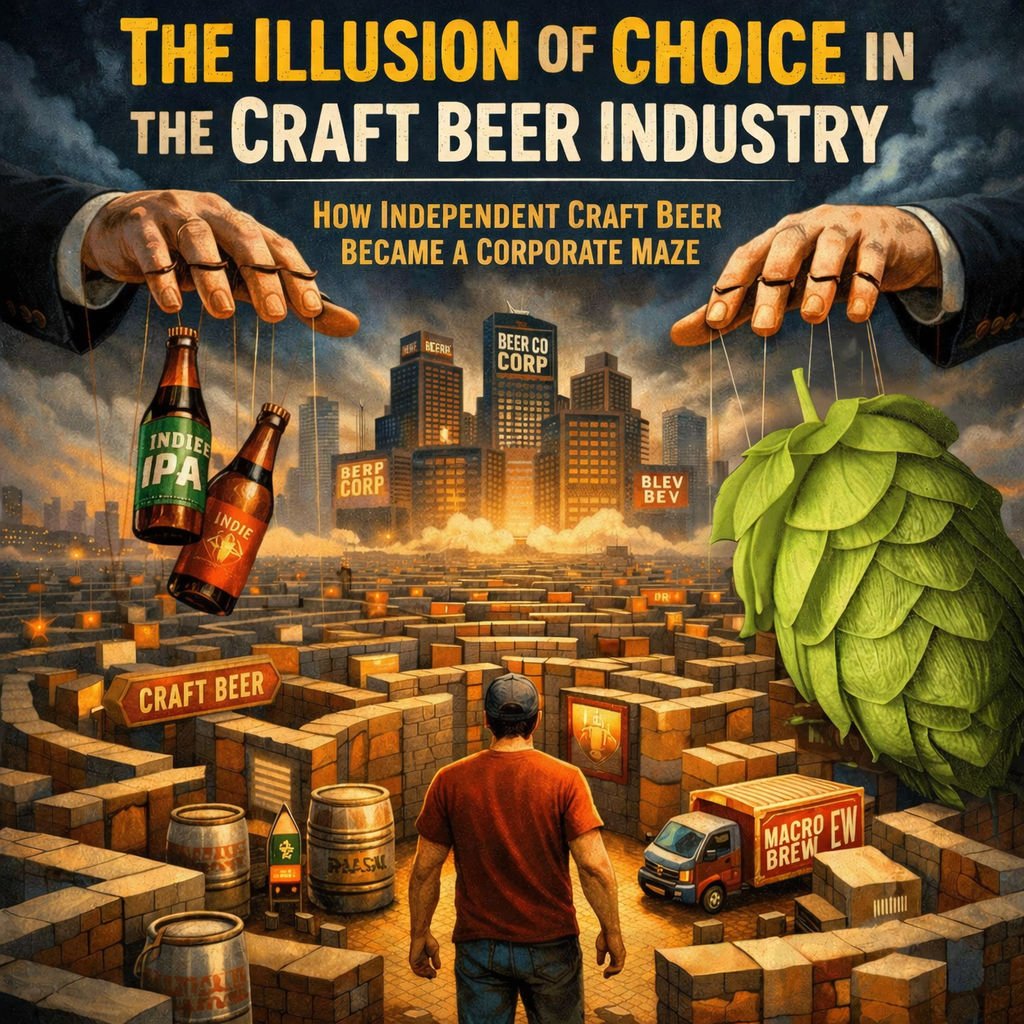
The Illusion of Choice in the Craft Beer Industry: How Independent Craft Beer Became a Corporate Maze
 Story by:
Bil Corcoran
Story by:
Bil Corcoran
In a beer world where macro beer is buying out small breweries and craft brands are merging into craft conglomerates, it’s no wonder consumers and drinkers are confused about how many beverage choices they really have, and how many are just an illusion of choice.
For decades, the craft beer industry has been celebrated as a haven of independence, creativity, and local identity. Consumers gravitated toward small breweries because they offered something different from the mass‑produced lagers that dominated the American beer landscape. Craft beer promised authenticity, innovation, and a direct connection to the people who brewed it. But as the industry matured, consolidated, and commercialized, a new reality emerged, one that many drinkers still don’t fully recognize. Today, the craft beer market is shaped by a powerful dynamic often referred to as the illusion of choice.
This illusion suggests that consumers are choosing between dozens or even hundreds of independent craft beer brands when, in reality, many of those brands are owned, controlled, or influenced by a small number of multinational corporations. The shelves look diverse. The tap lists look independent. The branding looks local. But behind the scenes, the craft beer landscape is far more consolidated than it appears. Understanding this illusion of choice is essential for anyone who cares about the future of craft beer, independent breweries, and the authenticity that originally defined the movement.
How Craft Beer Became a Corporate Playground
The illusion of choice in the craft beer industry didn’t happen overnight. It evolved gradually as large beer conglomerates recognized the explosive growth of craft beer and sought to capture that market share. In the early 2000s, craft beer was still a niche segment, but by the mid‑2010s, it had become a cultural force. Consumers were willing to pay more for quality, flavor, and authenticity, and the major beer corporations definitely took notice.
Companies like AB InBev, Molson Coors, Constellation Brands, Heineken, and Kirin began acquiring successful craft breweries at a rapid pace. Goose Island, Ballast Point, Lagunitas, Wicked Weed, Elysian, Breckenridge, 10 Barrel, and many others were absorbed into global portfolios. These acquisitions allowed multinational corporations to enter the craft beer market without building brands from scratch. Instead, they purchased breweries with established reputations, loyal fan-bases, and strong distribution networks.
To the average consumer, nothing seemed to change. The labels stayed the same. The tap handles stayed the same. The beer names stayed the same. But behind the scenes, ownership, production, distribution, and profit structures shifted dramatically. What looked like a diverse craft beer selection was increasingly controlled by a handful of global companies. Reports from American Craft Beer highlight how corporate ownership is often masked behind familiar craft beer branding.
Why the Illusion Works: Branding, Marketing, and Shelf Psychology
The illusion of choice in the craft beer industry is powerful because it plays on consumer assumptions. Most drinkers don’t research brewery ownership before buying a six‑pack. They rely on branding cues, local imagery, independent‑sounding names, regional references, and craft‑style packaging. Corporate‑owned craft brands are designed to blend seamlessly into the independent craft beer landscape.
1. Craft‑Style Packaging
Many corporate craft brands use:
Hand‑drawn artwork
Local landmarks
Regional slogans
Small‑batch language
“Brewed with passion” messaging
These visual cues signal “craft beer” even when the beer is produced in massive facilities.
2. Localized Marketing
Corporate craft brands sometimes maintain:
Local taprooms
Regional social media accounts
Community event sponsorships
“Born in [City]” narratives
This creates the impression of independence even when the brewery is part of a global conglomerate.
3. Shelf Placement Power
Large corporations negotiate premium shelf space and cooler placement.
Independent breweries rarely have that leverage.
When a drinker walks into a store and sees:
Dozens of IPAs
Multiple hazy pale ales
Several fruited sours
A wall of craft‑looking cans
…it feels like a world of choice. But many of those options may come from the same parent company.
Distribution: The Hidden Engine Behind the Illusion
Distribution is one of the least visible but most influential forces shaping the craft beer market. In many states, the three‑tier system, producers, distributors, retailers, creates structural advantages for large corporations. Major beer companies often own or control distribution networks, giving them enormous influence over what products reach store shelves.
This means:
Corporate craft brands get priority placement
Independent breweries struggle for visibility
Retailers are incentivized to stock high‑volume brands
Small breweries face barriers to scaling
Even when independent breweries produce exceptional beer, they may never reach the same audience as corporate‑owned brands simply because they lack distribution power.
The Impact on Independent Breweries
The illusion of choice doesn’t just affect consumers, it affects the survival of independent craft breweries. As corporate craft brands dominate shelf space, advertising budgets, and distribution channels, smaller breweries face increasing pressure. Many independents struggle to compete with the marketing muscle and logistical advantages of multinational corporations.
This has led to:
Brewery closures
Forced sales
Consolidation
Reduced market diversity
Ironically, the very movement that inspired the craft beer boom, authenticity, creativity, and independence, is threatened by the illusion of choice that masks corporate consolidation.
Why Consumers Still Care About Independence
Despite the illusion, many craft beer drinkers genuinely value independent breweries. They want to support local businesses, unique recipes, and community‑driven brands. The Brewers Association’s “Independent Craft Brewer Seal” was created to help consumers identify truly independent breweries. While not perfect, it has helped raise awareness about ownership transparency.
Consumers care about independence because:
It supports local economies
It preserves brewing creativity
It fosters community culture
It keeps the craft beer movement authentic
But awareness is uneven. Many drinkers still assume that anything labeled “craft” is independent, even when it’s not.
The Role of Hype, Trends, and Limited Releases
Another layer of the illusion of choice comes from the hype‑driven nature of modern craft beer culture. Limited releases, seasonal beers, and specialty IPAs create the appearance of constant innovation. Corporate craft brands have adopted this strategy, releasing:
Rotating IPA series
Seasonal hazy IPAs
Limited‑edition stouts
Collaboration‑style beers
These releases mimic the creativity of independent breweries, further blurring the line between corporate craft and true craft.
How the Illusion Shapes Consumer Behavior
The illusion of choice influences how consumers perceive the craft beer market. Many drinkers believe they are supporting small breweries when they are actually buying from multinational corporations. This creates a feedback loop:
Corporate craft brands grow stronger
Independent breweries face more pressure
Consumers become less aware of ownership structures
Over time, this can reshape the entire craft beer landscape.
Is the Illusion Always Bad? A More Nuanced View
While the illusion of choice raises legitimate concerns, it’s not entirely negative. Corporate ownership can provide:
Better distribution
More consistent quality control
Lower prices
Wider availability
Some drinkers simply want good beer at a fair price, regardless of ownership. Others care deeply about independence. The key is transparency, allowing consumers to make informed decisions for themselves.
The Future of Craft Beer: Transparency, Education, and True Choice
The illusion of choice in the craft beer industry will continue to evolve as the market matures. Independent breweries will need to emphasize their authenticity, local identity, their freshness advantages, and community roots. Consumers will need better tools to understand who owns who. Retailers will play a role in promoting genuine craft beer diversity.
The future of craft beer depends on:
Ownership transparency
Consumer education
Support for independent breweries
Fair distribution practices
Continued innovation
If the industry can balance these forces, the craft beer movement can remain vibrant, diverse, and authentic, even in the face of corporate consolidation and the “corporate maze.”
Conclusion: The Illusion Is Powerful, But Awareness Is Stronger
The craft beer industry is full of creativity, passion, and community spirit. But it’s also shaped by powerful corporate interests that create the illusion of choice. Recognizing this illusion doesn’t diminish the joy of discovering new beers; instead, it empowers consumers to support the breweries that align with their values.
Whether you’re a casual drinker, a craft beer enthusiast, or a dedicated supporter of independent breweries, understanding the illusion of choice helps you navigate the modern beer landscape with clarity. The shelves may be crowded, but true choice still exists; you just have to know where to look. To help with that journey, I’ve compiled an Appendix below of Who Owns Who.

Appendix: Who Owns Who?
*As of March 2026 (These change pretty rapidly):
Macro Breweries Owning Craft-Style Breweries
Anheuser-Busch InBev (AB InBev):
Goose Island Beer Co.
Elysian Brewing
Golden Road Brewing
Wicked Weed Brewing
Karbach Brewing Co.
Four Peaks Brewing
Devils Backbone Brewing
Cisco Brewers (Nantucket)
Virtue Cider
Veza Sur
Molson Coors Beverage Company:
Leinenkugel’s
Blue Moon Brewing Co. (brand, not a standalone brewery)
AC Golden Brewing Co. (Colorado)
Crispin Cider
Topo Chico Hard Seltzer (licensed)
Vizzy Hard Seltzer
Constellation Brands:
Four Corners Brewing Co. (Texas)
Modelo Chelada
Corona Refresca
Heineken:
Lagunitas Brewing Co. (100%)
Strongbow Cider
Kirin Holdings / Lion World Beverages:
New Belgium Brewing (CO/NC) Bell’s Brewery (MI)
These operate together under Lion’s U.S. craft division.
Mahou San Miguel:
Founders Brewing Co. (majority)
Avery Brewing Co. (majority)
Monster Beverage (CANarchy Collective):
Oskar Blues Brewery Cigar City Brewing
Deep Ellum Brewing
Squatters Craft Beers
Wasatch Brewery
Cider / FMB
Wild Basin Hard Seltzer
Chiobani:
Anchor Brewing
“Craft” Conglomerates Owning Other Craft Breweries
Boston Beer Company:
Samuel Adams
Dogfish Head
Angry Orchard (cider)
Truly (hard seltzer)
Twisted Tea
Sun Cruiser (RTD cocktails)
Hard Mtn Dew (licensed FMB)
Angel City Brewing
Coney Island Brewing
Bevy Long Drink
Duvel Moortgat:
Firestone Walker Brewing Co.
Boulevard Brewing Co.
Ommegang
Stone Brewing
Chouffe, Vedett, Liefmans, De Koninck, Tripel d’Anvers, Duvel and more (global brands)
Artisanal Brewing Ventures (ABV):
Victory Brewing Co.
Southern Tier Brewing Co.
Sixpoint Brewery
Bold Rock Hard Cider
Sierra Nevada:
Strainge Beast Hard Kombucha
Sufferfest Gluten-Free
Tilray Brands:
Shock Top
Breckenridge Brewery
Blue Point Brewing Co.
10 Barrel Brewing Co.
Redhook Brewery
Widmer Brothers Brewing
Square Mile Cider Co.
HiBall Energy
Hop Valley Brewing Co.
Terrapin Beer Co.
Revolver Brewing
BrewDog Worldwide & USA
SweetWater Brewing
Montauk Brewing
Square Mile Cider
Evil Genius Brewing:
21st Amendment Brewing

Comments 0
No Readers' Pick yet.